Life Short Tales Moral Stories

I Called My Husband Seventeen Times While A Serious Pregnancy Complication Left Me Unable To Stand. When He Did Not Answer, I Called His Mother For Help. She Took My Phone, Told The Doctor My Symptoms Had Stopped, Then Sent My Husband A Photograph Designed To Make Him Believe I Was Hiding Another Man.

Part 1 – The Scene He Misunderstood

When Caleb Rowan returned to his townhouse outside Charleston two days earlier than planned, he expected to surprise his eight-month-pregnant wife with flowers and breakfast from the café where they had celebrated their first anniversary.

Instead, he found an unfamiliar man’s jacket draped across the bedroom chair, their wedding portrait shattered beside the bed, and his wife kneeling in a spreading pool of blood.

For several shameful seconds, Caleb understood the room entirely wrong.

He noticed the shirt beneath Hannah’s nightgown had been fastened unevenly. He saw blood on the sheets, a medical bag near the window, and one broken photograph beneath her hand. Suspicion arrived before reason because his mother had spent years preparing him to interpret every unexplained detail as evidence of betrayal.

Then Hannah looked at him.

Her face was colorless, her breathing shallow, and both hands were pressed beneath the curve of her abdomen.

“Caleb, I cannot feel the baby moving.”

The accusation forming inside him disappeared beneath terror.

He dropped his travel bag and crossed the room, catching her before she collapsed completely. Hannah gripped his sleeve while another contraction tightened through her body.

“Someone answered for me,” she whispered.

Caleb barely understood the sentence. He pulled out his phone, but his hands shook so violently that he entered the emergency number incorrectly before finally reaching the dispatcher.

He answered questions about the pregnancy, bleeding, consciousness, pain, and fetal movement while pressing a clean towel against Hannah’s lower body. The dispatcher instructed him not to move her and confirmed that paramedics were already approaching.

“I called you seventeen times,” Hannah said.

“My phone was turned off during the flight. I came home early because I wanted to surprise you.”

She closed her eyes.

“I called your mother afterward.”

Caleb felt cold despite the warm room.

His mother, Lorraine Rowan, possessed an emergency number for his construction sites because Caleb often worked inside areas with limited cellular service. Hannah had apparently contacted her when he could not be reached.

“What did she say?”

Hannah struggled for breath.

“She said I was panicking again. She told me the hospital said I should lie down and wait.”

Caleb stared at her.

Lorraine had never liked Hannah, although she rarely expressed that dislike directly. She preferred comments that sounded protective.

Hannah was too emotional. Hannah used pregnancy to demand attention. Hannah exaggerated minor symptoms because she enjoyed controlling Caleb’s schedule.

Caleb usually answered that his mother meant well, then encouraged Hannah to avoid conflict.

The paramedics arrived before he could ask more. They entered with a stretcher, monitoring equipment, and the efficient urgency that immediately made Caleb understand how serious the situation had become.

One medic examined the bleeding and exchanged a look with his partner.

“Possible placental abruption. We are leaving immediately.”

As they moved Hannah downstairs, a paramedic picked up the unfamiliar jacket and handed it to Caleb, assuming it belonged to him.

Inside the ambulance, Hannah’s blood pressure continued falling. Oxygen covered half her face while Caleb held her hand and tried not to remember the suspicion that had occupied him when she needed belief more than anything else.

At Harbor Regional Medical Center, the obstetric team rushed Hannah through surgical doors. Caleb remained in the corridor wearing a shirt stained with blood.

Only then did he search the unfamiliar jacket.

The identification card inside belonged to Dr. Elias Morgan, an obstetrician affiliated with Hannah’s medical practice.

Caleb recognized the name. Elias was covering for Hannah’s regular physician during a professional conference.

The jacket did not belong to a lover.

It belonged to the doctor who had apparently reached Hannah before her husband did.

Caleb checked his phone and found seventeen missed calls, four incomplete voice messages, and one recording sent nearly two hours earlier.

Hannah’s weak voice filled the silent corridor.

“Caleb, the doctor said I need emergency care, but your mother called back and said she spoke with the hospital. She says I should stop frightening everyone and wait until you come home.”

The message ended abruptly.

A maternity nurse approached carrying Hannah’s phone inside a clear evidence pouch.

“Before your wife lost consciousness, she asked us to show you the final message she received.”

The screen displayed a photograph of Dr. Morgan standing outside their townhouse with his medical bag.

Beneath the photograph, Lorraine had written:

Do not return home yet. She is about to tell you everything.

Part 2 – The Call Lorraine Answered

Caleb read the message until the words became meaningless.

Lorraine had apparently intended to send the photograph to him but delivered it to Hannah instead. The phrasing was designed to create suspicion before Hannah could explain why another man had entered their home.

Caleb called his mother immediately.

Lorraine answered with unusual speed.

“Caleb, where are you?”

“At the hospital.”

A pause followed. She did not ask whether Hannah or the baby had survived.

“Did you go home first?”

The question confirmed that she already knew what he had found.

“Why was Dr. Morgan at our house?”

Lorraine released a tired breath.

“I warned you that Hannah depended too much on attention. A man’s coat was inside your bedroom while you were traveling. You are intelligent enough to understand what that suggests.”

Caleb looked down at the blood on his sleeve.

Several hours earlier, that suggestion might have controlled him.

Now it sounded grotesque.

“Why did you tell Hannah that the hospital advised her to wait?”

“She was panicking. Pregnant women frequently mistake ordinary discomfort for emergencies.”

“She was bleeding.”

“She claimed she was bleeding. Hannah has always described everything dramatically.”

Caleb’s hand tightened around the phone.

“Did you answer when Dr. Morgan called her?”

Lorraine remained silent.

“Mom, did you take her phone?”

“I was trying to calm the situation.”

“You told a doctor that her symptoms had stopped.”

“I told him what I believed was happening.”

“You were not the patient.”

The surgical doors opened before Lorraine responded. Caleb ended the call without warning and stood as the surgeon approached.

Dr. Naomi Fletcher removed her mask.

“Mr. Rowan, your wife experienced a severe placental abruption. We performed an emergency cesarean section and controlled the hemorrhage.”

Caleb could barely ask the next question.

“Are they alive?”

“Your wife is stable, although she required a significant blood transfusion. Your daughter was born prematurely and needs respiratory support, but her heartbeat is strong.”

His knees weakened.

A daughter.

Hannah had wanted to name her Lily if she arrived with the stubborn spirit Caleb claimed every Rowan woman inherited.

“Can I see them?”

“The neonatal team will take you to the baby shortly. Your wife remains sedated.”

Dr. Fletcher placed one hand against his shoulder.

“You arrived just in time. Another thirty minutes might have changed the outcome for both patients.”

Thirty minutes.

Caleb thought about Lorraine refusing help, Hannah waiting because years of criticism had trained her to question her own pain, and the moment he entered the bedroom searching for betrayal instead of danger.

Dr. Elias Morgan arrived shortly after midnight. His shirt was wrinkled, and a small cut crossed his palm.

Caleb held out the jacket.

“You left this in our bedroom.”

Elias accepted it.

“I removed it because your wife was overheating and needed help reaching the bed. I forgot it when I ran downstairs to meet the ambulance.”

“Why did you go to the house personally?”

Elias sat across from him.

Hannah had called the clinic shortly after seven in the evening. She described intense abdominal pain and reduced fetal movement. Elias instructed her to call emergency services immediately.

Six minutes later, he called back.

A woman answered and introduced herself as Hannah’s mother-in-law.

“She told me the pain had stopped,” Elias explained. “She said Hannah had become anxious throughout the pregnancy and frequently misunderstood normal symptoms.”

“Why did you not believe her?”

“Because I heard Hannah in the background saying she was bleeding. Then the call disconnected.”

Elias lived less than fifteen minutes away, so he drove to the townhouse while contacting emergency dispatch. When he arrived, Lorraine was leaving the building.

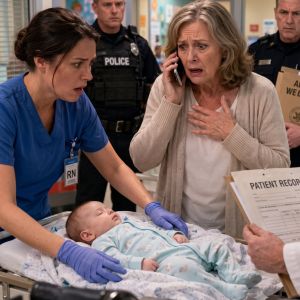
“She tried to stop me from going upstairs,” Elias continued. “She claimed Hannah had locked herself inside the bedroom to punish the family.”

Elias ignored her.

He found Hannah beside the bed, attempting to stand. The wedding portrait fell when she grabbed the dresser for support. The glass broke, cutting Elias’s hand and leaving blood across the frame and floor.

The disordered nightgown resulted from him opening several buttons so the medical team could place monitoring leads more quickly.

Every detail Caleb had interpreted as betrayal had been created by an emergency.

“Why did my mother photograph you?”

“She stood across the street when I left the building to direct the paramedics. I saw her holding up her phone.”

Elias read the message Lorraine mistakenly sent Hannah.

His expression hardened.

“She knew Hannah would tell you that she intercepted the calls. She wanted you suspicious before you heard the explanation.”

Caleb closed his eyes.

Lorraine had not merely refused to help.

She had constructed a scene designed to make him distrust the person whose life depended upon his response.

Part 3 – The Question Hannah Asked First

Caleb met his daughter at one twenty-eight in the morning.

She lay inside an incubator surrounded by sensors, tubes, and the gentle movement of assisted breathing. Her body seemed impossibly small beneath the hospital blanket.

A neonatal nurse asked whether the parents had chosen a name.

Several weeks earlier, Hannah had placed Caleb’s hand over the baby’s movement and said that if their daughter arrived courageous, she wanted to call her Lily Grace.

Caleb had laughed because courage seemed like an impossible expectation for someone not yet born.

Standing beside the incubator, he understood how wrong he had been.

“Her name is Lily Grace Rowan.”

The nurse wrote the name on a card.

Caleb slipped one finger through the incubator opening. Lily’s hand closed around it, and he cried without attempting to hide the sound.

Hannah regained consciousness the following afternoon. She looked pale and exhausted, with intravenous lines along one arm and monitoring leads across her chest.

Her eyes moved immediately toward Caleb.

“Where is the baby?”

“She is alive. She needs help breathing, but the doctors say she is strong.”

Hannah closed her eyes as tears moved toward her temples.

“Lily?”

“Lily Grace.”

Caleb attempted to take her hand, but she moved it several inches away.

The gesture was small, although it contained everything the night had changed.

“When you entered the bedroom, what did you think?” she asked.

Caleb could have softened the truth. He could have described confusion, panic, or incomplete information.

However, Hannah had nearly died because people kept replacing facts with convenient stories.

“I thought another man had been there for reasons unrelated to medicine.”

She looked directly at him.

“You believed I betrayed you?”

“For less than a minute, but yes.”

Hannah laughed once without humor.

“It did not take long for eight years of marriage to disappear inside your mind.”

“I know.”

“No, Caleb. You understand that you were wrong, but you do not yet understand why it happened.”

She turned toward the window.

For years, Lorraine had described Hannah as manipulative, dramatic, careless with money, and determined to separate Caleb from his family. Every time Hannah asked him to confront his mother, Caleb said he refused to choose between two women he loved.

“Not choosing was still a choice,” Hannah said. “You repeatedly chose the person creating the conflict because confronting her felt more difficult than asking me to tolerate it.”

Caleb lowered his head.

“You are right.”

“When I was on the floor, I saw the suspicion on your face before you came toward me.”

Her voice shook.

“I was terrified that our daughter had died, and my husband looked at me as though I had committed a crime.”

Caleb’s apology felt insufficient because it was insufficient.

He told her everything Elias explained, including Lorraine’s call, the photograph, and the message sent to the wrong person.

Hannah’s face changed.

“She expected you to believe he was my lover.”

“Yes.”

“Because she knew you would.”

Caleb could not deny it.

Lorraine arrived at the hospital that evening carrying white roses and a bag of infant clothing. Caleb waited beside the elevator before she reached Hannah’s floor.

“You cannot visit them.”

Lorraine stopped.

“Caleb, I understand that emotions are high, but I am Lily’s grandmother.”

“You refused emergency care while Hannah was bleeding.”

“I did not know the situation was serious.”

“A doctor told you it was serious.”

“He had not examined her.”

“You took her phone and lied about her symptoms.”

Lorraine’s polished concern disappeared.

“That woman has controlled you since the wedding. Every disagreement becomes evidence that I am cruel because she wants you isolated from your real family.”

“Hannah and Lily are my family.”

“I am your mother.”

“That title does not authorize you to decide whether my wife deserves medical help.”

Lorraine gripped the roses until several stems bent.

“Everything I did was intended to protect you.”

“You nearly allowed my wife and daughter to die because you wanted to prove Hannah was unreliable.”

Her voice rose.

“Do not accuse me of something monstrous because your wife panicked.”

Caleb removed the flowers from her hands and placed them on a nearby chair.

“You will have no contact with Hannah or Lily unless Hannah requests it. Do not call, visit, send relatives, or ask hospital employees for information.”

“If you send me away tonight, you will lose your mother.”

Caleb pressed the elevator button.

“I lost my mother when she heard a pregnant woman begging for emergency help and chose to protect a grudge instead.”

Hospital security escorted Lorraine outside.

For the first time in Caleb’s life, silence did not follow his mother’s cruelty.

A boundary did.

Part 4 – Evidence from the Hallway

The police investigation began after Dr. Morgan documented the intercepted call.

Telephone records confirmed that Hannah contacted the clinic, emergency dispatch, Caleb, and Lorraine repeatedly. Elias’s return call lasted four minutes before ending abruptly.

A neighbor’s doorbell camera recorded Lorraine entering the townhouse shortly before the emergency. Another camera captured her leaving as Elias arrived.

The most damaging evidence came from an audio recording made unintentionally by the smart intercom in the hallway. Lorraine’s raised voice activated the system, which preserved part of the exchange.

Hannah could be heard saying:

“Please call an ambulance. Something is wrong.”

Lorraine answered:

“You are not summoning an entire emergency team because of another ordinary pain.”

Hannah begged for her phone.

Lorraine told her to stop using pregnancy to control Caleb’s attention, then left the apartment after placing the phone on a table beyond Hannah’s reach.

The recording also captured Elias confronting Lorraine at the entrance.

“Your daughter-in-law may be experiencing a life-threatening complication.”

“She is experiencing another performance,” Lorraine replied.

Once confronted with the evidence, Lorraine admitted taking the phone and minimizing Hannah’s condition. She continued claiming she believed the bleeding was minor.

Prosecutors charged her with reckless endangerment, interference with emergency assistance, and evidence manipulation related to the photograph intended to create a false accusation.

Caleb provided testimony.

Standing against his mother in court was among the most painful decisions he had made, although he understood that describing the truth was not an act of betrayal. The betrayal had occurred earlier, when Lorraine treated Hannah’s life as expendable.

Lily remained in neonatal intensive care for seven weeks.

Hannah visited daily after her own discharge, sitting beside the incubator for hours while Lily gained weight and gradually learned to breathe without mechanical support. Caleb attended every day, although he did not treat his presence as proof that Hannah owed him reconciliation.

They rarely discussed the future of the marriage.

Caleb began individual therapy to understand why Lorraine’s suspicions had entered his thinking so easily. His father had left when Caleb was nine after a marriage filled with accusations, surveillance, and public conflict. Lorraine spent the following years insisting that betrayal existed inside every loving relationship and only foolish people failed to anticipate it.

Caleb had mistaken inherited fear for wisdom.

When Lily was finally cleared to leave the hospital, Hannah established several conditions.

Lorraine would not receive their address, medical information, photographs, or access to the child. Every lock would be replaced because Lorraine previously held an emergency key. Any attempt at indirect contact through relatives would be documented and reported.

“These are not requests,” Hannah said. “They are the conditions under which Lily and I will return home.”

“I understand.”

“If your mother contacts you, I need to know immediately.”

“You will.”

“I cannot remain married to someone who asks me to trust him while deciding privately which truths I am allowed to hear.”

Caleb nodded.

The locksmith arrived that afternoon.

He also removed the damaged wedding portrait from the bedroom wall. Blood remained beneath the cracked glass, and Caleb intended to throw the entire frame away.

Hannah stopped him.

“Replace the glass.”

He looked at her.

“Why would you want to keep it?”

“Because the marriage did not become false simply because the picture was damaged. Whether it survives depends upon what we build after the damage.”

The statement was not forgiveness.

It was permission to begin proving that change could exist.

Part 5 – The Difference Between Remorse and Repair

Caleb moved into the guest room and accepted that Hannah might eventually ask him to leave completely.

He handled nighttime feedings after Lily came home, attended pediatric appointments, and followed every boundary without requesting praise. When relatives called Lorraine’s prosecution unfair, he corrected them instead of asking Hannah to defend herself.

“My mother heard a medical emergency and prevented assistance,” he told his aunt. “The criminal case exists because of her decisions, not because Hannah is vindictive.”

His construction firm reassigned him temporarily to local projects so he could remain near home. Caleb had once treated career flexibility as something Hannah should provide automatically. He now recognized that partnership required him to rearrange his own ambitions as well.

Hannah also began therapy, although her recovery followed a different path.

She struggled to trust her body after years of Lorraine calling every symptom exaggerated. Even after surviving surgery, Hannah sometimes questioned whether pain deserved attention or whether requesting help would make her burdensome.

Dr. Fletcher reminded her that recognizing danger was not selfishness.

The criminal case ended with Lorraine pleading guilty to reckless endangerment and interference with emergency communication. She received supervised probation, mandatory counseling, community service, and a protective order prohibiting contact with Hannah for three years.

The court also barred her from approaching Lily without written parental permission.

Lorraine sent Caleb a letter describing her therapy and asking whether she could see a photograph of the child.

He gave the unopened letter to Hannah.

“You decide whether we read it.”

Hannah placed it inside a drawer.

“Not yet.”

Caleb did not argue.

Ten months after Lily’s birth, he and Hannah attended their first joint counseling session focused on whether the marriage could continue rather than simply how they would parent.

The counselor asked Caleb what he wanted Hannah to understand.

He considered the question.

“I want her to know that I regret doubting her.”

Hannah’s expression remained guarded.

The counselor looked at him.

“Regret describes your discomfort about the past. What responsibility are you accepting for the future?”

Caleb answered more slowly.

“I am responsible for challenging suspicion before acting upon it. I am responsible for protecting our boundaries even when confrontation makes me uncomfortable. I am responsible for listening to Hannah’s account without comparing it against the story my mother taught me.”

Hannah looked toward him.

“That is closer.”

Trust returned in small moments rather than declarations.

Caleb informed Hannah when Lorraine attempted to contact his employer. He declined a family holiday gathering after relatives insisted Lorraine deserved forgiveness before accountability. He stopped describing neutrality as fairness when one person was clearly causing harm.

Hannah, in return, gradually allowed him to participate in decisions without assuming every question concealed disbelief.

Neither pretended that the process was romantic.

Repair looked like schedules, transparency, difficult conversations, and the repeated choice not to return to easier patterns.

Part 6 – The Photograph Behind New Glass

Lily’s first birthday took place in a waterfront park beneath wide oak trees and clear spring sunlight.

She had grown from a premature infant surrounded by machines into a determined child who disliked remaining still. Hannah placed her several feet away on the grass, then opened both arms.

Lily took one step, paused, and took three more before falling into her mother’s lap with delighted laughter.

Caleb photographed the moment.

The image contained no shattered frame, unknown jacket, or blood. It contained Hannah laughing while Lily gripped her shoulders beneath the morning light.

Lorraine sent another letter that week. She wrote that counseling had helped her recognize how fear, resentment, and abandonment shaped her need to control Caleb’s relationships. She asked for a supervised meeting.

Hannah read the letter and returned it to the drawer.

“Not now.”

“Not now,” Caleb repeated.

He understood that Lorraine’s progress did not create automatic access to the people she endangered.

Hannah looked at him.

A scar remained between them, although it no longer controlled every conversation.

She reached for his hand.

“Do you know what hurt most that night?”

“That I doubted you.”

“Yes, but there was something else. Your mother had called me dramatic so often that I started believing her. I waited when the pain began because I was afraid the hospital would think I was wasting their time.”

She watched Lily attempting to stand again.

“I never want our daughter to learn that enduring pain quietly makes her easier to love.”

“She will not learn that from us.”

Caleb did not promise perfection. He promised to ask questions before reaching conclusions, to treat requests for help seriously, and to speak when silence would protect harm.

Several weeks later, they rehung their wedding photograph.

The original frame had been repaired, and the broken glass had been replaced. A faint discoloration remained near one corner where the blood could not be removed completely.

Caleb suggested restoring it further.

Hannah declined.

“The mark belongs to the story, but it does not cover the entire picture.”

Their marriage never returned to the uncomplicated version that existed before Lily’s birth. That version had depended upon avoidance, unspoken resentment, and Caleb’s belief that he could remain neutral between cruelty and the person receiving it.

The relationship they built afterward was more demanding and more honest.

Hannah no longer minimized discomfort to appear reasonable. Caleb no longer interpreted conflict as something dangerous merely because his mother disliked boundaries. Neither of them used Lily as evidence that the marriage had healed.

They measured repair through everyday behavior.

One evening, Caleb returned home and found Hannah asleep on the sofa while Lily rested against her chest. A medical envelope lay unopened on the table.

Once, he might have opened it and decided which information Hannah needed immediately.

Instead, he placed dinner in the refrigerator, covered both of them with a blanket, and waited until Hannah awakened.

“A letter arrived from your doctor,” he said. “Would you like to open it now or tomorrow?”

Hannah studied him briefly.

“Tomorrow. Tonight I only want tea.”

He prepared it without asking another question.

Steam rose above the cups while Lily slept between them.

The night of the emergency had once seemed like the moment Caleb discovered a hidden betrayal. In truth, it exposed several older deceptions.

Lorraine had called control protection. Caleb had called cowardice neutrality. Hannah had called silent endurance strength because she feared becoming inconvenient.

None of them could return to those stories.

Outside, harbor lights moved across the water. Caleb looked toward the repaired wedding photograph hanging above the staircase.

The glass was new.

The image remained the same.

What had changed was their willingness to see everything surrounding it.

THE END

Related Posts

Two Hours After Our Daughter Was Born, My Husband Calmly Told Me He Already Had Another Family And Refused To Acknowledge Our Baby—He Never Imagined My Family Had Already Uncovered Every Secret That Would Cost Him His Career, His Reputation, And Everything He Thought He Owned

Two Hours After Our Daughter Was Born, My Husband Looked At Me And Said, “I Already Have A Son With Someone Else. I’m Not Signing Anything For This...

Seven Hours After Giving Birth, My Husband Walked Out On Me And Our Newborn To Celebrate With His Family… One Quiet Phone Call Froze Every Credit Card, Exposed Every Lie, And Forced Him To Pay A Price No Celebration Could Ever Undo

Seven Hours After Giving Birth, My Husband Told Me To Find My Own Ride Home—While His Family Celebrated With My Money, One Quiet Call Changed Everything The Evening...

My Husband Gave My Chair To His Mistress, Then Suggested I Eat Downstairs With The Catering Staff. He Thought Removing Me From The Family Table Would Prove I Did Not Belong. Minutes Later, I Walked Across The Ballroom, Sat Beside The Most Powerful Investor In The Room, And Finally Revealed The Identity My Husband Had Never Bothered To Discover.

Part 1 – The Chair They Gave to Someone Else In the center of the Meridian Arts Foundation gala, my husband looked directly at me and suggested that...

My Husband Thought He Could Keep Two Families Hidden Forever… But One Question From Our Daughter Triggered A Chain Of Truths That Cost Him His Company, His Future, And The Only Family That Had Truly Loved Him

When My Husband’s Hidden Family Arrived at the Gala, One Photograph Revealed That My Own Family Had Known the Truth for Years The Night I Chose My Daughter...

I Thought Signing the Divorce Papers Was the Last Time I’d Ever See My Wife. Then, Two Months Later, I Found Her Sitting Alone in a Hospital Hallway, Looking So Fragile That I Could Barely Recognize the Woman I Had Once Promised to Protect Forever. In That Moment, I Realized Letting Her Go Might Have Been the Biggest Mistake of My Life.

The Woman in Room 614 The first time Grant Holloway saw his ex-wife after the divorce, she was asleep beneath a gray hospital blanket with one hand resting...

Để lại một bình luận

Email của bạn sẽ không được hiển thị công khai. Các trường bắt buộc được đánh dấu *