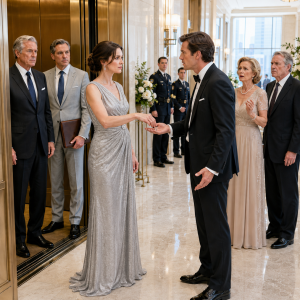
Part 1 – The Anniversary Dinner
The envelope landed beside my dessert plate before the waiter had finished pouring coffee.
My husband, Nathaniel Mercer, did not lower his voice or wait until we reached home. He remained seated at the center of the private dining room, surrounded by his mother, several directors from Mercer & Vale Development, and the family of the woman sitting beside him.
“Our marriage has become an obstacle to both of us,” he said. “You have never understood the life I am building, and I am no longer willing to apologize for wanting more.”
Across the table, Celeste Harrington rested one manicured hand near his. Her father controlled Harrington Urban Capital, the investment group negotiating the largest redevelopment agreement in Philadelphia’s recent history.
Celeste wore the composed smile of a woman watching a difficult acquisition reach closing.
The dinner had supposedly been arranged for our tenth anniversary.
I had arrived directly from the home of Margaret Alden, an eighty-seven-year-old widow I had cared for during the final three years of her life. Margaret had died that morning, and I had barely slept since leaving the hospice nurse beside her bed.
Nathaniel knew she was gone. He also knew that I had held her hand through the final night while he attended meetings with Celeste.
His mother, Eleanor Mercer, looked toward my plain navy dress and released a disappointed breath.
“Nathaniel has tried to be patient, Claire. However, a man carrying responsibilities of this scale needs a wife who contributes more than compassion and domestic routine.”
I had worked as a private geriatric nurse before reducing my hours to care for Margaret exclusively. Nathaniel often described that decision as proof that I lacked ambition, although my income had supported us during the earliest years of his company.
He pushed the envelope closer.
“The settlement is generous. You keep your retirement account and personal car. I retain the house, business interests, and future development proceeds.”
Every person at the table seemed to know what was happening except me. Celeste’s mother avoided my eyes, while William Harrington examined his wine with the satisfaction of a man who believed the final obstruction had been removed.
I opened the envelope but did not read beyond the first page.
“How long have these documents been prepared?”
Nathaniel’s jaw tightened.
“That question does not change anything.”
“Four months,” Celeste answered before he could stop her. “Everyone agreed that tonight would provide a clean transition.”
The humiliation was deliberate. Nathaniel expected shock to make me obedient, while the witnesses would later remember that I had accepted the separation quietly.
I folded the papers and placed them inside my handbag.
“Thank you for making your priorities impossible to misunderstand.”
Nathaniel leaned forward.
“Do not create a scene, Claire.”
“I am not creating anything. I am finally observing what already exists.”
I stood, thanked the restaurant staff, and left without touching dessert.
Outside, cold rain swept across Rittenhouse Square. My telephone showed three missed calls from Samuel Price, Margaret’s longtime attorney.
His message contained only one sentence.
Mrs. Alden left instructions that you come to my office before speaking with your husband.
Part 2 – The Woman Who Remembered Me
Samuel’s office occupied the upper floor of a restored building near Washington Square. I arrived shortly after sunrise, still wearing yesterday’s dress beneath a borrowed coat.
He placed Margaret’s will in front of me and waited while I found my name.
Claire Elizabeth Dawson.
I appeared not as a minor beneficiary or paid caregiver, but as the principal heir to her personal estate, several historic properties, and thirty-eight percent of Mercer & Vale Development.
“That company belongs to Nathaniel and Owen Vale,” I said.
“They founded it, but Margaret financed its earliest acquisitions through a private holding company. Her voting interest was never publicly connected to her name.”
My hands became cold.
Nathaniel had spent years claiming that he and Owen built everything without assistance. He mocked Margaret as a lonely old woman whose medications and bedding consumed my attention, yet her money had rescued his company twice.
Samuel handed me a sealed letter written in Margaret’s narrow, elegant script.
My dear Claire,
You entered my house believing I needed help with medicine, meals, and the indignities of age. What I needed most was someone who spoke to me as though my thoughts still mattered.
You never asked about my property or influence. You asked whether I wanted the curtains open.
That is why I trust you with what follows.
Do not sign anything Nathaniel places before you. If he suddenly remembers tenderness, ask what changed before his affection returned. The Harrington transaction threatens more than company ownership, and your anniversary was selected for a reason.
I pressed the letter against the table.
Samuel reviewed the divorce papers and noticed drafting references dated almost five months earlier. The proposed settlement transferred marital interests into entities connected to the Harrington redevelopment while assigning me responsibility for several liabilities.
“He expected you to sign before discovering Margaret’s will,” Samuel said.
My telephone began vibrating. Nathaniel called repeatedly, followed by Eleanor and the company’s outside counsel.
A message appeared.
Claire, whatever Margaret promised you, do not be manipulated. You do not understand development finance.
For ten years, that tone had sent me rushing to apologize before understanding what offense I had committed.
That morning, I turned the screen facedown.
Samuel introduced me to divorce attorney Renee Patel, who reviewed the documents with increasing concern.
“This agreement does not merely end the marriage,” she explained. “It attempts to isolate you from future claims involving company assets and classify questionable transfers as Nathaniel’s separate obligations.”
“Why would he need me separated from them?”
“Because your name may already appear somewhere important.”
The answer began emerging when Owen Vale requested a confidential meeting.
He arrived looking older than I remembered, with gray at his temples and exhaustion beneath his eyes.
“Margaret told me to speak if Nathaniel moved against you before the Harrington vote,” he said. “I should have spoken much earlier.”
Owen revealed that the projections supporting the redevelopment had been altered. Property values were understated, environmental liabilities were concealed, and Harrington Capital would gain control if Mercer & Vale missed aggressive repayment targets.
Nathaniel had signed every misleading document.
“Margaret refused approval because she believed the transaction was designed to force a default,” Owen said. “Harrington would acquire the riverfront portfolio for a fraction of its value.”
“Why did Nathaniel cooperate?”
Owen looked toward the window.
“William promised him leadership of the combined company, along with a new personal partnership through Celeste.”
My marriage had not ended because Nathaniel discovered love elsewhere.
It had been removed as part of a transaction.
Part 3 – The Signature From Our Wedding Day

Before Owen left, he played a voicemail Margaret had recorded the night before her death.
Her voice sounded weak but precise.
“Owen, the Harrington agreement is only the cover. Claire must examine the private accounts connected to Walnut Street House. Tell her the anniversary date matters because Nathaniel used it before.”
The name awakened a memory.
On our courthouse wedding day, Nathaniel and I had eaten grocery-store cake on the floor of our first apartment. Before opening champagne, he placed a document across my knees and asked me to sign.
“Just a witness form for our first property option,” he had said. “Owen forgot to handle it before filing.”
I had signed without reading carefully because I was twenty-six, deeply in love, and eager to believe that trust made questions unnecessary.
My telephone vibrated while I described the memory.
Nathaniel had sent a photograph of an old document.
My younger signature appeared beneath the words Owner of Record.
The property was Walnut Street House, Margaret’s first Philadelphia residence and the original collateral supporting Mercer & Vale.
His message read:
You signed more than you remember. Call me before you embarrass yourself.
Renee enlarged the photograph.
“He is threatening you with a document that may prove he deceived you.”
Samuel requested the complete title history. Before the records arrived, Eleanor called.
Her voice sounded unlike the polished woman from the anniversary dinner.
“Claire, I found something in my late husband’s study. Margaret sent me a letter telling me where to look if Nathaniel publicly moved against you.”
Inside a black ledger, Eleanor found property references, dates, private payments, and initials. One entry connected Walnut Street House to Nathaniel’s father, Margaret Alden, and C.E.D.—my initials before marriage.
Another entry contained my mother’s maiden surname, Bellamy.
When Eleanor brought the ledger to Samuel’s office, she looked directly at me.
“I treated you cruelly because I believed gentleness made Nathaniel weak. Last night, when he humiliated you, he looked proud. That was when I understood what I had helped him become.”
The ledger revealed a history none of us expected.
Margaret’s late sister had been business partners with my maternal grandfather in a neighborhood preservation trust. After both families suffered financial losses, several properties were placed into complicated option agreements intended to protect them from predatory buyers.
Walnut Street House had temporarily been assigned to my mother’s family line. Years later, Nathaniel’s father discovered that I descended from the original beneficiary.
He introduced Nathaniel to me at a charity clinic where I volunteered.
Our meeting had not been accidental.
Nathaniel courted me partly because marriage would make it easier to obtain my signature and consolidate disputed title rights without explaining their history.
The realization left me physically ill.
I had believed he chose me despite my ordinary background. In reality, my background had been the hidden asset that made me useful.
“Did Nathaniel know before we met?”
Eleanor closed her eyes.
“His father knew. I believe Nathaniel learned during your engagement.”
Every anniversary, every joke about my lack of ambition, and every complaint that I contributed nothing to his success changed shape.
My signature had helped secure the property that launched his company.
Part 4 – The Offer Hidden Inside An Apology
Nathaniel arrived at our house that evening without permission.
Renee had advised me not to meet him alone, so Samuel and a private security officer remained nearby.
Nathaniel entered carrying flowers and wearing the expression he once used when seeking forgiveness for forgotten birthdays.
“Gracie, this has gone far enough.”
He had not called me that in more than a year.
“You remembered the nickname quickly.”
“I handled the dinner badly. Celeste and my mother pushed for a public announcement, and I allowed business pressure to affect my judgment.”
“You prepared the divorce months ago.”
“People prepare options during uncertainty. That does not mean the marriage is beyond repair.”
“Would you be discussing repair if Margaret had left her shares elsewhere?”
He ignored the question and placed a folder on the table.
He offered to withdraw the divorce, end his relationship with Celeste, and grant me a generous annual allowance. In return, I would appoint him voting proxy for Margaret’s shares and approve the Harrington transaction.
“The company employs more than four hundred people,” he said. “If you interfere because your feelings are hurt, families will lose their livelihoods.”
“Margaret believed the transaction would close divisions and surrender the portfolio after a manufactured default.”
His expression hardened.
“Margaret was elderly and suspicious. Owen resented my leadership, while Samuel benefits from prolonging the estate.”
“What about my signature on Walnut Street House?”
For the first time, he lost control of his breathing.
“You signed legally.”
“You told me I was witnessing a filing.”
“You knew it concerned company property.”
“I knew what you chose to explain.”
Nathaniel stepped closer.
“Do not turn a technical misunderstanding into fraud.”
Samuel rose from his chair.
“The meeting is over.”
Nathaniel looked at me.
“Claire, everything you have comes from the life we built.”
I thought about the wages I contributed when the company could not pay him, the investors I entertained, the years I cared for Margaret while he mocked the work, and the signature obtained under false pretenses.
“You built your life using things I was never allowed to know I owned.”
He left the flowers behind.
After the door closed, I realized his apology contained no remorse, only revised terms.
Part 5 – The Accounts Beneath Walnut Street
A forensic review of Margaret’s files and the black ledger uncovered private accounts connected to the original property trust.
For nearly a decade, Mercer & Vale collected rental income, preservation tax credits, and refinancing proceeds from properties whose ownership rights were partly derived from my family line. Nathaniel routed several payments through entities controlled by his father and later through a consulting firm belonging to Eleanor’s brother.
That money funded the company’s earliest expansion and Nathaniel’s personal equity purchases.
The Harrington projections concealed those obligations because accurate valuations would reveal that Mercer & Vale did not own several properties as cleanly as represented.
More damaging evidence appeared on Margaret’s encrypted drive. Emails showed Nathaniel pressuring appraisers to reduce values, moving environmental costs into unrelated subsidiaries, and promising William Harrington that my divorce would be completed before the shareholder vote.
One email from Celeste read:
Once Claire signs, she has no standing to challenge the old title structure. Margaret cannot delay us forever.
Nathaniel replied:
The anniversary will keep her emotional. She will want the humiliation finished quickly.
Those words hurt more than seeing Celeste beside him.
Nathaniel had studied my desire to avoid conflict and converted it into a closing strategy.
Owen agreed to testify and supplied reports contradicting the altered projections. Eleanor surrendered the ledger and correspondence from her husband’s archives. She admitted knowing Nathaniel had selected the anniversary dinner to pressure me, although she had not understood the title deception.
Samuel notified the board that Margaret’s voting rights would remain opposed to the Harrington transaction until an independent investigation concluded.
The vote failed.
Harrington Capital threatened litigation, but its lenders withdrew after receiving the accurate environmental and title reports. Without financing, the redevelopment collapsed.
Nathaniel publicly blamed me for endangering the company. The independent directors responded by placing him on administrative leave while a special committee reviewed the altered valuations, undisclosed conflicts, and misuse of my signature.
Celeste ended their relationship within forty-eight hours of her father withdrawing support.
Nathaniel called me that night.
“She never mattered the way you think.”
“That does not improve anything.”
“We can still protect each other.”
“You mean I can still protect you.”
He remained silent.
For the first time, silence served me rather than him.
Part 6 – The Boardroom Without His Chair
Three months later, Mercer & Vale held an emergency shareholder meeting inside its headquarters overlooking the Delaware River.
Nathaniel arrived with attorneys and attempted to occupy the chairman’s seat. The independent director asked him to sit elsewhere because he remained suspended.
I entered with Samuel, Renee, Owen, and Eleanor.
Several executives looked surprised to see my mother-in-law beside me. She did not touch my arm or perform an affection we had never shared, but her presence communicated a choice she should have made years earlier.
Forensic accountants presented their findings.
Nathaniel knowingly signed inaccurate financial statements, concealed title disputes, and used marital access to obtain my signature on a property transfer whose effect he never explained. He also negotiated personal benefits from Harrington while presenting the deal as necessary for company survival.
William Harrington denied directing the misconduct, but emails showed that his team understood Mercer & Vale would probably default after closing.
The board voted to remove Nathaniel as chief executive and refer the findings to regulators.
He stood suddenly.
“This company would not exist without me.”
Owen answered from across the table.
“It would not exist without Margaret’s money, Claire’s property rights, employee labor, and the many people you trained yourself to overlook.”
Nathaniel turned toward me.
“Is this what you wanted?”
Months earlier, I might have wanted him to experience the humiliation he designed for me. Sitting there, I felt no pleasure.
“I wanted the truth before another person signed something you had chosen not to explain.”
The board restored misdirected income to the original trust and created an independent preservation subsidiary. I retained Margaret’s voting interest but declined the chief executive role several directors offered.
Instead, I required professional management, transparent audits, tenant protections, and environmental review before future redevelopment.
Owen accepted temporary leadership under those conditions.
Nathaniel left through a side entrance.
No reporters waited there because the board refused to turn accountability into spectacle.
Part 7 – The Divorce He Could Not Control
The divorce proceedings lasted another six months.
Nathaniel attempted to classify the company interest as separate property while arguing that my inherited shares should remain outside any discussion of his misconduct.
Renee demonstrated that he had used marital funds, concealed income, and prepared the anniversary settlement to prevent examination of disputed assets.
The court did not award me everything, nor did I want everything.
I received my lawful share of marital property, restitution connected to unauthorized income, and full protection from company liabilities created without my informed consent.
Nathaniel kept assets that legitimately belonged to him, although their value had fallen after his removal.
The judge invalidated several provisions of the original settlement and referred the signature issue for separate investigation. Nathaniel eventually entered a civil agreement acknowledging that I had not received accurate disclosure when signing the Walnut Street document.
Outside the courthouse, he asked to speak privately.
Renee remained several feet away.
“Did you ever love me?” he asked.
The question might once have broken me.
“I loved the person I believed you were. I also loved you during years when the evidence should have changed my mind.”
He looked older than forty-two.
“Margaret turned you against me.”
“Margaret gave me information. Your choices determined what the information meant.”
“I lost everything.”
“You lost control of things you believed nobody else deserved to understand.”
He waited for comfort because I had supplied it throughout our marriage.
I gave him none.
Part 8 – The House With Open Curtains
One year after Margaret’s death, Walnut Street House reopened as the Alden-Bellamy Center for Care and Preservation.
The first floor provided legal and financial counseling for family caregivers who had left careers or depleted savings while supporting relatives. Upper rooms housed training programs for nurses, home health aides, and preservation workers maintaining accessible historic properties.
I used part of Margaret’s inheritance to establish the center, while the restored property trust funded operations without depending entirely on annual donations.
A framed photograph of Margaret stood near the library window. She wore her pale green cardigan and pearl earrings, looking directly at the camera with the impatient dignity that had survived age, illness, and other people’s tendency to dismiss her.
Beneath the photograph hung one sentence from her letter.
You asked whether I wanted the curtains open.
Eleanor attended the opening but remained near the back. Our relationship had not transformed into sudden closeness. Apologies could begin repair, but they could not erase ten years of deliberate contempt.
She approached after the guests left.
“Margaret would approve.”
“She would find three things to criticize before admitting it.”
Eleanor smiled faintly.
“That sounds accurate.”
We stood together without pretending we had become family in the way either of us once understood that word.
Owen later joined me on the front steps. Under independent leadership, Mercer & Vale survived, although it abandoned the Harrington project and sold several speculative assets. The company was smaller, more stable, and no longer organized around Nathaniel’s image.
“Do you regret keeping the shares?” he asked.
“Sometimes. Then I remember that walking away would have allowed the same system to continue with a different face.”
That evening, I opened every curtain in Walnut Street House before locking the doors.
For years, I believed devotion meant staying available, remaining patient, and accepting that other people possessed more important ambitions. Margaret understood before I did that care had value precisely because powerful people depended upon it while pretending it cost nothing.
Nathaniel chose our anniversary because he believed memory would weaken me. Instead, the date exposed the first signature he had taken through trust and the final signature he would never receive.
I did not inherit a perfect life from Margaret.
I inherited the right questions, the documents that answered them, and enough authority to ensure that nobody could bury those answers again.
THE END