Part One: Ten Days as His Wife
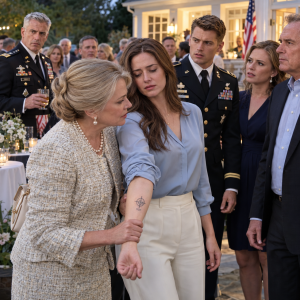
My cousin accused me of marrying a terminally ill man for his money while his memorial flowers still surrounded the chapel. Twenty mourners stood within hearing distance, yet nobody challenged her cruelty or asked what those final ten days had actually meant.
“Stop pretending this marriage was some noble sacrifice, Evelyn, because everyone understands why you married a dying man,” Brooke Carter said.
I closed my fingers around the plain silver wedding ring Samuel Reed had struggled to place on my hand. His illness had weakened his coordination, so I had guided his trembling fingers during our quiet ceremony inside his Craftsman house near Seattle’s Green Lake.
Our marriage lasted only ten days, although I had known Samuel for nearly five months. During those final days, I organized his medication, prepared vegetable soup, read historical novels beside his bed, and played word games whenever he remained strong enough.
I volunteered three afternoons each week with a palliative-companionship program serving terminally ill patients who lacked dependable family support. Some people wanted practical assistance, while others wanted someone capable of sitting quietly without transforming every moment into a conversation about illness.
Samuel requested a word game during my first visit.
“Do you actually know the rules, or will you invent them whenever you start losing?”
“I know every rule, although strategic improvisation remains available during emergencies.”
His restrained smile suggested that I had passed an examination he never explained.
Samuel was forty-three and had taught American history for sixteen years before advanced cancer forced him to leave the classroom. His home contained hundreds of books, dried plants, old street photographs, and several framed pictures turned toward the wall.
He rarely discussed his childhood, and I never pressured him because companionship should not require confession. Instead, we debated novels, complained about weak coffee, and created increasingly ridiculous definitions for words neither of us could pronounce confidently.
One afternoon, Samuel attempted to describe something from his adolescence, but his illness interrupted his speech. His jaw tightened, and his fingers gripped the wooden table while frustration overtook him.
Rather than watching him struggle, I turned toward the window and invented a story about a hospital volunteer who became trapped inside a supply closet while wearing a cardboard box as a hat. I added increasingly absurd details until his hands relaxed.
“You changed the subject deliberately,” he whispered afterward.
“I would never manipulate a conversation merely to protect someone’s dignity.”
His smile remained long after the joke ended.
A week later, Samuel greeted me wearing a pressed blue shirt and placed a small velvet box beside our game board.
“Evelyn, I want you to marry me before I lose the opportunity to ask properly.”
I believed his request resulted from fear, pain, or medication, so I reminded him that we had known each other only five months.
“Five extremely competitive months should count differently from ordinary time,” he replied.
When I remained silent, his humor faded.
“The hospital asked me to identify an emergency contact, and I realized nobody would come if they called.”
I told him he deserved more than a marriage created by pity.
“That is precisely why I asked you, because your kindness has never felt like pity or obligation.”
My aunt Diane called the decision irresponsible, while Brooke described me as a fortune hunter. My older brother, Michael, warned that everyone would assume I expected an inheritance.
Their suspicion did not change my answer.
Samuel passed away ten days after our wedding with his hand resting inside mine. The final complete sentence he spoke concerned our unfinished game.
“Do not rearrange the letters after I leave, because I already know how you cheat.”
At the memorial, moments after Brooke delivered her accusation, a silver-haired man in a charcoal suit approached me. He introduced himself as Samuel’s attorney, Jonathan Hale.
“Mrs. Reed, your husband instructed me to wait until today before explaining who he truly was.”
Jonathan removed a sealed envelope bearing my name in Samuel’s uneven handwriting.
Before I opened it, the attorney added a warning that made the chapel disappear around me.
“Samuel did not merely leave you property, Evelyn, because he also left you a memory you no longer possess.”
Part Two: The Boy Beside the Repair Shop
Jonathan refused to discuss the envelope while my relatives remained nearby. Samuel had instructed him to accompany me to my apartment and ensure that I read the letter somewhere untouched by accusation.
Brooke followed us toward the chapel entrance.
“How convenient that the mysterious attorney needs privacy before revealing the inheritance.”
Jonathan looked at her without visible irritation.
“Privacy is appropriate when a widow receives her husband’s final message, regardless of anyone else’s curiosity.”
During the drive home, my phone filled with messages from relatives who had never visited Samuel. Some predicted that he had left me his Green Lake house, while others suggested that marrying him proved I had become emotionally unstable.
I turned off the phone before entering my apartment. Jonathan arrived carrying a leather portfolio, a worn novel, and a paper package tied with dark green string.
“Before you begin, please understand that Samuel carefully separated emotional history from legal decisions,” he explained.
I opened the envelope and read the first sentence twice.
Evelyn, our meeting through the companionship program was not the first time our lives crossed.
The letter identified Samuel as the quiet teenage boy who had lived behind a watch-repair shop near Tacoma’s Hilltop neighborhood. My family occupied a small rental house around the corner until I was thirteen.
Memories returned through disconnected images: wet sidewalks, red maple leaves, the narrow shop window, and an older boy cleaning watch gears beside his grandfather. He spoke with a pronounced stutter and usually remained behind the counter whenever customers entered.
My parents were killed in a highway accident shortly after my thirteenth birthday. Aunt Diane declined permanent guardianship, claiming her house and finances could not accommodate another child.
I entered foster care with my belongings packed inside two black trash bags. During the following four years, I moved between homes often enough that forgetting Tacoma became a method of survival.
“There was a boy named Sam who repaired watches with his grandfather,” I said.
Jonathan placed the paper package on my table and removed a weathered leather journal. My name appeared on its first page.
Samuel had written a single entry for every birthday after my disappearance.
Evelyn at fourteen: I hope someone gives her a drawer nobody can empty without permission.
Evelyn at seventeen: I hope she has discovered that belonging should never require silence.
Evelyn at twenty-five: I hope someone remembers how she takes her coffee before she must explain.
The entries continued through adulthood, although Samuel admitted that he never knew where I lived. He had preserved the ritual because remembering me protected a part of himself that humiliation had nearly destroyed.
“Why would he write about me for thirty years?”
Jonathan opened Samuel’s letter to the next page.
When Samuel was seventeen, an impatient customer mocked his stutter outside the repair shop because he could not quickly explain why an antique watch required additional work. The man called him defective and suggested that nobody would ever trust a teacher who spoke like him.
Samuel sat behind the building afterward, furious and ashamed. I was twelve when I found him there.
Instead of asking why he could not speak properly, I sat beside him and invented an elaborate story about a crow stealing watches because it intended to control time. I continued until Samuel stopped gripping his sleeves and finally laughed.
I remembered the crow before remembering his face.
“I thought it was an ordinary afternoon, and I never understood that it mattered.”
“For Samuel, that afternoon became evidence that companionship could preserve dignity without demanding an explanation.”
Jonathan handed me the old novel he had brought. Between two chapters rested a pressed red maple leaf, fragile with age.
According to Samuel, I had placed it there and told him he would never lose his page again.
“He recognized me during my first volunteer visit, didn’t he?”
“Immediately, although he feared that revealing the past would turn your compassion into obligation.”
Samuel wanted me to choose marriage based upon the man before me, not because I felt indebted to the lonely boy I had once comforted.
Before Jonathan could explain the legal documents, repeated knocking sounded against my apartment door. Brooke stood outside with Michael and Aunt Diane, whose raised phone was recording everything.