The Room Where Money Could Not Speak

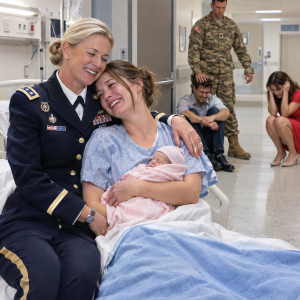
Six hours after my daughter was born, when the morning light had barely begun to soften the hospital windows and the ache in my body still seemed to have its own voice, I learned that fear could enter a room without raising its volume. My husband, Graham Alden, stood beside my recovery bed with his father, Lawrence, while I held our newborn close beneath the white blanket. They spoke about the hospital as if it were a disappointing hotel, about the nurses as if they were employees who had failed to recognize the family name, and about the legal papers Lawrence had brought in a leather folder. Then Graham leaned toward me and said, in a tone so even that it sounded almost reasonable, that I should sign the agreement before I was discharged.
Our daughter, June, slept with her cheek against my chest, her tiny fingers curled near her chin. I had spent nineteen hours in labor, and for the first time since the delivery, I had stopped counting minutes. I was simply listening to her breathe. The room smelled of clean sheets and coffee from the nurses’ station, and a pale stripe of sunlight lay across the blanket, making the little cap on June’s head look brighter than it was. Then Graham set the folder on my tray table, close enough that I could see my name printed at the top.
“It’s a practical arrangement,” he said. “You sign, we all go home, and nobody has to turn this into a long fight.”
Lawrence folded his hands over the top of his cane. He had built a national investment company from a modest office in Denver, and he carried himself like a man who had never heard the word no without immediately searching for the person responsible. “The baby needs stability,” he said. “The family has the resources to provide it. This document only makes that clear.”
The agreement did not make anything clear except what they wanted. It gave Graham and Lawrence control over decisions about June, limited my ability to take her anywhere without their approval, and allowed them to question my fitness as a mother if I refused to cooperate. I could feel the paper’s presence from across the bed, as if it had been placed there to remind me that my exhaustion was supposed to make me easy to persuade.
“I’m not signing this,” I said.
Graham’s expression changed in a small, practiced way, the smile leaving first and the warmth following it. “You’re tired, Elise. You’ve been through a lot. If you keep making emotional choices, people will start to wonder whether you can handle a newborn.”
He did not shout, and that was what made the words settle so coldly. He knew the power of a calm voice in a room full of witnesses, and he had spent the last year telling me that his father’s lawyers could make any story sound convincing. I tightened my arms around June, careful not to wake her, while Lawrence stood near the window and watched me as though my refusal were a temporary inconvenience.
My parents had been gone since I was nine, and it was my uncle, Silas Ward, who had taken me in, though he never spoke of it as a sacrifice. He gave me a room above his auto repair shop, drove me to school in a truck that rattled on cold mornings, and taught me that a promise mattered most when keeping it became inconvenient. By then he was in his late seventies, a quiet man with a slight hearing loss and hands that always seemed to carry the faint scent of engine oil, no matter how thoroughly he washed them. I had called him after the delivery, but I had not expected him to arrive before visiting hours.
The door opened, and there he was, wearing his old denim jacket over a checked shirt, his silver hair combed neatly back. He paused long enough to take in the folder, Graham’s stance beside my bed, and the way I had curled around June. Then his eyes found mine, and he gave one small nod, the kind that had steadied me when I was a child and did not yet know how to ask for help.
“Silas,” I whispered.
He stepped inside and closed the door behind him. “I’m here, sweetheart.”
The Man Between the Bed and the Door

Graham shifted toward him, already annoyed. “This is a private family matter.”
Silas looked at the baby first, not at Graham. “Then you should be speaking gently.”
Lawrence let out a breath that might have been a laugh if it had contained any humor. “You have no idea what this family is trying to protect.”
“I know what she’s holding,” Silas answered, and nodded toward June.
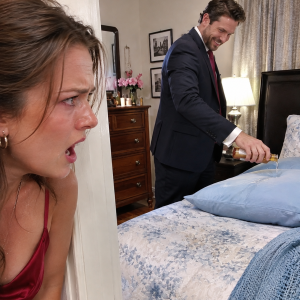
Graham took one step closer to the bed, reaching toward the folder as if he meant to place it directly in my hands. Silas moved without haste, but the space between Graham and the mattress disappeared. His open palm rested against Graham’s wrist, not hard enough to injure him, only firm enough to stop the reach. The nurses’ station fell quiet beyond the door, and I heard the wheels of a cart pause in the corridor.
“Step back,” Silas said.
Graham tried to pull free, more startled than hurt, and Lawrence came away from the window. “You can’t touch him,” he snapped. “Do you understand who you’re dealing with?”
Silas released Graham at once and turned toward Lawrence. He reached up to his ears, removed his hearing aids, and placed them carefully on the tray beside a glass of water. The gesture was not a challenge; I had seen him do it when a room became too loud or too crowded with competing voices. Still, both men stopped talking.
Silas slipped a small brass lighter from his jacket pocket. It was scratched and dulled with age, with a short inscription stamped across the side: “Khe Sanh, 1968.” I had seen the lighter many times, usually when he used it to light the little stove in the shop during winter power outages. Beneath his rolled sleeve ran a pale, uneven scar, a reminder of the years he had spent as an Army engineer before he came home and rebuilt his life one repair at a time.
Lawrence stared at the lighter. The color drained from his face so quickly that I thought he might need the chair beside him. His cane shifted in his hand, and for the first time since I had met him, he seemed to have no rehearsed answer ready.
“Silas Ward?” he said.
Silas looked at him steadily. “You remember.”
For a moment, the hospital room seemed to hold two different years at once. Lawrence had been a young officer in Vietnam, though he had almost never spoken about that part of his life. Silas had served in the same region, and according to the story he told me only once, he had helped move an injured group of men to safety during a chaotic night outside Khe Sanh. One of those men had been Lawrence. My uncle had not known his name then, and Lawrence had never known the name of the soldier who kept him conscious until help arrived.
The old lighter had belonged to Silas’s closest friend, who had given it to him before their unit left. Lawrence recognized the engraving because he had once seen it in the hands of the man who had refused to leave him behind. I had never understood why Lawrence became quiet whenever my uncle visited. Now I saw that he had recognized him years ago and chosen to keep the memory to himself.
“You were there,” Lawrence murmured.
“I was there,” Silas said. “And you were a scared young man who needed another person to stay.”
Lawrence glanced at me, then at the unsigned papers. Whatever his face was trying to conceal, shame had begun to show through it. Graham, however, was still looking at his phone.
The Call He Thought Would Settle Everything

He lifted the phone to his ear and tapped a name in his contacts. “I’m calling Judge Evelyn Shaw. She can put an emergency order in place before Elise gets discharged.”
My heart began to pound, and June stirred against my chest. I remembered the small pink rabbit on the shelf near the window, the one Graham had brought as a gift during my eighth month of pregnancy, supposedly because he thought it would look sweet in the nursery. He had forgotten it was there. I had not. Inside its soft body was a recording device my attorney had arranged after I told her about Graham’s threats to send me away for evaluation and raise June without me. For two months, it had captured conversations in our home that Graham believed would never leave those walls.
I had not wanted to believe that I would need evidence against my own husband. I had told myself that people said ugly things during arguments and that the pressure of the pregnancy would pass. Yet every time Graham spoke about having me declared incapable, I had taken another step toward protecting myself, even when I could not admit to myself what I was doing.