The House on Briar Hollow Lane

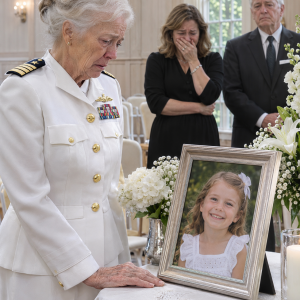
When I walked into the county courthouse in my Navy dress uniform, the conversations in the hallway softened and then stopped, one by one, as people turned to look. My father saw me first. He gave a short, disbelieving laugh, the kind he used when he wanted everyone nearby to know that he found something ridiculous. My mother’s eyes traveled from my polished shoes to the ribbons on my chest, and her mouth tightened as if I had arrived wearing a costume to a family gathering.
Then Judge Whitaker looked down at the case file, glanced toward me, and murmured, “I wondered if it could really be her.”
I understood, in that moment, that my parents had come to court prepared to argue about a farmhouse. They had not come prepared to see what their daughter had made of the life they once wished she would choose differently.
Two days earlier, I had been outside my little house near Fredericksburg, Virginia, trimming the rosebushes along the front walk, when a cream-colored envelope arrived from the county courthouse. The delivery driver handed it to me with the ordinary politeness people use when they don’t know they are placing a difficult thing into someone’s hands. I carried it inside, set it on the kitchen table, and opened it beside a mug of coffee that had already gone cold.
The case heading read Bell versus Bell. My parents, Leonard and Maureen Bell, were listed as the plaintiffs. I was named as the sole defendant.
My own mother and father were suing me over the farmhouse my grandfather had left me.
I sat there for a long time with the papers spread across the table, while my old hound, Scout, leaned his broad head against my knee. He had learned, over the years, that paperwork could make me quiet in a way that usually meant I needed company.
“Well, Scout,” I said, rubbing behind his ears, “they’ve found a new way to get my attention.”
I had not seen my parents in twelve years. After I completed officer training, my father never came to visit, and my mother sent one message that I read only once: “We raised a gracious daughter, not a military officer.” I didn’t reply. I didn’t ask what she meant by gracious, or whether she had truly meant to wound me. I simply put the message away and did my best to stop waiting for a different one.
I built a life in the Navy without their approval or their curiosity. I took responsibility for missions, logistics, and the sailors who depended on decisions made quickly and carefully. I learned how to keep my voice steady when a room was tense, how to listen before giving an order, and how to keep working after exhaustion had made every thought feel slow. There were years when the work took me far from home, and years when I told myself that was where I belonged.
Then, during an overseas deployment, an explosive device struck our convoy vehicle. I came home with a reconstructed knee, a lasting limp, and scars I rarely discussed. I also came home with a disability pension, which I kept to myself, and more memories than I knew what to do with.
My grandfather, Silas Bell, had left me his farmhouse on Briar Hollow Lane. He had owned the land for most of his life and built the house with his own hands, working on it in the evenings after his regular job. He used to tell me that a person should leave a place better than they found it, even if the only thing they managed to fix was one loose step.
I had paid the property taxes since 2013, from my Navy account, including the years I was deployed. The court papers said I had abandoned the farmhouse and that my parents had paid every expense themselves. I read those sentences twice, then a third time, because I wanted to be certain I understood the claim.
This was not a mistake made by a clerk. It was my parents’ version of events, entered into an official case.
That evening, I opened the cedar chest at the foot of my bed. Inside were neatly folded uniforms, a few pieces of service gear, and the flag that had been folded for my teammate, Sam, after he never made it back from that deployment. I didn’t take the flag out. I only looked at it for a moment before lifting my dress uniform from the chest.
The dark fabric still held its shape. I ran one hand along the jacket, remembering the first time I wore it, and how proud I had been even though my parents had found nothing to celebrate.
“They want to see me in court, Scout?” I said.
The dog watched from the rug, his ears tipped forward.
“All right,” I whispered. “Then they can see who I became.”
The next morning, I drove to the farmhouse before heading to the courthouse. The old maple beside the yard had lost several branches in a storm, the white paint had begun to peel from the siding, and one corner of the porch dipped enough that I had to watch my step. Still, as I stood by the gravel drive, I could picture my grandfather there with his tool belt and a hammer in his hand, studying the house with the quiet concentration he brought to every repair.
My parents had never helped build that farmhouse. As far as I knew, they had never paid its taxes or repaired its roof. Grandpa had left it to me, and I had taken his decision as a gift and a trust, never imagining I would have to prove either one in court.
I fastened each ribbon on my uniform as carefully as I could. My knee throbbed when I stood too long, and the jacket felt tighter across my shoulders than it had years before, but the weight of the uniform was familiar. I had earned every part of it.
At the courthouse, an older security guard noticed the ribbons and stepped aside to let me pass.
“Good morning, ma’am,” he said, quietly.
I nodded and thanked him. I hadn’t come looking for anyone’s recognition, but his small courtesy steadied me.
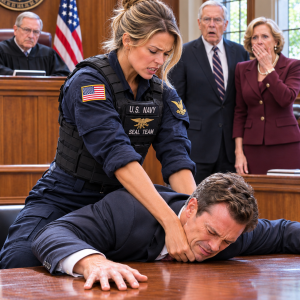
When the clerk called the case, I entered the courtroom alone. My father sat beside his lawyer, a narrow-faced man with a folder balanced on his lap. My mother wore a neat floral dress and a strand of pearls. She looked at me without standing, her gaze lingering on my uniform.
“Look at that outfit,” she muttered.
My father straightened his tie and gave another quiet chuckle. I chose not to answer. I had come to address the claim, not to reopen every argument we had ever left unfinished.
Judge Whitaker entered, took his seat, and reviewed several pages in the file. He was a silver-haired man with a measured manner, the kind of person who seemed to listen with his whole face. After a moment, he looked toward my father.
“Mr. Bell, you’re claiming your daughter abandoned the property?”
“Yes, Your Honor,” my father said. “The house has been empty for years, and we’ve been covering all of the expenses.”
The judge nodded once, then turned toward me.
“Commander Bell, would you like to respond?”
My father’s confident expression shifted when the judge used my rank. My mother’s fingers closed around her pearls.
I rose carefully, bracing for the familiar sting in my knee.
“Yes, Your Honor. I’m prepared to answer.”
Before I could say more, Judge Whitaker reached for the thick folder on his bench.
“Before you do, there’s something in this file that I suspect your parents haven’t taken into account.”
He removed a county document and held it by the edges. I recognized the sweeping signature at the bottom, although I had never seen the original before: Silas Bell’s, with its broad loops and the sharp upward stroke he always added to the last letter.
My father leaned forward. The color left his face.
The Paper in the Judge’s Hand
Judge Whitaker gave everyone a moment to look at the document before he spoke.
“This is a notarized deed, recorded with the county clerk in May of 2012.”
My father blinked at it as if the paper might change if he stared hard enough.
“That can’t be right, Your Honor,” he said. “My father never told us about any deed.”
“I imagine he didn’t,” the judge replied. He turned toward the lawyer at my parents’ table. “Mr. Keene, did you review the land records before this complaint was filed?”
The lawyer rose halfway, then stood properly, his damp forehead catching the overhead light.
“We relied on our clients’ understanding that the title remained in the family, Your Honor.”
“In the family,” the judge repeated. He looked back at my father. “Mr. Bell, did you believe you owned this farmhouse?”
“We looked after it,” my father said. “It belonged to my father. I was his son.”
Judge Whitaker lowered the document to the bench.
“That doesn’t establish ownership. A person may transfer property during his lifetime, and this deed shows that Silas Bell transferred the farmhouse at 219 Briar Hollow Lane to his granddaughter, Audrey Bell, in May of 2012. It was properly notarized and recorded. Your name is not listed as an owner.”
My mother made a small sound, then pressed her fingers to her pearls. I remained still, trying to take in what I was hearing. I had known Grandpa intended for the farmhouse to be mine, but I hadn’t known the deed had been recorded so long before he passed away. The week before I shipped out, he had put a key in my hand and told me not to let anyone talk me out of what he had decided. I had trusted him enough not to ask for proof.
The judge turned to me.
“Commander, do you have records showing who paid the property expenses?”