The Sleeve Beneath the Stain

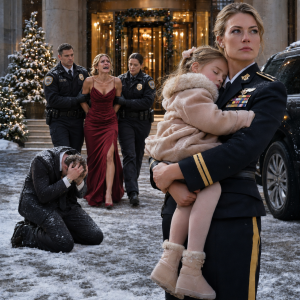
The first thing Staff Sergeant Nolan Harlan noticed was the insignia beneath my turned-back sleeve. The second was the wine dripping from my Army dress uniform onto the restaurant floor. He went pale, his glass slipped from his hand, and as it shattered beside his chair, he stared at me as if the room had changed around him.
My sister, Paige, was still smiling.
“What’s wrong with you?” she said, turning toward him. “She’s just upset because everyone finally sees what real service looks like.”
Nolan didn’t look at her. He was staring at the small patch exposed inside my jacket.
“Paige, stop talking,” he said. Then he came to his feet, shoulders square, his expression suddenly stripped of every trace of amusement. “Do you know what that means?”
For most of my life, my family had assumed they knew exactly who I was. I was the quiet older daughter who sat behind a desk, lived alone, and spent too much time on a computer. My sister was the one with the bright smile, the charming fiancé, and a gift for making every room feel as though it belonged to her.
They had been wrong about me for years. By the time that small insignia showed beneath my lapel, I had learned that correcting them would have meant breaking promises I had made to keep other people safe.
I was Captain Elise Calloway, an Army intelligence officer. My work was quiet by design, and most of it could never be discussed at a family table. That evening, in a private dining room outside Washington, my sister’s favorite story about me finally met the truth.
The Quiet Work
The secure intelligence facility where I worked had no windows, and after enough long shifts, I stopped noticing their absence. The air was cool and dry, the rooms lit by fluorescent panels, and the server racks gave off a steady hum that followed me home in my head. In that underground space, I studied patterns most people would never see: a change in a radio signal, a vehicle appearing on a route at an unusual hour, a set of small details that, together, could help a team make a safer decision.
I had been an Army intelligence analyst for eight years. My job was not to kick down doors or stand in front of a camera. I helped the people who did those things understand what might be waiting for them and how to return safely. Sometimes that meant hours of careful work followed by a short, urgent meeting. Sometimes it meant staying awake through the night because someone several time zones away was counting on an answer.
My family knew I worked for the Army. They did not know the details, and I could not give them the ones they wanted. Their imagination filled that silence with filing cabinets and office supplies.
At a Thanksgiving dinner three years earlier, my younger sister, Paige, had lifted her glass and looked across the table at me with an indulgent smile.
“You know what your problem is, Elise? You’ve been sitting at a computer since you were twenty-two. Don’t your hands get tired from all that typing?”
Our father, Robert, laughed. “Someone has to keep the paperwork moving. Without Elise, the rest of the Army might run out of forms.”
My mother, Diane, smiled at Paige, then gave me the kind of sympathetic look people use when they think you’ve settled for less than you could have had.
“You were always a quiet girl,” she said. “It’s nice that you found something steady.”
I let the remarks pass. I had learned early that a person who works with sensitive information cannot answer every curious question, and that keeping quiet can look, to people who don’t understand, very much like having nothing to say. I also thought that if my family wanted to believe I was ordinary, there was no harm in letting them.
Paige took my silence as permission to make me a running joke. At family cookouts, she told her friends I spent my days staring at spreadsheets. When I missed her bachelorette weekend because a priority assignment had come in, she said my filing cabinets must have been lonely. My mother never corrected her. My father sometimes joined in.
When Paige met Nolan Harlan, a staff sergeant with the 2nd Ranger Battalion, the jokes became a performance. Nolan was broad-shouldered, direct, and easy to admire. He had the confidence of a man who had spent years training for difficult work, and Paige was delighted to introduce him as proof that her life had taken an exciting turn.
One Saturday, she called while I was sitting in my car after a long shift.
“You should come by for the game,” she said. “Nolan’s friends will be there. It might be good for you to meet people who actually serve instead of those computer people at your office.”
I was tired enough that the parking lot lights seemed too bright. Still, I thought perhaps she wanted me there for more than an audience.
“I’ve had a long week,” I told her.
“You work at a desk, Elise. It can’t be that exhausting.”
I went anyway.
At Paige’s apartment, she introduced me to Nolan and several of his friends as if she were unveiling an amusing side character. One of the men asked what I did in the Army. Before I could answer, Paige jumped in.
“She does intelligence,” she said, laughing. “Don’t picture some thrilling spy story. Think spreadsheets, supply forms, and making sure the printer has paper.”
A few people chuckled. Nolan lifted his beer.
“Nothing wrong with that,” he said. “The Army needs people keeping the wheels on while the rest of us are out doing the hard part.”
I smiled politely. “That’s true. Every part of the work matters.”
He seemed to take my answer as proof that I had nothing to say for myself. When I left, he followed me to the hallway.
“Don’t let Paige get to you,” he said. “Sisters tease each other. She tells me you’ve got a steady job.”
“I’m not upset,” I replied.
He studied me for a moment. “You really work intelligence?”
“I can’t discuss my current assignment.”
He gave a small, amused laugh. “Sure. Classified. I’ve heard that one before.”
I didn’t try to persuade him. I walked down the stairwell and into the damp evening, carrying my silence with me.
The Cost of Keeping Peace
That spring, my father called to say the transmission on my parents’ car had failed. He sounded worried, and he explained that my mother needed the car for appointments and he needed it to get to his part-time job at a hardware store.
The repair was going to cost just over four thousand dollars. He said he didn’t know what they would do.
I had spent years saving carefully, so I didn’t hesitate.
“I’ll send it over,” I told him. “Take care of Mom and get the car fixed.”
“You’re a good daughter, Elise. We’re lucky to have you.”
Ten days later, I saw a photo of Paige and Nolan at an expensive restaurant in Washington. A bottle of champagne sat between them, and Paige wore a new designer dress. The caption praised Nolan for knowing how to treat his future wife.
I called my father.
“How’s the car?”
For a moment, he said nothing. Then he admitted that Paige had needed money for a birthday dinner for Nolan and that he had given her part of what I sent.
“She was trying to introduce him to people who might help with his future in private security,” he said. “You have a good salary, Elise. You don’t even have anyone to spend it on. Why are you making this difficult?”
Difficult. Selfish. The words landed more heavily because I had heard versions of them before. I had helped my parents with their mortgage when my father was out of work. I had paid for dental work my mother needed. I had covered Paige’s overdue credit cards more than once, each time believing that perhaps one last rescue would help her get back on her feet.
“Don’t ask me for money again,” I said.
“Now, wait a minute—”
I ended the call.
A moment later, the secure phone on my desk rang. A team needed updated information for an urgent assignment. I put my personal phone away and returned to work. Whatever my family had done would have to wait; people were depending on the analysis in front of me.
Three weeks later, Paige called me late at night. I was inside the secure facility, following a network of signals across several systems, and I couldn’t answer a personal phone. When I finally got outside in the early morning, I saw seventeen missed calls and a string of angry messages.
I called her back from the parking lot.
“How could you ignore me?” she demanded. “Nolan proposed tonight. It was the most important night of my life, and my own sister couldn’t take five seconds to congratulate me.”
“I was on duty,” I said. My voice was rough with fatigue. “I was in a secure area. I can’t bring a phone in there.”
“Stop pretending you’re some kind of spy. You sit at a computer. Nolan says actual soldiers can always make a call if there’s an emergency.”
I looked up at the empty rows of parking spaces and took a slow breath.
“Congratulations, Paige. I hope you’re happy together.”
She ignored the sentiment. Their official engagement dinner, she announced, would be at a steakhouse in Northern Virginia on May fifteenth. The private room and dinner were my responsibility.
“Dad said you got upset about the money for Nolan’s birthday,” she added. “You earn plenty, Elise, and you live like a miser. This is your chance to welcome a real hero into the family.”
“And if I don’t pay?”
“Then I’ll tell everyone you’re jealous and bitter, and that you refused to support your own sister. Wear your dress uniform. Nolan wants to compare your little ribbons with his real decorations.”