The sentence hit the chapel harder than any accusation. Vivian’s composure cracked. Grant stared at Nathaniel as if language itself had betrayed him.
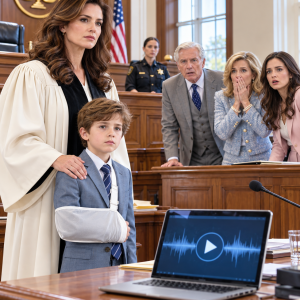
On the screen behind the podium, the evidence team projected Maribel’s recovered video. Her voice filled the chapel, weak but unmistakable.
“My son does not belong to you.”
Then Grant’s voice. Vivian’s. The demand for the signature. The plan to move quickly before anyone questioned grief.
The vineyard workers looked horrified. The board members looked ill. Nolan Price lowered his head as officers cuffed him.
Grant tried to move toward the side exit. He did not get three steps. Detectives caught him near the chapel wall, and his sunglasses fell to the floor, one lens cracking beneath someone’s shoe. His face twisted with panic.
“Nate, listen to me,” he pleaded. “Mom said if the baby lived, I would lose everything. She said you would hand the company to Maribel’s people.”
Nathaniel stepped down from the podium.
“You lost everything when you decided my wife and son were obstacles.”
Vivian, being led past him in cuffs, stopped long enough to spit one final command.
“I am your mother. You cannot destroy this family.”
For the first time in his life, those words carried no power.
Nathaniel looked at Maribel’s casket.
“She was my family too.”
Part 4 — What The Vineyard Remembered
The months after the arrests did not feel like victory. They felt like paperwork, interviews, hearings, custody filings, forensic reports, grief counseling, and long nights in a nursery Nathaniel had not allowed anyone else to decorate. The world wanted a clean story: corrupt mother, greedy brother, heroic husband, surviving baby, fallen wine empire. The truth was heavier.
Maribel was still gone.
Miles still cried at two in the morning with the fierce insistence of someone who had survived too much before he knew language. Nathaniel still reached for his phone to call Maribel when small things happened: the first time Miles held his finger, the first time the baby turned toward sunlight, the first time a nurse said he was gaining weight beautifully.
Then he remembered.
Grief returned most cruelly during ordinary happiness.
Vivian and Grant faced trial separately. Nolan Price surrendered his license and cooperated in exchange for reduced charges, providing records of payments, forged drafts, and instructions routed through private accounts. Grant tried to blame Vivian, then Nolan, then panic, then grief. Vivian blamed everyone except herself.
The court did not accept grief as an accounting method.
The company nearly collapsed when the scandal became public. Distributors paused orders. Investors threatened lawsuits. Two board members resigned before they could be removed. Nathaniel stepped into leadership not because he wanted power, but because Maribel had died trying to protect something larger than a family name.
His first decision was to stop calling Pierce & Vale a legacy company.
“Legacy is not what we inherit,” he told the remaining board. “It is what survives our behavior.”
He created an independent trust holding Maribel’s shares for Miles until adulthood. He opened the books to a forensic audit. He sold the private jet Grant had loved and used the money to cover wages for vineyard workers during the restructuring. He terminated contracts tied to shell vendors and transferred a portion of future profits into the Maribel Vale Legal Defense Fund, supporting mothers facing coercion, medical intimidation, or financial abuse during pregnancy.
Some shareholders called it emotional.
Nathaniel answered, “Good. Emotion is not the enemy of governance. Secrecy is.”
At home, he removed the black curtains Vivian had ordered and opened every window in the great room. He replaced the staged funeral flowers with photographs of Maribel laughing: Maribel in muddy boots between vineyard rows, Maribel holding pruning shears incorrectly and laughing because a worker corrected her, Maribel asleep on the porch with a book open on her lap.
The room began to belong to her again.
Elena visited often. She never asked for gratitude, which made Nathaniel more grateful. One afternoon, while Miles slept in the sunroom, Nathaniel asked her how Maribel had known to record that final video.
Elena looked at the baby before answering.
“She told me once that if your family ever became quiet all at once, someone was hiding a blade.”
Nathaniel laughed softly, then covered his eyes.
“That sounds like her.”
“She was scared,” Elena said. “But she was not helpless.”
Those words stayed with him.
Maribel had not been merely a victim in the final chapter of her life. She had been leaving evidence. She had been protecting her child. She had been fighting with whatever strength remained, down to a button torn from a jacket and a phone hidden where someone honest might find it.
Part 5 — The Last Clue

A year after Maribel’s death, the vineyard held its first public harvest dinner under the new foundation name. Nathaniel had resisted the idea, but Elena reminded him that hiding had been Vivian’s language, not Maribel’s. So he opened the south lawn to workers, neighbors, doctors from the clinic, legal advocates, and families helped by the fund.
Miles sat in a high chair beside him, banging a spoon against the tray with the solemn determination of a judge calling court to order. He had Maribel’s eyes, dark and searching, and the same stubborn grip that had first curled around Nathaniel’s finger through an incubator port.
At sunset, Nathaniel carried him down the vineyard path beneath jacaranda trees blooming purple beyond the stone wall. The air smelled of warm earth and cut grass. In the distance, guests laughed softly over dinner. For the first time in a year, the estate did not feel like a stage for tragedy.
It felt like land.
Nathaniel stopped near the row Maribel had once claimed as her favorite because the grapes there were “dramatic but honest.” He shifted Miles against his shoulder and looked toward the hills.
“Your mother won,” he whispered. “She only needed me to understand the final clue.”
Miles answered by grabbing his collar.
Nathaniel smiled through tears.
There were still hard days. There would always be hard days. Some mornings, he woke angry before he woke sad. Some nights, he dreamed of the casket and Maribel’s clenched hand. Sometimes he imagined what he would have said if he had arrived sooner, though Elena and every counselor told him that guilt loved impossible timelines.
He kept the button in a sealed frame inside his office, not as a trophy, but as a witness. Beside it, he kept a copy of Maribel’s signature, the real one, left-leaning and sharp, cut across the page like a woman who refused to be rewritten.
When Miles was old enough, Nathaniel knew he would tell him the truth carefully. Not the courtroom version first. Not the headlines. He would tell him about Maribel’s laugh, her stubbornness, her hatred of staged flowers, the way she believed companies should be audited and babies should be sung to off-key. He would tell him that courage is not always loud. Sometimes it is a hidden phone. A torn button. A hand that refuses to open until love arrives.
He would also tell him that family is not proven by blood, inheritance, or names carved into wine barrels. Family is proven by what people protect when power tempts them to take.
Vivian had thought family meant obedience.
Grant had thought family meant entitlement.
Maribel had known better.
She had protected the truth.
And because she did, the child they tried to erase grew under sunlight, held by a father who had finally learned that grief could be more than pain. It could be evidence. It could be duty. It could be the beginning of a different inheritance.
On the first anniversary evening, after the guests left and Miles slept, Nathaniel walked into the great room alone. The windows were open. The curtains were light. No candles burned. No staged flowers crowded the air.
He stood where the casket had once been and spoke into the quiet.
“I heard you, Maribel.”
The house did not answer.
But for once, it did not feel silent.
THE END