Part 1 – The Bride They Decided Did Not Belong
By the time the security guard escorted Natalie Brooks through the brass-framed doors of Bellamy Bridal House, the humiliation had already lasted nearly forty minutes. The final act merely gave it a public stage.
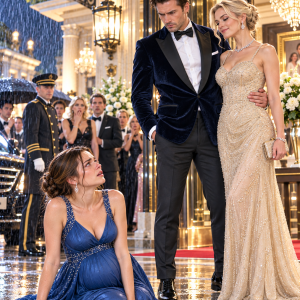
Natalie stumbled onto the broad sidewalk of Michigan Avenue, catching herself against a stone planter before she fell. Cold spring wind swept between the downtown buildings, lifting the hem of the simple blue dress she had worn beneath her raincoat. Behind the glass, the boutique remained warm and bright, filled with crystal fixtures, ivory carpeting, and wedding gowns displayed beneath carefully directed lights.
People passing on the sidewalk glanced at Natalie’s reddened face, the broken clasp on her handbag, and the faint marks forming around her wrist. Most of them immediately looked away.
Inside the showroom, her childhood friend Lauren Whitaker sat on a velvet sofa beside two women from her fiancé’s social circle. Lauren still held the champagne glass she had accepted while Natalie was being told that her appointment had been entered under the wrong service category. She looked through the window, met Natalie’s eyes for a brief moment, then turned back toward the boutique owner.
That small movement hurt more than the guard’s hand around Natalie’s arm.
Lauren had suggested Bellamy Bridal House, claiming she had arranged a private consultation through a former college acquaintance. Natalie had hesitated because the gowns began at prices far beyond the modest budget she and Oliver had discussed, but Lauren insisted that looking cost nothing and that every bride deserved one afternoon surrounded by beautiful things.
The afternoon had become a demonstration of where Lauren believed Natalie belonged.
The owner, Celeste Bellamy, examined Natalie’s coat, shoes, and engagement ring before asking whether she understood the minimum purchase requirement. When Natalie explained that she worked as a public-school music therapist and hoped to find something elegant without borrowing money, Celeste smiled toward the other women.
“Our gowns are not intended for experimental appointments,” she said. “We reserve these rooms for serious clients who understand the craftsmanship involved.”
Lauren remained silent while one of the women laughed softly.
Natalie attempted to leave without creating a scene, but Celeste accused her of photographing a restricted design after seeing Natalie’s phone in her hand. The phone had been open because Oliver had sent a message asking whether she wanted him to bring dinner home.
The security guard blocked the door and demanded to search her bag. When Natalie refused, he took her wrist, pulled the bag from her shoulder, and opened it in front of the showroom.
He found lesson plans, an asthma inhaler, grocery receipts, and the envelope containing the deposit Natalie had saved for six months.
Celeste looked at the cash and said, “That might cover one sleeve.”
Lauren laughed with everyone else.
Now Natalie stood outside, shaking from a combination of anger and disbelief. She retrieved her phone from the pavement and called Oliver.
He answered on the first ring.
“How did the appointment go?”
Natalie tried to speak calmly, but the first words emerged through an uneven breath. “They searched my bag, Oliver. The owner said I was wasting their time, and the security guard dragged me outside because I would not let him keep my phone.”
The warmth disappeared from his voice.
“Did he injure you?”
She looked at the marks around her wrist. “He grabbed me hard enough to leave bruises, but I am all right.”
“You are not all right if someone put his hands on you.”
Natalie closed her eyes as wind pressed tears across her cheeks. Oliver was usually patient, gentle, and almost frustratingly reluctant to argue. She had never heard him sound so controlled.
“Where are you standing?” he asked.
“Outside Bellamy Bridal House.”
The silence that followed felt different from uncertainty. It sounded like recognition.
“Stay near the entrance, but do not go back inside,” Oliver said.
“Your truck is still at the mechanic, and I can take the train home.”
“Natalie, remain where the cameras can see you. I am sending someone to you now.”
She stared through the boutique window at Lauren.
“Sending whom?”
Oliver exhaled slowly. “There is something I should have told you before we became engaged.”
A deeper unease replaced the humiliation. “What are you talking about?”
“The gold ring you are wearing did not come from an antique shop in Wisconsin. It belonged to my great-grandmother, and it was recently valued at more than two million dollars.”
Natalie lowered her eyes toward the oval emerald surrounded by small diamonds. Oliver had described it as a family piece with sentimental value, explaining that the irregular setting made it look older than it was.
“Why would your family own a ring worth that much?”
“Because my family owns far more than I ever allowed you to believe.”
Before Natalie could ask another question, Oliver quietly added, “Please stay there until I arrive.”
Part 2 – The Man Who Arrived Without Apology
Fifteen minutes later, traffic along Michigan Avenue slowed beneath the coordinated arrival of several dark vehicles. They were not military-looking or theatrical, but their polished uniformity drew immediate attention. Drivers in matching suits stepped onto the pavement, followed by security personnel who positioned themselves with practiced efficiency.
The lead car stopped directly in front of Natalie.
Oliver stepped out wearing a charcoal suit she had never seen, followed by an older woman carrying a leather case and a silver-haired man whom several people on the sidewalk seemed to recognize. The ordinary canvas jacket, worn boots, and inexpensive watch Oliver preferred were gone.
He approached Natalie without acknowledging the gathering crowd.
“Let me see your wrist.”
She extended her arm, still too confused to resist. His expression hardened when he saw the marks.
“Did the guard cause this?”
“Yes, although that is no longer the only thing I need explained.”
Oliver lifted his eyes toward her face. “You deserve every explanation, and I will give you one. First, I need to make sure they preserved the surveillance footage.”
The boutique doors opened. Celeste Bellamy appeared with Lauren and the two women behind her. Confidence returned to Celeste’s expression when she saw Oliver standing beside Natalie, perhaps because she still recognized him only as the quiet man who had once collected Natalie after a school concert in an old pickup truck.
“Sir, your fiancée became disruptive after misunderstanding our policies,” Celeste said. “My staff acted appropriately to protect the merchandise and our clients.”
The silver-haired man beside Oliver opened the leather case and removed several documents.
“I am Martin Hayes, general counsel for Harrington Ward Holdings,” he said. “This building, the neighboring retail property, and the commercial loan financing this boutique are held through entities represented by my office.”
Celeste’s face lost its color.
Lauren whispered, “Harrington Ward?”
Oliver finally turned toward them.
“My legal name is Oliver Harrington.”
The name moved through the nearby crowd in quiet recognition. Harrington Ward Holdings controlled hotel developments, rail infrastructure, commercial real estate, and several charitable foundations across the Midwest. The family avoided interviews and rarely attended public events, but their financial influence was familiar to anyone working in luxury retail.
Celeste attempted to recover quickly.
“Mr. Harrington, I had no idea that Miss Brooks was connected to your family.”
Natalie watched Oliver’s expression become colder.
“You should not need to know whom a woman is marrying before treating her with basic dignity.”
Lauren stepped forward. “Oliver, this became complicated very quickly, and Natalie was emotional before the guard intervened.”
Natalie turned toward her former friend.
“I was emotional because you invited me here to watch them humiliate me.”
Lauren shook her head. **“That is not what happened.”
“You told Celeste my budget before we arrived,”** Natalie replied. “You knew exactly how she would respond.”

Oliver looked at Lauren without raising his voice.
“Do not speak to Natalie again unless she asks you a direct question.”
Lauren fell silent.
Martin Hayes informed Celeste that the boutique’s security recordings, employee communications, and appointment records were subject to immediate legal preservation. The older woman who had arrived with Oliver introduced herself as Evelyn Shaw, head of the family’s compliance office.
“We have also contacted the police regarding unlawful detention, unauthorized search, and the use of force,” Evelyn said. “The building security system recorded the sidewalk, so destroying interior footage will not improve your position.”
Celeste’s gaze moved toward the watching pedestrians. “Surely this can be handled privately.”
Natalie answered before Oliver could respond.
“You wanted an audience when you opened my bag in front of everyone.”
The boutique owner looked away.
Oliver placed his coat around Natalie’s shoulders and guided her toward the waiting car. She went with him because she no longer wanted to stand beneath the windows of a place that had made cruelty look elegant.
However, once the doors closed and the city moved beyond the tinted glass, she pulled her hand away from his.
“I do not know who is sitting beside me.”
Oliver nodded, accepting the accusation without defense.
“Then I will start at the beginning.”
Part 3 – The Life Built Behind an Ordinary Name

The car took them to a private residence above a Harrington hotel overlooking Lake Michigan. Natalie expected excessive decoration, but the rooms were restrained, comfortable, and strangely quiet. Oliver asked the staff to leave them alone, then removed his jacket and sat across from her rather than beside her.
“My grandfather created Harrington Ward with his older sister,” he began. “My father expanded it, and I inherited a controlling interest after he died. I serve as executive chairman, although the company is managed publicly by professional officers.”
Natalie stared at him.
“You told me you worked as an agricultural equipment consultant.”
“One of our oldest divisions manufactures irrigation and grain-storage systems. I have worked on those projects, but describing myself as a consultant allowed me to avoid the rest of the truth.”
“You allowed me to believe you worried about rent.”
Oliver looked down briefly. “I rented the apartment because I wanted a life that belonged to me rather than the family name. The concern about rent was unnecessary, but the apartment, the neighborhood, and the work I did there were real.”
Natalie remembered dividing restaurant bills, postponing dental treatment, and accepting extra evening sessions because she believed they were building a modest future together.
“When my car required repairs, you helped me compare payment plans,” she said. “You could have replaced every car in the parking lot.”
“Yes.”
The simplicity of the answer made her angrier.
“Why did you let me struggle?”
Oliver’s voice remained quiet. “I paid the hospital balance after your surgery through an anonymous assistance fund, and the landlord who reduced the rent was compensated by one of my trusts. I convinced myself that protecting you without revealing myself was different from controlling your choices.”
Natalie rose from the chair.
“You investigated my bills and arranged my life behind my back.”
“I did, and I understand why that feels like another betrayal.”
She crossed the room toward the windows. Chicago spread beneath them in lights and traffic, while the lake disappeared into darkness.
“Were you ever planning to tell me?”
“I planned to tell you before the wedding, although I kept delaying because every month with you felt more honest than the life I had left.”
Natalie turned toward him. “The honesty existed only for you. I was making decisions with false information.”
Oliver absorbed the words without interrupting.
“My previous relationships changed the moment women learned what the family controlled,” he said after a while. “Some became interested in marriage within weeks. Others sold private conversations or approached board members. I began believing that secrecy was the only way to know whether affection was real.”
“So you tested me.”
Pain appeared across his face. “Yes, although I did not call it that because the word would have exposed how unfair it was.”
Natalie returned to the chair but did not sit.
“Did you love me while you were lying?”
“Completely, which makes the lie worse rather than better.”
His answer stopped her for a moment.
Oliver continued, “I will not use what happened today to pressure you into forgiveness. The wedding can be postponed or canceled. The ring can remain with you, return to the family, or be sold for the music program you have been trying to fund. You decide everything from this moment forward.”
Natalie studied the man she had loved for three years. His wealth had altered the scale of his deception, but it had not erased the patience she knew, the meals he cooked after her late shifts, or the hours he spent repairing instruments for her students. Those memories were genuine, yet they existed beside a secret large enough to reshape their future.
“What are you going to do to Bellamy Bridal House?” she asked.
Oliver answered carefully. “Nothing you do not approve.”
“That is not what you wanted to do when you arrived.”
“When I saw your wrist, I wanted to remove every protection they had. Anger is not the same as justice, and I know you will not allow me to confuse them.”
For the first time since leaving the boutique, Natalie recognized the man she loved beneath the surname she had never known.
Part 4 – The Consequences Natalie Chose
The following morning, Natalie met with Oliver, Martin Hayes, and Evelyn Shaw. She refused the aggressive strategy initially prepared by the legal team, which included terminating the boutique’s lease and reviewing every lender connected to Celeste’s investors.
“I will not answer class-based humiliation by proving that richer people can cause greater damage,” Natalie said. “I want the footage preserved, the guard investigated, and every employee who participated held accountable through lawful processes.”
Oliver accepted the decision immediately.
Natalie also requested an independent review of Bellamy Bridal House’s treatment of previous clients. Evelyn discovered that the boutique required staff to rank appointments by perceived wealth, social connections, appearance, and probability of generating publicity. Women considered insufficiently valuable were assigned shortened consultations, denied access to certain gowns, or pressured into leaving deposits for services they had not requested.
Several former employees described discriminatory instructions. A seamstress revealed that Celeste used security personnel to intimidate clients who complained about hidden fees. Another woman reported being locked in a fitting room until her sister paid an additional cleaning charge.
The investigation became larger than Natalie’s experience because the boutique had relied upon customers believing that humiliation was the price of entering an exclusive world.
Natalie filed a complaint regarding the guard’s conduct and a civil action focused on the search, physical restraint, and public discrimination. She refused a confidential settlement.
“Privacy would protect them, not me,” she explained when Celeste’s attorney offered a substantial payment. “Any resolution must require policy changes, employee protections, and compensation for clients who were treated similarly.”
Oliver supported the terms but kept Harrington Ward Holdings publicly separate from the lawsuit. Natalie did not want the story presented as a powerful heir rescuing a powerless woman. She wanted the record to show that Bellamy Bridal House had violated its clients’ rights regardless of whom they might marry.
Lauren sent dozens of messages, beginning with apologies and gradually shifting toward excuses. She claimed that Celeste had promised a harmless joke, that she never expected security to intervene, and that the other women pressured her to continue.
Natalie agreed to meet her once in a quiet café.
Lauren arrived wearing dark glasses and placed her phone face down on the table.
“My husband’s firm believes Oliver’s family is reviewing several of their accounts,” she said. “Everything has become frighteningly serious.”
Natalie recognized that Lauren had begun with her own consequences rather than the harm she had caused.
“Why did you invite me to the boutique?”
Lauren looked toward the window. “You stopped needing me after you met Oliver. You were happy with a simple life, and somehow that made me feel as though all the things I had worked to display were meaningless.”
“So you wanted strangers to reduce me until you felt larger.”
Tears gathered in Lauren’s eyes. “I did not know Oliver was an Harrington.”
Natalie leaned back.
“You keep saying that as though it improves what you did.”
Lauren covered her face. “I am sorry.”
“You are sorry that the woman you humiliated turned out to have powerful connections. I needed you to care before you knew that.”
Natalie left without anger, but she also left without the friendship.
Part 5 – The Family Oliver Had Escaped

Several weeks later, Oliver invited Natalie to meet his mother at the Harrington family home in Wisconsin. He made clear that she could refuse, although Natalie wanted to understand the world that had taught him secrecy.
The property was a large lakeside house surrounded by orchards, not the palace she had imagined. Oliver’s mother, Catherine Harrington, welcomed Natalie with sincere warmth but offered no excuses for her son.
“Oliver grew up watching people transform themselves around money,” Catherine said during lunch. “His father believed privacy meant safety, and eventually Oliver began believing concealment was the same as privacy.”
Oliver sat quietly beside Natalie.
“Did you know he planned to marry me?” Natalie asked.
“He told me after proposing, but he refused to share your name until you agreed to meet the family.”
Catherine smiled sadly. “That secrecy hurt us as well, although you carried the greater cost.”
After lunch, Oliver showed Natalie the agricultural equipment division where he had genuinely spent much of the previous three years. Workers greeted him without ceremony, and several asked about repairs he had helped design. The modest version of Oliver had not been entirely fictional. He had selected real pieces of himself and hidden everything that might have changed how Natalie viewed them.
In an old office overlooking the workshop, he handed her a folder.
“These are complete disclosures of the trusts, companies, properties, and obligations connected to me,” he said. “You should review them with an attorney who represents only you.”
Natalie opened the folder and saw columns of assets that exceeded anything she could comfortably imagine.
“This does not solve what happened.”
“No, but future decisions should never again depend on information I withheld.”
He also offered a prenuptial agreement guaranteeing Natalie independent property, career freedom, legal representation, and control over any charitable work she chose to establish. She noticed that the document placed strict limitations on Harrington family offices accessing her personal records.
“You included medical, employment, and financial privacy protections.”
“Because helping without consent became another way I controlled your life,” Oliver replied. “I will not repeat it.”
Natalie closed the folder.
“I still love you, but I do not yet trust the life surrounding you.”
“Then we build trust before we build a marriage.”
They postponed the wedding indefinitely and returned to separate apartments. Oliver stopped arranging unseen solutions to Natalie’s problems, even when watching her struggle made him uncomfortable. Natalie began therapy to separate the boutique humiliation from the broader betrayal that followed it. They attended counseling together, where Oliver learned that confession did not immediately earn restoration.
The process was slow because genuine repair could not arrive in a convoy.
Part 6 – A Wedding Without a Price Tag

Bellamy Bridal House closed nine months after Natalie’s appointment. The closure resulted not from Oliver terminating the lease, but from legal judgments, withdrawn licenses, and evidence showing repeated misconduct. Celeste sold the remaining inventory to pay settlements for former clients and employees.
Natalie used part of her own settlement to establish the Open Door Formalwear Cooperative, a nonprofit studio that provided affordable wedding attire, interview clothing, prom dresses, and tailoring services. Former Bellamy seamstresses joined the project, receiving fair wages and ownership opportunities.
The first studio opened in a renovated neighborhood storefront near the school district where Natalie worked. There were no guarded entrances, concealed price thresholds, or appointment rankings based on jewelry.
Oliver invested nothing until the cooperative’s board formally requested a low-interest facilities loan. Natalie wanted the organization built through transparent agreements rather than private rescue.
One evening, nearly a year after the boutique incident, Natalie found Oliver repairing a donated violin in the back room of the studio. He wore an old sweater and the inexpensive watch she remembered, although she now knew the watch had belonged to his grandfather and carried more sentimental value than any luxury replacement.
“The board approved the loan,” she told him. “They negotiated the interest rate lower than your proposal.”
Oliver smiled. “I expected nothing less.”
Natalie sat beside him and watched his careful hands adjust the bridge.
“I think I am ready to plan the wedding again.”
He stopped moving.
“Are you certain?”
“I am certain that I want a marriage, although I do not want a Harrington event, a hotel ballroom, or six hundred guests selected by an office.”
“What do you want?”
“The school garden, our families, my students’ quartet, and food from the restaurant where we had our first date.”
Oliver’s expression softened. “That sounds perfect.”
Natalie chose a simple gown created by three seamstresses from the cooperative. It was not copied from a famous designer, insured for an extraordinary amount, or photographed for a society magazine. Every stitch was visible to the people who made it, and every dollar spent supported workers whose labor had once been hidden behind luxury labels.
They married on a bright September afternoon beneath maple trees beginning to change color. Catherine Harrington sat beside Natalie’s mother, while Oliver’s executives occupied folding chairs behind music teachers, nurses, mechanics, and families from Natalie’s school.
Before the ceremony, Oliver offered to replace the emerald ring with something less connected to the history he had concealed.
Natalie shook her head.
“The ring did not lie to me. You did, and you worked to change that.”
He accepted the distinction.
During their vows, Oliver did not promise to protect Natalie from every cruel person or solve every problem through influence. He promised transparency, respect, and the discipline to ask before helping.
Natalie promised love without worship, partnership without surrender, and honesty even when truth threatened comfort.
Afterward, one of her students asked whether Oliver was truly one of the richest men in America. Natalie glanced toward her husband, who was carrying folding chairs with the school custodian because the rental company had arrived late.
“His family has a great deal of money,” she answered. “That is not the most important thing about him.”
The child considered this seriously.
“Is the most important thing that he carries chairs?”
Natalie smiled. “Sometimes character is easiest to see when nobody important is watching.”
Across the garden, Oliver looked toward her and smiled as though he understood the conversation without hearing it.
The afternoon at Bellamy Bridal House had exposed cruelty, betrayal, and a hidden fortune, but it had also forced Natalie and Oliver to confront the difference between love and possession. Oliver once believed money could be hidden without changing their relationship, then briefly believed it could repair everything once revealed. Natalie taught him that wealth was neither proof of worth nor a substitute for accountability.
As the musicians began the final song, Natalie rested her hand over the emerald ring. Its value no longer frightened or impressed her. It was simply an object carrying a complicated history, while the marriage beside it had been rebuilt through choices made openly.
They left the garden without an armored convoy, society photographers, or headlines announcing the union of an influential family. Oliver drove the same repaired pickup truck he had owned when they met, although Natalie now knew a second vehicle and a security team followed several blocks behind at Catherine’s insistence.
She laughed when she noticed them in the mirror.
“Some truths are apparently easier to change than others.”
Oliver reached across the console and took her hand.
“At least this time, you know they are there.”
That difference was small enough to sound ordinary, yet it contained everything their future required.
THE END