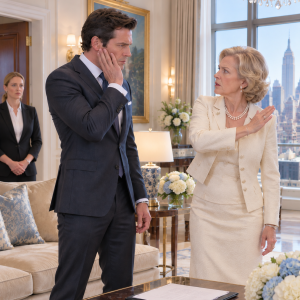
Part 1 – The Funeral With Two Empty Chairs
My husband’s funeral ended beneath a cold October sky with two empty chairs in the front row.
Our sons, Andrew and Caleb, had been informed of every detail. I sent the service schedule, burial time, hotel information, and directions to the cemetery. Neither replied until the evening before the funeral, when Andrew sent a short message to our family group.
“There is no reason to honor a man who left everyone buried in debt.”
Caleb responded with a laughing reaction before adding,
“I cannot lose another workday pretending Dad was some misunderstood genius.”
Their father, Thomas Whitmore, had died after a brief illness at sixty-eight. During the final two years of his life, lawsuits surrounded his regional freight-equipment company, banks demanded repayment, and several newspapers described him as an aging entrepreneur trapped beneath reckless borrowing.
Andrew repeatedly called him financially irresponsible. Caleb accused him of destroying the family inheritance.
Neither son visited during Thomas’s final month.
At the funeral, I sat between my sister and Thomas’s oldest employee while rain darkened the shoulders of my black coat. Nearly eighty mechanics, warehouse supervisors, drivers, and former clients attended. Several had known Thomas for more than thirty years.
The people who believed he had failed were absent.
The people who had watched him work remained.
After the burial, Thomas’s attorney, Nathan Collins, approached with a sealed envelope.
“Eleanor, he instructed me to give you this seven days after the funeral, but I believe you should know where to go.”
He handed me a storage-unit key and an address outside Indianapolis.
“Did the boys receive anything?”
Nathan’s expression remained neutral.
“Their instructions depend upon what they do after his death.”
One week later, I drove alone to a climate-controlled storage facility near the old industrial district. The manager led me to a large unit secured by two locks and a coded alarm.
Inside stood a folding table, six metal filing cabinets, a wooden trunk, and Thomas’s restored green pickup truck.
The truck surprised me more than anything else.
Thomas had driven it for twenty-two years, despite Andrew’s insistence that wealthy clients would never respect a man arriving in an old vehicle. He finally stopped using it when the engine failed, although he refused to sell it.
A white envelope rested against the windshield.
Eleanor,
Begin with the trunk. Do not call Andrew or Caleb until you understand everything.
The trunk contained precisely labeled files, sealed envelopes, property maps, tax records, partnership agreements, and one small metal lockbox.
The first folder read:
DEBT — PUBLIC RECORD.
Inside were the loans, lawsuits, judgments, and financial statements our sons had quoted repeatedly. The reported liabilities exceeded seven million dollars. Several businesses appeared insolvent, while creditors seemed positioned to seize everything.
The next folder read:
ASSETS — PRIVATE STRUCTURE.
I opened it and discovered a financial life I had never seen.
Thomas owned minority interests in warehouse-automation companies, maintenance-software firms, industrial land partnerships, and several distribution centers held through private entities. He had invested quietly in a routing platform whose value had multiplied after major retailers adopted it.
The records continued through Delaware companies, Nevada partnerships, municipal bonds, private lending agreements, and farmland leased for renewable-energy projects.
By the time I reached the final valuation report, my hands were shaking.
Thomas had not died owing seven million dollars.
After accounting for every liability, tax reserve, and pending settlement, his estate held assets worth slightly more than twenty-three million dollars.
The debt was real, but it had been arranged deliberately. Some loans reduced taxable income. Others protected operating companies from hostile buyers. Several lawsuits had been funded and settled through insurance structures that our sons never understood.
Thomas had allowed the public image of failure to remain because he wanted certain people to reveal how they behaved when money appeared to be gone.
I opened the metal lockbox.
Inside were two encrypted drives and a handwritten letter.
My dear Eleanor,
If Andrew and Caleb attended my funeral, spoke respectfully to you, and accepted that no inheritance was guaranteed, Nathan may show them the first trust.
If they abandoned you, mocked my death, or immediately demanded money, they have answered the question I spent years asking.
This is not revenge. It is a filter.
I wanted to know whether my sons loved their father, respected their mother, or merely waited for access to whatever they believed I controlled.
You are the sole executor and trustee. Nothing transfers without your independent approval.
Do not confuse guilt with obligation.
I sat inside the storage unit until darkness filled the narrow windows.
Thomas had hidden the truth from me as well. That realization hurt, although I understood why he trusted me to manage what followed.
Our sons had not merely missed his funeral.
They had announced that love required visible financial value.
Part 2 – The Sons Who Returned After The Rumors
Andrew and Caleb appeared at my house nine days later.
They had heard that creditors were withdrawing claims, that Thomas’s former headquarters had not entered foreclosure, and that one of his private companies had quietly paid several large settlements.
Andrew entered without waiting for an invitation.
At forty-one, he wore expensive athletic shoes, a fitted coat, and the constant impatience of a technology founder who believed other people’s schedules were signs of inferior ambition.
Caleb followed carrying flowers purchased from a grocery store. He was thirty-eight, worked in commercial real estate, and had spent years borrowing against future commissions.
“Mom, we are worried about you,” Caleb said.
“You were not worried during the funeral.”
He placed the flowers on the table.
“We handled that badly.”
Andrew remained standing.
“People are saying Dad had hidden assets. Nathan refuses to discuss the estate, and several creditors have stopped contacting us.”
“Why were his creditors contacting you?”
Andrew looked toward Caleb.
“Dad used our names in several business conversations.”
The storage files had already explained that problem. Andrew and Caleb had represented themselves as future owners while seeking personal loans. They told banks and investors that Thomas’s companies would eventually support their obligations.
Now those lenders wanted reassurance.
“Did your father guarantee either of your debts?”
“Not formally,” Andrew admitted. “However, everyone understood the family relationship.”
“Your father understood it differently.”
Caleb sat beside me.
“Mom, we should discuss this together. Whatever happened between us and Dad, we are still his sons.”
“You remembered that after hearing rumors about hidden assets.”
Andrew’s expression hardened.
“Legally, children have inheritance rights.”
“Not automatically under Indiana law when a valid estate plan says otherwise.”
His surprise revealed that he had already researched the question but expected me not to understand it.
I told them that Thomas had created conditional trusts. I did not reveal the total value, account structures, or private businesses. I explained only that their conduct after his death affected what they might receive.
Caleb stood abruptly.
“He planned to judge us from the grave?”
“He observed you while he was alive.”
Andrew laughed without humor.
“This is emotional manipulation.”
“No. Manipulation requires creating behavior. Your father allowed you to choose.”
They left angrily, then returned the following day with apologies.
For several weeks, their voices became softer. They brought groceries, asked whether I needed help, and mentioned childhood memories they had ignored for years.
Every visit eventually reached money.
Andrew needed capital to save his software company. Caleb faced a mortgage adjustment and several failed property investments. Both insisted that Thomas would have wanted the family name protected.
I established modest monthly allowances through a temporary support trust.
The amount covered ordinary living expenses but could not rescue companies, purchase luxury vehicles, or fund new investments.

Their reaction confirmed everything.
“You are sitting on millions while treating us like irresponsible teenagers,” Andrew shouted during one meeting.
“You borrowed against an inheritance before confirming it existed.”
Caleb leaned forward.
“How much is there?”
“Enough to reveal why you returned.”
I showed them one recorded message from Thomas.
He sat behind his old desk wearing a blue work shirt.
“If you are watching because you are concerned about your mother, stay and listen. If you are watching because you want a number, you have already answered me.”
Neither son remained for the rest of the video.
Part 3 – The Competitor Andrew Tried To Destroy

One year after the funeral, I invited Andrew and Caleb to dinner.
I hoped time, counseling, and reduced financial pressure might have changed something. Caleb had begun working steadily again, while Andrew claimed his company was approaching a major financing round.
The evening remained polite until dessert.
Andrew placed his napkin beside his plate.
“This arrangement has become ridiculous. My company needs two million dollars to complete development. That money could multiply instead of sitting inside trusts.”
“Your father’s assets are not sitting idle.”
“Then give me access to my share.”
Caleb added,
“My mortgage costs have increased, and the allowance barely covers anything meaningful.”
I studied both men.
“Do you know the name Meridian Route Systems?”
Andrew’s face changed.
Three years earlier, his startup attempted to enter the freight-routing market by offering below-cost contracts and spreading claims that Meridian used outdated technology. Andrew recruited two of its engineers, copied portions of its sales strategy, and encouraged investors to pressure the smaller company into a forced sale.
Meridian survived and later secured a national retail contract.
Thomas had secretly owned thirty-four percent of the business.
“Your father watched you try to bankrupt one of his most important investments,” I said.
Andrew stared at me.
“Dad owned Meridian?”
“He funded its founders when banks refused them. He respected their technology and their treatment of employees.”
“Why did he never tell me?”
“Because he wanted to see whether you competed by creating something better or by destroying people with fewer resources.”
Andrew pushed away from the table.
“Business is not a morality lesson.”
“That sentence explains why he did not give you control.”
Caleb asked whether Thomas had hidden investments connected to his real-estate work as well.
I told him about two affordable warehouse projects he attempted to purchase through aggressive foreclosure bids. Thomas had financed the community lenders protecting those properties.
Both sons had unknowingly targeted their father’s interests because they valued conquest more than understanding.
“He was testing us for years,” Caleb said.
“He was watching how you behaved when you believed nobody important was paying attention.”
Andrew left before dessert ended.
Eight days later, I received a lawsuit.
My sons accused me of manipulating Thomas while he suffered cognitive decline. They demanded removal of the trusts, immediate disclosure of every asset, and appointment of an independent administrator.
Their petition described Thomas as confused, secretive, physically weak, and vulnerable to influence during his final year.
They portrayed me as an isolated widow who had persuaded a sick husband to disinherit his children.
Nathan read the complaint twice.
“Thomas prepared for this exact argument.”
He opened the second encrypted drive.
Part 4 – The Evidence Prepared Before Death
Thomas had recorded twelve videos over eighteen months.
Each began with the date, current financial information, recent family events, and a statement explaining why he was creating the record.
He also completed independent evaluations with three neurologists, two estate psychiatrists, and a geriatric specialist. Every physician concluded that he possessed full decision-making capacity.
The medical examinations occurred before and after major trust amendments.
His videos addressed specific incidents.
In one, Thomas described Andrew requesting a one-million-dollar loan after calling him incompetent during a family dinner.
“Andrew considered me capable when he wanted my signature and confused when I refused,” Thomas said.
Another video addressed Caleb.
“Caleb brought a deed transfer to Christmas dinner and described it as routine planning. The document would have placed Eleanor’s home under his control after my death. I read every page before refusing.”
Thomas had preserved emails, text messages, draft agreements, and recordings from meetings where our sons attempted to gain control.
He also documented my limited role.
Nathan handled the legal design. Independent trustees approved the structures. I had not known the extent of the assets until after the funeral.
The final video carried the title:
FOR THE COURTROOM.
Thomas sat inside his green pickup, which had already been placed in storage.
“If this recording is being played before a judge, my sons have claimed that disappointment equals dementia.”
He looked directly into the camera.
“Andrew, on June fourteenth, you requested a loan for a business model that depended upon copying proprietary routing tools. Caleb, on December twenty-third, you asked me to transfer Eleanor’s home while telling her the papers concerned property taxes.”
He listed dates, amounts, names, and conversations with remarkable precision.
Then his voice softened.
“I love my sons, but love does not require me to reward the habits that are destroying them. My estate plan protects Eleanor, employees, grandchildren, and community programs before it protects adult men who repeatedly confused inheritance with income.”
Nathan paused the recording.
“They will probably settle once they learn this exists.”
They did not.
Andrew believed the medical reports had been arranged. Caleb’s attorney argued that Thomas’s detailed planning demonstrated paranoia rather than competence.
The case proceeded to court.
Part 5 – The Trial They Believed Would Expose Me

The hearing began on a rainy Tuesday morning inside the Marion County courthouse.
Andrew and Caleb sat behind two attorneys and avoided looking toward me. Several reporters attended because court filings had revealed that Thomas’s estate might be significantly larger than public records suggested.
Their lead attorney described Thomas as an aging businessman terrified of losing control.
He claimed I encouraged secrecy, isolated him from his sons, and used conditional trusts to punish family members for ordinary disagreements.
Nathan answered with documents rather than emotion.
He presented medical evaluations, attorney notes, trustee records, financial statements, and recordings showing that Thomas met privately with every professional involved.
Then the courtroom watched the videos.
Thomas explained current events, identified each asset structure, described recent conversations, and answered questions posed by independent physicians.
No confusion appeared.
The final video from the pickup played last.
Andrew lowered his head when Thomas described the copied technology. Caleb became pale during the account of the Christmas deed.
The judge watched without interruption.
Thomas concluded,
“My sons may call this revenge because they cannot imagine money serving any purpose besides rewarding them. The estate plan is not revenge. It is protection against predictable pressure.”
The attorney attempted to argue that Thomas had rehearsed the recording.
Nathan produced raw footage showing breaks, questions, corrections, and extended discussions with medical specialists.
The case collapsed before lunch.
The judge upheld the trusts, confirmed my authority as executor, and permanently dismissed the claim that Thomas lacked capacity.
Because Andrew and Caleb had violated a no-contest provision, their access to discretionary principal was terminated.
They retained only the modest monthly support available under separate rehabilitation trusts, contingent upon financial counseling, employment, and community service.
The court ordered them to pay a substantial portion of the estate’s legal expenses.
Outside the courthouse, Andrew confronted me.
“You let Dad humiliate us publicly.”
“You filed the public lawsuit.”
Caleb looked exhausted.
“Are we really receiving nothing else?”
“You are receiving time to build lives that do not depend upon his money.”
Andrew walked away without answering.
Caleb remained long enough to say,
“I wish he had simply talked to us.”
“He did. You considered every refusal evidence that he had failed you.”
Part 6 – The Estate Thomas Wanted To Build
After the lawsuit ended, I followed the instructions inside the file labeled NEXT STEPS.
Ten million dollars funded the Whitmore Skilled Trades Initiative, which established training centers for diesel mechanics, industrial electricians, warehouse technicians, and commercial vehicle maintenance specialists.
Thomas had begun his career repairing refrigeration units behind a grocery warehouse. He believed technical work deserved the same respect and financial support given to university education.
Six million dollars entered protected education trusts for future grandchildren. Andrew and Caleb could not borrow against the funds, select investments, or redirect distributions.
The trusts paid schools and training programs directly.
Three million dollars remained invested to support former Whitmore Equipment employees facing medical emergencies or retirement shortfalls.
The remaining estate secured my housing, healthcare, and independent life.
I sold the largest family home because maintaining empty rooms felt like continuing an argument after everyone had left.
I purchased a smaller house near Bloomington with a garden, library, and wide porch facing a wooded trail.
Andrew stopped calling for several months.
Caleb continued attending required counseling and accepted a salaried position managing maintenance contracts for a regional property company. The job offered less status than his former commissions but provided predictable income.
One afternoon, he arrived without asking for money.
“I came to apologize for the funeral.”
I waited.
“I thought Dad’s debt made him embarrassing,” he continued. “Then I used his supposed failure to excuse my absence.”
“Why are you apologizing now?”
“Because counseling made me explain what I believed I was owed. I could not explain it without hearing how ugly it sounded.”
I did not tell him everything was forgiven.
I invited him to stay for coffee.
Andrew’s path remained harder.
His startup failed after investors discovered inflated projections and aggressive customer-acquisition practices. He blamed the estate publicly, then spent several months without speaking to anyone in the family.
Eventually, he began consulting for small logistics firms. For the first time, his income depended upon whether clients found his work useful rather than whether his father provided capital.
Part 7 – The Green Pickup

Two years after Thomas’s death, the first Whitmore training center opened near Fort Wayne.
The facility contained repair bays, electrical laboratories, simulation rooms, and classrooms built beside an operating distribution yard. Students received paid apprenticeships rather than promises of future employment.
Caleb attended the opening and spent most of the afternoon speaking with instructors.
Andrew arrived late and remained near the back.
After the ceremony, he approached me.
“Dad would have liked this.”
“He designed most of it before he died.”
Andrew looked through the windows at students working around a truck engine.
“Was there ever a way for us to pass his test?”
“It was not one moment. He wanted consistent responsibility.”
“Do you think he hated us?”
“No. I think he stopped believing unrestricted money would help you.”
Andrew nodded slowly.
That was the first conversation in years where he did not argue.
Several weeks later, I visited Thomas’s grave and drove the restored green pickup from storage. The mechanics from the training center had rebuilt the engine, repaired the rust, and preserved the faded paint exactly as Thomas preferred.
After placing flowers beside the headstone, I noticed a small brass key lying beneath the passenger seat.
It opened a narrow compartment hidden inside the dashboard.
The compartment contained a final envelope.
Eleanor,
If you found this, the difficult work is probably finished.
The estate money protects you. What follows belongs to the life we postponed.
Inside were documents for a small cottage overlooking Lake Michigan, purchased in my name twelve years earlier. Thomas had used it occasionally while inspecting projects and always described the trips as business.
A travel account contained enough money for every journey we had postponed because the company required attention.
Beneath the property documents lay a map marked with restaurants, walking trails, bookstores, and one note.
Begin wherever you want. You no longer need to wait for my schedule.
Part 8 – Eleanor Without The Estate
I moved into the lakeside cottage the following spring.
The house had cedar walls, broad windows, and a narrow path leading toward the water. Thomas had selected furniture years earlier but left several rooms unfinished, perhaps knowing that I would need space to choose something without him.
I traveled through Nova Scotia, Ireland, and the Pacific Northwest. I attended training-center graduations, read scholarship applications, and learned how many young people needed practical opportunity more than inspirational speeches.
Andrew and Caleb continued receiving modest support, although neither spoke about the allowances as inheritance anymore.
Caleb completed his financial-counseling requirement and later volunteered to teach basic property maintenance at one training center.
Andrew built a smaller consulting company with clear contracts and no borrowed family reputation. He eventually repaid two former employees whose compensation had disappeared during the startup failure.
Neither son became perfect.
Thomas had never demanded perfection.
He demanded that money stop protecting them from self-recognition.
On the third anniversary of his death, Andrew and Caleb joined me at the cemetery.
There were no empty chairs, cameras, attorneys, or inheritance documents.
Caleb cleaned leaves from the headstone. Andrew stood silently before saying,
“I should have attended the funeral.”
“Yes,” I answered.
He did not ask me to soften the truth.
“I cannot change it.”
“No, but you can decide what kind of man remembers it.”
We remained until the afternoon light began fading.
Thomas’s methods had been secretive, complicated, and sometimes painful. I would always wish he had trusted me earlier with the full truth. However, the final purpose of his estate was clearer than the numbers inside the trunk.
He had not hidden wealth merely to surprise us.
He had removed money from the room so character could become visible.
When I returned to the green pickup, I placed the cemetery flowers on the passenger seat and started the restored engine.
For years, I had been Thomas’s wife, his executor, and the person responsible for carrying out his last design.
Driving toward the lake, I was finally only Eleanor.
That was not an inheritance anyone could contest.
THE END