The prosecution answered by placing those details inside the context Mark had tried to remove.
An expert explained how coercive control affects memory, communication, and decisions during danger. The jury learned that victims often minimize violence, protect offenders, and apologize because those actions can reduce immediate risk.
Emily testified for nearly four hours.
She described how Mark isolated her gradually, first by criticizing friends, then by changing account passwords, controlling transportation, and monitoring calls.
“He never announced that I was becoming trapped,” she said. “He made every restriction sound temporary and reasonable until I could no longer remember when I stopped making ordinary decisions.”
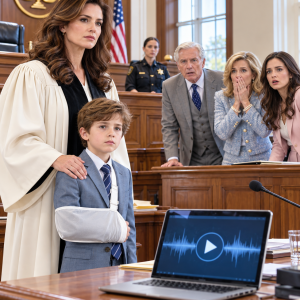
The prosecutor played the bedroom recording.
Mark’s voice filled the courtroom.
“Your sister cannot help you. Nobody will believe a nervous woman who keeps changing her story.”
Then Patricia’s voice followed.
“Take the phone before she creates evidence.”
The jury watched the kitchen footage next.
Mark looked away.
Patricia closed her eyes.
During cross-examination, the defense attorney asked why Emily had remained married if the violence was as serious as she claimed.
Emily answered without hesitation.
“Because leaving required money, privacy, transportation, physical safety, and confidence that he would not kill me afterward. He had systematically removed all five.”
That answer remained with me longer than the verdict.
Mark was convicted of aggravated assault, unlawful restraint, witness intimidation, stalking, and financial crimes. He received sixteen years in prison followed by extended supervision and restitution obligations.
Patricia was convicted of conspiracy, identity theft, evidence tampering, and financial exploitation. She received seven years.
The court restored the remaining trust property, ordered the lake house sold, and directed recovered funds toward Emily’s restitution.
Neither sentence returned the years she lost.
However, both stopped Mark and Patricia from redefining those years as misunderstandings.
Part 6: Healing Without Becoming A Different Person
Emily spent the following year learning that safety could feel uncomfortable after fear became familiar.
She rented a small house near mine, enrolled in an interior design program, and began attending a support group where nobody demanded that she tell the story in the correct order.
Some days she felt powerful.
Other days, a slammed car door made her drop whatever she was holding.
Recovery did not move forward in a straight line, and I stopped treating difficult days as evidence that she was failing.
For years, my career taught me to value action, timelines, and measurable outcomes. Supporting Emily required a different discipline. I had to remain available without controlling her decisions, offer information without issuing commands, and accept that protecting someone does not mean becoming the new authority over her life.
One evening, while we assembled shelves inside her new living room, she asked:
“Did you know before I called?”
I tightened a screw and considered the truth.
“I suspected something, but I did not know enough to force you to speak.”
“Do you blame yourself?”
“Sometimes.”
She sat beside me on the floor.
“I became skilled at making everything look normal.”
“I became skilled at accepting your explanations because I was afraid pushing harder might make you disappear completely.”
We held hands between half-open boxes, exactly as we had during childhood whenever one of us felt frightened.
Neither of us pretended love had made us all-knowing.
Part 7: The Evidence Center We Built Together

Two years after the arrest, Emily began volunteering with a domestic violence organization called Safe Harbor Columbus. She helped clients create financial inventories, recover identification documents, and understand how controlling partners used debt, passwords, and property titles as weapons.
I later joined the organization’s advisory board.
Together, we helped establish the Carter Evidence Center, named after our father. The program provided secure digital storage for photographs, recordings, financial statements, medical documents, and emergency contacts before victims were ready to leave.
The center did not pressure anyone to report immediately.
It preserved options.
At the opening ceremony, Emily stood at the podium while I remained in the audience.
“For years, I believed evidence mattered only if I was ready to use it immediately,” she said. “Preserving information gave me something violence had removed from every other part of my life: a future choice.”
Afterward, a young woman approached us with tears in her eyes.
“My husband checks my phone every night,” she whispered.
Emily did not tell her to leave that afternoon.
She asked whether the woman had safe access to another device, a trusted person, and somewhere private to receive information.
That was the difference between rescuing someone and helping her rebuild control.
Part 8: The Door We No Longer Feared
Three years after Mark’s conviction, Emily and I sat on her front porch during a quiet autumn morning. Maple leaves moved across the sidewalk, and two cups of coffee cooled between us.
She had completed her design degree and begun working with a firm renovating affordable housing. The work suited her because she understood how strongly a room could influence whether someone felt trapped or protected.
“Do you ever wish you had hit him that night?” she asked.
I remembered Mark blocking the doorway, smiling because he believed intimidation remained consequence-free.
“No.”
Emily raised an eyebrow.
“Not even once?”
“A bruise would have healed, and his attorney would have used it to distract everyone.”
I smiled.
“A conviction lasts considerably longer.”
She laughed without looking toward the door.
That simple absence of fear made my eyes burn.
For most of our lives, Emily and I believed protection meant one twin arriving whenever the other called. The case taught us that protection could also mean preserving evidence, respecting procedure, allowing professionals to build a case, and refusing to replace one form of control with another.
Mark had told Emily that nobody would believe her.
He misunderstood what belief was required to do.
Belief opened the first door, but evidence held it open long enough for safety to become possible.
The recording beneath the bed, the medical history, the dispatch calls, the financial transfers, and the security footage did not make Emily more worthy of protection. She had always deserved protection.
The evidence prevented powerful people from pretending otherwise.
Emily reached for my hand, and our fingers closed together with the familiar certainty of childhood.
No one waited inside her house to monitor the conversation.
No one controlled the locks, accounts, or telephone.
The front door remained open behind us while morning light crossed the floor.
For the first time in years, neither twin feared what might come through it.
THE END