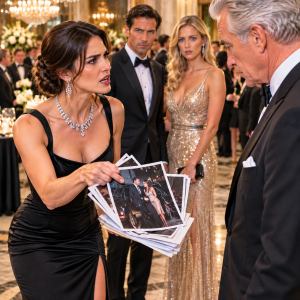
Some transactions supported legitimate company needs during the crisis. Others financed private properties, political donations, and personal investment accounts.
Nathan had transformed emergency authority into permanent control.
The board removed him as chief financial officer. Regulators opened investigations involving securities disclosures, fiduciary breaches, fraud, and obstruction.
I recused myself from several decisions because emotional betrayal could not replace independent governance.
Nathan’s attorneys argued that the company survived because of his actions. The auditors agreed that some decisions had prevented immediate failure, but they rejected the idea that necessity justified concealed ownership changes or forged authority.
At a preliminary hearing, Nathan looked toward me.
“You are dismantling the company Father spent his life protecting.”
“No. I am separating the company from the crimes used to control it.”
“You would sacrifice everyone for Leah and those boys.”
I remained calm.
“They are my sons, and protecting their legal rights is not a sacrifice imposed upon the company. The company benefited from their concealment.”
Evidence showed that Walter participated in the original coercion against Leah and maintained silence for seven years after learning the truth. His death prevented criminal accountability, but the company formally acknowledged his conduct.
We removed his portrait from the headquarters lobby and replaced it with a historical exhibit describing both his leadership and his failures.
Corporate memory should not become another form of inheritance fraud.
Nathan eventually accepted a plea agreement involving forgery, fiduciary fraud, and obstruction. He surrendered improperly obtained holdings, paid restitution, and received a prison sentence followed by restrictions on serving as a corporate fiduciary.
I did not ask prosecutors for leniency or additional punishment.
Legal accountability belonged to the evidence.
Part 6: The Orchard We Chose Not To Sell
The original reason for my return had been selling the Holloway orchard.
After the truth emerged, the proposed resort transaction became impossible to consider. The land contained too much pain to become a private luxury development and too much potential to remain another monument to family wealth.
Leah suggested converting part of it into a community agricultural center.
She had spent years teaching herself food preservation, candle making, market sales, and seasonal farm management. She understood what local families needed more clearly than any consultant I could hire.
Together with community leaders, we created the Rogue Valley Community Orchard and Learning Farm. The nonprofit provided agricultural training, youth programs, commercial kitchen access, and business support for single parents and small food producers.
Leah accepted the position of community programs director only after an independent board established compensation and authority.
“I will not become another woman whose labor disappears beneath a Holloway name,” she said.
“Then your name should appear first wherever your work appears.”
The education trust Walter created for the boys was transferred into independently managed accounts. Additional restitution recovered from Nathan’s transactions funded scholarships for rural students.
Ethan became interested in agricultural engineering. Noah preferred environmental science and insisted that every building should collect rainwater.
They still called me Graham for almost a year.
Then one afternoon, while Ethan and I repaired an irrigation line, Noah arrived carrying sandwiches.
He watched me struggle with a rusted connector.
“Dad, you are turning it the wrong way.”
The word passed naturally enough that he did not notice it immediately.
I did.
My hands stopped moving.
Noah’s face became red.
“I can call you something else.”
“You may call me whatever feels honest.”
He looked toward the orchard.
“Dad feels honest today.”
I turned away briefly because tears made the metal fitting impossible to see.
Part 7: What Leah And I Could Still Become
People in town assumed Leah and I would immediately resume our old relationship. They wanted romance to repair the years because romance creates a cleaner story than grief.
We refused that pressure.
I remained in Ashland more often, purchased a modest house near the orchard, and stepped back from several daily corporate responsibilities. Leah maintained her own home and finances.
We attended family counseling with the boys.
Trust developed through ordinary consistency rather than dramatic promises. I arrived when expected, accepted their anger, and never used my losses to compete with theirs.
Leah eventually told me about the years she spent frightened that Walter or Nathan would remove the children if she attracted attention. She described working during pregnancy, raising twins beside an ill mother, and reading company profiles about my success while believing I had chosen not to respond.
“Sometimes I hated you,” she admitted.
“You had every reason to hate the version of me they created.”
“The hatred kept me moving for a while.”
“You do not need to apologize for surviving.”
Our first kiss after sixteen years occurred almost two years after the market reunion. It was quiet, uncertain, and followed by a conversation about whether affection might endanger the stability we had built.
We chose to move slowly.
There was no proposal, public announcement, or promise to recover the life we lost.
We began building another one.
Part 8: The Seasons That Finally Belonged To Us

Four years after my return, the orchard hosted its first autumn harvest festival. Families moved between apple trees, students demonstrated irrigation projects, and local vendors sold food from the commercial kitchen Leah helped design.
At the entrance stood a simple wooden sign:
Truth cannot return the seasons taken from us, but it can change what grows afterward.
Ethan, now sixteen, managed the youth engineering exhibit. Noah directed children toward a pollinator garden and corrected every adult who called bees dangerous.
Leah stood beside the preserve table wearing the same calm smile I had recognized at the market, although life no longer seemed to press against her from every direction.
I approached carrying coffee.
“The county commissioner wants another tour.”
She accepted the cup.
“He has already taken two.”
“He believes a third tour may produce a better photograph.”
She laughed.
That sound still carried the power to return me to the young man who imagined building a life beside her.
However, I no longer wanted to erase the years between then and now. Those years belonged to Leah and the boys. They contained pain, but also resilience, friendships, skills, and choices made without me.
Later that afternoon, Ethan asked whether I regretted returning to sell the orchard.
“I regret that it took your grandfather’s death to bring me back.”
“Would you have found us otherwise?”
The honest answer hurt.
“I do not know.”
He considered that.
“Then maybe the orchard was tired of waiting.”
We stood beneath the old trees my grandfather planted.
For most of my adult life, I measured legacy through distribution networks, market share, and the value of land. Nathan measured it through control. Walter measured it through preservation of the family company, even when preservation required destroying individual lives.
The boys taught me a different definition.
Legacy was not the property carrying our surname.
It was what people could safely build after we stopped controlling the outcome.
I did not recover sixteen birthdays, first words, school mornings, or Christmases. Money could fund education, housing, and opportunity, but it could not purchase memories retroactively.
What I received was the privilege of being present for what came next.
I attended high school meetings, learned which jokes embarrassed Ethan, remembered that Noah disliked raisins, and discovered that Leah drank coffee without sugar after decades of preferring it sweet.
The details became more valuable than every corporate victory.
Nathan once believed my sons threatened his authority.
In reality, they freed all of us from a family structure built around fear of losing control.
Walter’s confession arrived too late to become courage, but it preserved enough truth for accountability.
Leah’s letters had been intercepted, but her love survived without becoming dependent upon my return.
The orchard remained ours, although ownership no longer meant exclusion.
On summer evenings, the market vendors gathered there for community dinners. Children ran between trees while parents learned business accounting, food safety, and agricultural skills.
Sometimes I watched Leah speaking with a mother who feared she could not support her children alone. Leah never promised rescue.
She offered tools, work, and respect.
That was how she had survived.
One evening after everyone left, the four of us sat at a long wooden table near the barn. Ethan argued about college programs, Noah described a wetland restoration project, and Leah reached beneath the table to take my hand.
Sixteen years earlier, my father and brother decided that love threatened the company.
They were wrong.
Love was not what nearly destroyed Holloway Produce.
Control, secrecy, and entitlement created the damage.
Truth did not restore the family we might have become.
It gave us enough freedom to become a family we could still choose.
THE END