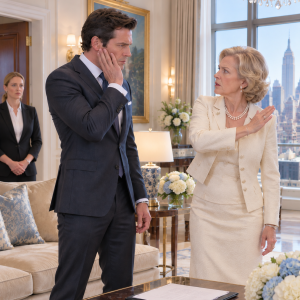
“I was protecting myself.”
“From what?”
His answer erupted through the room.
“From becoming nobody if you ever left me.”
The truth settled between us.
The affair, the money, the resentment, and the need to discredit me all came from the same fear.
Grant could not tolerate knowing that the life everyone admired depended partly upon a wife he treated as invisible.
He wanted Sabrina because she applauded the version of him that required no uncomfortable history. He wanted control of the trust because ownership might erase the fact that my father had given him his beginning.
The agents placed him under arrest.
As they led him toward the elevator, Grant looked back.
“Sabrina trapped me.”
“No,” I said. “You trapped yourself.”
The doors closed.
The Letter My Father Left Behind

Three months later, Raymond accepted a plea agreement.
His testimony exposed twenty-two years of financial crimes involving stolen client assets, false loans, shell companies, forged authorizations, and systematic manipulation of executives who feared losing status.
Grant had been useful because resentment made him obedient.
During the investigation, Leonard asked me to visit his office.
A sealed envelope rested on the desk. My father’s handwriting appeared across the front.
For Evelyn. Open only if Raymond Vale is exposed.
My hands trembled as I broke the seal.
My dearest Evelyn,
If you are reading this letter, then I was correct about Raymond.
The letter explained that my father discovered irregular transfers and quietly restructured the trust before confronting his adviser.
Then one sentence altered everything I believed about my family.
Leonard Shaw is not merely my oldest friend.
I looked across the desk.
Leonard was crying.
I continued reading.
He is your biological father.
The office seemed to disappear.
“What?”
Leonard lowered his head.
The father who raised me had learned years earlier that a medical condition prevented him from having biological children. During a temporary separation, my mother fell in love with Leonard and became pregnant.
When my parents reconciled, the three adults made an agreement.
My father would raise me openly as his daughter. Leonard would remain close but never claim a parental role that might destabilize the family.
He became my godfather, adviser, protector, and constant presence without telling me why.
“That is why Grant hated you,” I whispered.
Leonard shook his head.
“Grant never knew.”
He pushed another document across the desk.
“Raymond knew.”
Raymond discovered the secret years earlier and deliberately encouraged Grant to view Leonard as an enemy seeking control of the company. He wanted Grant defensive, insecure, and willing to move against the trust.
Then Leonard showed me the original trust agreement.
My father had not given me fifty-one percent ownership independently.
I controlled forty-nine percent.
Leonard held two percent.
Together, we possessed the majority.
The final clause changed everything.
If either trustee became the target of spousal fraud intended to seize trust assets, all temporary voting authority would transfer automatically to the unaffected trustee until the matter was resolved.
Grant’s forged documents activated that protection.
The moment he attempted to steal the company, he transferred temporary control of his entire corporate world to Leonard—the man he feared most.
Leonard smiled through tears.
“Your father always believed Grant’s ego would eventually defeat him.”
I closed the letter.
“Was the man who raised me truly my father?”
Leonard answered without hesitation.
“In every way that matters. He chose you every day, and I honored that choice because I loved both of you.”
Blood explained one relationship.
Devotion defined another.
I did not feel that one father had replaced the other. I understood that two men had loved me differently, while Raymond weaponized the secret because he believed truth existed only as leverage.
The Chair That Had Always Been Mine

Six months after his arrest, Grant pleaded guilty to fraud, conspiracy, identity theft, and falsification of financial documents.
Raymond received a substantially longer sentence because of the duration and scale of his crimes.
Thomas preserved his legal license after cooperating fully. An anonymous charitable foundation covered his daughter’s remaining treatment costs.
Sabrina resigned from Meridian Crest and relocated to Boston. We never became friends, although I eventually stopped hating her.
She had believed a liar.
So had I.
The board appointed me chairwoman of Meridian Crest Holdings. For the first time, I stopped apologizing for occupying space inside the company my family had created.
At my first board meeting, I sat in Grant’s former chair.
One director asked whether the experience felt strange.
I looked through the glass wall toward Philadelphia’s skyline.
“No,” I answered. “It feels accurate.”
I restructured executive oversight, strengthened whistleblower protections, separated employee healthcare decisions from individual managerial authority, and created independent controls over trust-linked capital.
Thomas joined the ethics committee after completing an external review. He had failed under pressure, but cooperation and accountability allowed him to rebuild.
Leonard refused the chairmanship.
“Your father did not create the trust so I could govern your life,” he said. “He created it so nobody else could.”
That evening, Leonard and I visited my father’s grave.
I placed my old wedding ring beneath the stone.
Not because Grant deserved another moment of attention, but because I finally understood what the ring represented.
It belonged to a life in which I had made myself smaller to preserve someone else’s confidence.
Leonard touched my shoulder.
“Are you all right?”
I looked toward the distant city.
Grant had traveled to Manhattan believing he was choosing between two women.
In reality, he was choosing whether I would ever discover what he truly thought of me.
He left his tablet unlocked because he considered my curiosity as limited as my ambition. He scattered fraudulent documents across our kitchen because he believed I would organize them without reading them.
Most importantly, he assumed my loyalty had erased my ability to leave.
He was wrong.
Grant’s betrayal did not create my strength. It merely ended the habits preventing me from using it.
The company was never the greatest thing I recovered.
I recovered the right to trust my own intelligence.
I recovered the history men had concealed because they believed knowledge would make me difficult to control.
I recovered a relationship with Leonard that no longer depended upon secrecy, while preserving the memory of the father who chose to raise me.
Before leaving the cemetery, I looked at the name engraved across the stone.
“He protected me even after he was gone.”
Leonard nodded.
“He hoped you would never need the protection.”
“But he prepared it anyway.”
We walked back toward the car.
In Manhattan, Grant had spent a week deciding whether life would become easier without me.
It did not.
My life became easier without him.
Not because divorce removed every wound, but because nobody remained beside me calling invisibility devotion or theft ambition.
Grant believed he was leaving to choose another woman.
Instead, he gave me seven uninterrupted days to reclaim the life he had never bothered to learn was mine.
THE END