It was an impressive forgery.
The problem was the date.
The form claimed Samuel signed it on August 18.
He had been attending a judicial conference in Baltimore that day and had never entered the Philadelphia courthouse.
More fundamentally, he could not lawfully authorize access to records in his own daughter’s custody case.
“Do not touch anything else in that envelope,” he told his clerk.
He called courthouse security, the presiding judge, and the inspector responsible for internal investigations.
A female investigator named Denise Park arrived within the hour.
Samuel gave her the envelope exactly as he had received it.
He did not call Daniel.
He did not confront Sloan.
He did not ask a colleague for special treatment.
For perhaps the first time in his career, restraint felt less like authority and more like helplessness.
That afternoon Rachel called.
Samuel told her only what he could establish: somebody had apparently used his forged signature to obtain sealed medical materials.
Rachel immediately said Daniel was responsible.
Samuel resisted.
“I do not know that yet.”
Her frustration sharpened.
“You still want to protect him?”
“No. I want to protect the difference between what we know and what we suspect.”
Rachel laughed bitterly.
“There you are again. Judge Bennett always knows the procedure, but when I need my father, I get the procedure instead.”
Samuel looked toward Sophie, asleep on the sofa in his chambers beneath his spare coat.
He stopped defending himself.
“You are right.”
Silence followed.
Then Samuel did something more difficult than admitting a legal error.
He admitted a personal one.
“Two years ago, I chose what strangers might think about my position over what my daughter needed from me. I thought distance was integrity, and I was wrong.”
Rachel began crying.
Samuel’s voice broke too.
“I will not interfere in your custody case. I will not call your judge or threaten Daniel with my title. But if you need your father at the hospital, I will come. If Sophie needs breakfast, I will learn. If you need me to sit outside your door and say nothing, I can do that too.”
After a long pause, Rachel whispered:
“Come tonight.”
PART 3: The Woman He Had Failed

Samuel arrived at Jefferson University Hospital shortly after six.
He entered Rachel’s room without his robe, without judicial staff, and without knowing what to say.
Rachel was thirty-four but looked simultaneously younger and older beneath the fluorescent lights. A soft gray cap covered most of the hair she had lost during chemotherapy, an IV line ran into her arm, and her face had become thinner than the daughter Samuel remembered.
She looked toward the doorway.
“You look terrible.”
Samuel almost laughed.
“You are not exactly thriving yourself.”
Rachel smiled.
Then both of them cried.
There was no dramatic embrace.
Samuel sat beside the bed.
After several minutes, Rachel reached for his hand.
He held hers.
“I owe you a real apology,” he said.
“Dad—”
“When you left Daniel, you were frightened, and I treated your fear like a legal problem because legal problems were easier for me than emotional ones.”
Rachel stared at the ceiling.
“I thought you believed him.”
“I did not.”
“You behaved as though you did.”
Samuel nodded.
“Which was worse.”
During the next two hours, Rachel told him what the previous four months had actually been like.
The biopsy.
The word malignant.
The first infusion.
Hair falling into the shower drain.
Trying to explain “bad cells” to a five-year-old.
Daniel initially asking reasonable questions because they shared a child, followed by increasingly specific inquiries that began reappearing almost word-for-word in Sloan’s legal correspondence.
When Rachel stopped sharing medical details, the information continued flowing anyway.
Samuel helped her write down dates, questions, treatments, sealed filings, and statements Daniel appeared to know before he should have known them.
He did not call it an investigation.
He called it preserving memory.
The next morning, Denise Park contacted him.
Access logs showed Rachel’s sealed files had been opened six times from a workstation inside the courthouse’s restricted-records division.
The employee account belonged to Patricia Doyle.
Samuel knew her.
Everyone did.
Patricia was fifty-one and had worked for the court system for twenty-three years, including seventeen in sealed records.
She had brought cupcakes when Samuel was appointed.
She had sent flowers after his mother died.
Security footage placed Patricia at the relevant workstation during four of the six unauthorized accesses.
The trail became worse.
The exported medical documents carried an internal workstation code, and the same code appeared on records attached to Daniel’s emergency custody petition.
Investigators also discovered communications between Patricia and someone associated with Sloan’s office.
Eventually, they uncovered payments.
The motive was depressingly ordinary.
Patricia’s husband had lost his job.
Their debts had accumulated.
Sloan apparently discovered she could access restricted records and began paying for information.
The first requests involved other cases.
Small amounts became larger amounts.
A boundary crossed once became progressively easier to cross again.
When Rachel’s sealed records appeared, privacy had become something Patricia could price.
She forged Samuel’s signature using an older judicial document so the access would appear authorized if anyone examined the logs.
Then, when Sloan used the information too openly in Daniel’s emergency motion, Patricia panicked and anonymously mailed Samuel the evidence, hoping the documents might somehow be withdrawn before a full investigation began.
Instead, the envelope preserved the scheme.
PART 4: The Hearing Samuel Refused to Attend
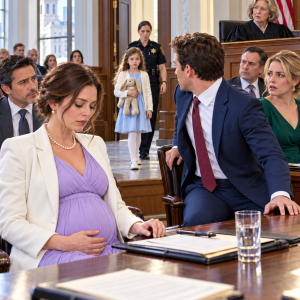
Daniel’s emergency custody hearing took place before Judge Allison Monroe, who had no meaningful personal connection with Samuel.
Samuel did not attend.
Every part of him wanted to sit in the gallery where Daniel could see him.
That was precisely why he stayed away.
He would not turn his position into silent intimidation or give Daniel grounds to claim that Rachel had weaponized her father’s office.
At 11:34, Rachel’s attorney called.
The emergency petition had been denied.
Sophie would remain primarily with Rachel while the existing parenting arrangement continued pending a fuller review.
Judge Monroe had also ordered Sloan to explain the source of the medical exhibits and directed preservation of communications and metadata.
Rachel had testified.
Sloan asked whether chemotherapy caused fatigue, whether she had vomited while Sophie was home, and whether relatives sometimes helped with childcare.
Rachel answered truthfully.
Then Judge Monroe asked what happened when she became too exhausted to care for Sophie alone.
Rachel said:
“I call my mother. I call our neighbor. And now, if he answers, I call my father.”
Samuel could not speak when he heard that.
Being restored to Rachel’s emergency-contact list mattered more than any ruling he had issued in thirty years.
Over the following weeks, the custody evaluation examined Rachel’s actual parenting rather than isolated medical facts.
Her oncologist explained that treatment produced substantial but temporary side effects and that nothing about the diagnosis itself established parental unfitness.
Rachel had a documented support plan involving Margaret, neighbors, backup childcare, transportation, and medical contingencies.
Daniel’s new attorney stopped calling Rachel an incapable mother and shifted toward arguments about routine and stability.
The language became more respectable.
The goal remained the same.
Daniel wanted primary custody while Rachel underwent treatment.
The court ultimately rejected that request.
Rachel’s illness did not make her unfit, and accepting assistance from relatives did not demonstrate incapacity.
Reasonable temporary accommodations could be made during surgery and recovery without stripping her of primary custody.
The illegally obtained medical materials were excluded from consideration, while the misconduct surrounding them continued through separate investigative and disciplinary channels.
When Rachel told Samuel about the ruling, she repeated something Judge Monroe had said.
“A responsible parent is not someone who never needs help. A responsible parent knows when to ask for it.”
Samuel looked away.
Rachel noticed.
“What?”
“Nothing important.”
“Dad.”
He smiled faintly.
“I should have learned that lesson twenty years ago.”
PART 5: Justice Without Satisfaction

Patricia was suspended and later dismissed from the courthouse.
The investigation resulted in criminal proceedings involving unauthorized access, forgery, and disclosure of confidential records.
Sloan withdrew from Daniel’s custody case and from other matters contaminated by his conduct. His communications and payment history were referred to disciplinary authorities and became part of separate legal proceedings.
Samuel gave evidence when properly requested.
Nothing more.
He asked for no special punishment and no special mercy.
The hardest part was accepting that justice did not feel satisfying.
Patricia had been someone he knew for decades.
Watching a familiar colleague destroy her career through a series of increasingly serious compromises did not produce pleasure.
It produced grief.
Daniel’s exact knowledge of the illegal source remained more difficult to establish.
He maintained that Sloan told him the medical information had been obtained legitimately.
Samuel disliked that explanation but refused to convert dislike into certainty.
What could be established was sufficient: Daniel had exploited Rachel’s temporary physical weakness, treated her cancer as a custody opportunity, and used private medical details without asking why his lawyer possessed them.
Whether that made him criminally connected to the leak belonged to investigators.
Whether it changed Rachel’s understanding of him belonged to Rachel.