PART 1 — THE FAMILY SECRET I NEVER EXPECTED A SIX-YEAR-OLD TO REVEAL
When I married Nathan Whitmore, I believed I was joining a family that had already endured terrible heartbreak and was slowly learning how to live with it.
I understood that losing someone you loved didn’t mean their memory would ever disappear.
What I didn’t understand was that my new husband had been keeping an entire part of his life hidden behind a locked door.
And the person who finally revealed that secret wasn’t an adult.
It was a six-year-old girl who had no idea she was telling me anything unusual.
My name is Lauren Mitchell, and I was living in Madison, Wisconsin, when I met Nathan.
He was a widower raising two daughters, six-year-old Sophie and four-year-old Olivia.
During our second date, Nathan told me their mother had died three years earlier.
He watched my expression carefully, as though expecting me to decide that becoming involved with his family would be too complicated.
“I have two little girls, Lauren, and their mother passed away three years ago. I understand if that’s more than you expected when we started seeing each other.”
I reached across the table and gently touched his hand.
“Thank you for being honest with me. Having children and experiencing a painful loss doesn’t make you someone I should be afraid to love.”
His shoulders relaxed.
Over the following months, I gradually became part of his family’s everyday life.
Sophie was endlessly curious.
She wanted to know why thunderstorms happened, why adults drank bitter coffee, and whether clouds ever became tired of floating.
Olivia was quieter.
At first, she hid behind Nathan whenever I visited.
Within a few weeks, however, she began climbing into my lap with picture books and insisting that I read every page before bedtime.
I never tried to take their mother’s place.
I wanted to become another dependable person who loved them without requiring them to forget Elizabeth.
I learned their favorite breakfasts, helped decorate birthday cards, and discovered that Sophie hated having her hair brushed.
Olivia insisted on sleeping beside a stuffed rabbit named Clover.
After dating for a year, Nathan and I married during a small lakeside ceremony.
Sophie wore a flower crown and repeatedly asked when everyone would finally cut the wedding cake.
Olivia fell asleep against her grandmother before the reception ended.
Nathan looked genuinely happy that day.
But occasionally, I noticed him watching his daughters with an expression I couldn’t quite understand.
After our wedding, I moved into his comfortable two-story home in a quiet neighborhood outside Madison.
It had a spacious kitchen, a wraparound porch, and family photographs covering the hallway walls.
Toys were scattered beneath the sofa.
Children’s drawings decorated the refrigerator.
Little shoes accumulated beside the front entrance.
Everything suggested a home filled with warmth and ordinary family life.
Except for one thing.
At the far end of the downstairs hallway stood a heavy wooden door.
And that door was always locked.
PART 2 — THE LOCKED BASEMENT DOOR NOBODY WANTED TO DISCUSS
I noticed the basement door during my first week in Nathan’s house.
Initially, I assumed it led to a storage area containing expensive equipment or objects that might be dangerous for young children.
One evening, while we were cleaning the kitchen after dinner, I asked why nobody ever opened it.
Nathan continued drying a plate.
“It’s mostly storage down there. Old tools, cardboard boxes, and things I haven’t sorted through. I don’t want Sophie and Olivia wandering downstairs and getting hurt.”
His explanation sounded reasonable.
Both girls were curious enough to turn any unexplored corner into an adventure.
I accepted his answer without pressing further.
But as the weeks passed, I began noticing strange little moments.
Sometimes Sophie stood in the hallway staring at the locked door, almost as though she expected someone to appear.
Olivia occasionally approached it while clutching Clover, only to hurry away when she realized an adult was watching.
Once, I found Sophie sitting cross-legged in front of the basement entrance, studying the brass doorknob.
“What are you doing over here, sweetheart? Are you looking for something?”
She immediately stood.
“Nothing important, Lauren. I was just thinking.”
Then she disappeared into the living room.
I wondered whether something stored downstairs frightened them.
Nathan had told me that Elizabeth died after a sudden illness, and I knew the girls were still struggling to understand what losing their mother meant.
Perhaps the basement contained belongings he wasn’t emotionally prepared to discuss.
I didn’t want to force him into painful memories before he was ready.
During our first months of marriage, Nathan rarely brought up Elizabeth unless one of the children mentioned her.
He never became angry when they spoke about their mother.
But his expression changed.
Sometimes he smiled quietly.
Other times, he abruptly remembered something that needed doing elsewhere in the house.
I interpreted those reactions as ordinary grief.
Our marriage wasn’t perfect, but most evenings were peaceful.
We prepared dinner together, helped Sophie practice reading, and laughed at Olivia’s increasingly elaborate imaginary adventures.
I believed we were gradually finding our rhythm as a family.
Then, one chilly Thursday in early October, both girls woke with mild colds.
I stayed home to care for them while Nathan attended his usual appointments.
By lunchtime, their fevers had settled, and their energy had returned.
They transformed the living room into an elaborate hide-and-seek course, ignoring my reminders not to jump from the furniture.
I was reheating chicken soup when Sophie appeared beside me.
She gently tugged my sleeve.
Her expression was unusually serious.
“Lauren, would you like to see where our mommy lives now?”
PART 3 — THE INVITATION THAT LED ME TO THE BASEMENT

I stopped stirring the soup.
For several seconds, I wasn’t certain I’d heard Sophie correctly.
She looked perfectly calm, as though she’d invited me to see a drawing she’d made at school.
“What did you say, honey? Do you mean you want to show me something that belonged to your mom?”
Sophie shook her head.
“No. I mean where Mommy lives now. Daddy takes us to see her sometimes, especially when he misses her.”
A cold sensation moved through my chest.
Before I could respond, Olivia entered the kitchen dragging Clover by one fabric ear.
“Mommy’s downstairs,” she announced matter-of-factly. “We watch her on the television.”
I looked from one girl to the other.
I’d never had a reason to believe Nathan lied about Elizabeth’s death.
But the certainty in their voices frightened me.
Suddenly, the locked basement door seemed far more important.
“Sophie, when you say Mommy lives downstairs, can you explain what you mean?”
She frowned, apparently confused that I needed clarification.
“She’s in the basement with her things. We go there when Daddy wants to spend time with her.”
My mind raced through possibilities I didn’t want to consider.
I remembered Nathan’s evasive explanations, the locked door, and the girls’ unusual behavior whenever they passed the hallway.
Sophie took my hand.
“Come on, Lauren. I’ll show you, and then you’ll understand.”
I followed them down the hallway.
The brass handle reflected the afternoon light.
I turned it gently.
Locked.
Sophie didn’t appear surprised.
“Daddy keeps it locked when we’re not visiting Mommy. He knows how to open it.”
I considered calling Nathan immediately.
Looking back, I know waiting for him would have been wiser.
But I was frightened, and the children’s statements suggested something might need attention.
I asked them to remain in the hallway while I searched for the spare key.
Eventually, I located it among the household keys in the kitchen.
My fingers trembled as I fitted it into the lock.
The mechanism clicked.
Sophie smiled.
Olivia held Clover tightly against her chest.
I opened the door and switched on the light.
A narrow staircase descended into a dim basement.
The air smelled damp, with a faint sour odor suggesting something had been leaking for a considerable time.
I carefully started downstairs.
Then I stopped.
Whatever I’d imagined finding, it was nothing like the room in front of me.
PART 4 — THE ROOM WHERE ELIZABETH’S MEMORY NEVER FADED
The basement wasn’t an ordinary storage room filled with forgotten furniture and household clutter.
It was a carefully preserved collection of one woman’s life.
An aging sofa stood against the far wall with a folded knitted blanket resting across its arm.
Shelves held photograph albums, framed portraits, children’s drawings, and neatly labeled boxes.
A small wooden table displayed a miniature tea set.
An old television stood beside stacks of DVDs.
A woman’s cardigan hung over the back of a chair.
Near the wall, a pair of yellow rain boots rested beneath a photograph showing Elizabeth laughing in a garden.
Everywhere I looked, I found another reminder of her.
A leaking pipe dripped into a plastic bucket near the back wall.
Dark stains had begun spreading across the surrounding plaster.
Related Posts

A Corrupt Sheriff Sh0t My 17-Year-Old Son in Both Knees, Shattering His Dreams of Becoming a Basketball Player. He Thought His Victim Was Just the Son of a Poor Courthouse Janitor. What He Didn’t Know Was That I Once Had a Codename, “Specter,” and a Completely Different Identity…

My Husband Ordered Me and Our Two-Year-Old Daughter Out of the House, Shouting, “I’m Through Spending My Hard-Earned Money on the Two of You! Let’s See How You Manage Without Me!” That Evening, He Bragged on Facebook, “Twelve Years of Paying for Everything. I’m Finally Free!” That Evening, He Bragged on Facebook About Finally Being Rid of Us, and His Mother and Sister Cheered Him On. I Didn’t Argue or Beg to Come Home. I Simply Blocked Them All. But at 7:14 the Next Morning, My Father Called and Said, “I Saw His Post, Sweetheart. Good. I Can Finally Break My Promise.” Two Hours Later, Dad Sent Me a Photograph of an Old Document Bearing My Husband’s Signature. By the Time Garrett Called Begging Me to Come Home, I Finally Understood Why He Was So Afraid of My Father.

“Derek Has Chosen a Better Future, Caroline.” My Husband’s Wealthy Mistress Smirked as I Stood Barefoot in the Freezing Rain, Holding Our Crying One-Year-Old Daughter. He Drove Away Without Looking Back, Leaving Me With Just $37. Three Years Later, Our Unexpected Reunion Revealed Who Had Truly Built a Better Future…
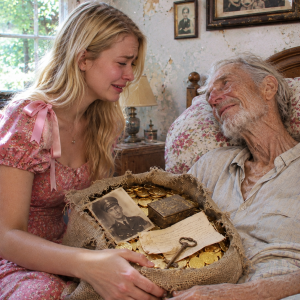
For Twelve Years, I Cared for My Father-in-Law While His Own Children Rarely Bothered to Visit. Just Before He Passed, He Pointed to His Old, Torn Pillow and Whispered, “It’s Yours, Willa. Don’t Let Them Take It.” The Next Morning, My Sister-in-Law Tossed It Into My Arms and Sneered, “There You Go! Twelve Years of Waiting on an Old Man, and All You’ve Earned Is a Filthy Pillow!” I Held Back My Tears and Carried It Away. That Night, I Discovered Something Hidden Inside That Harold Had Never Told His Children About. When We Later Gathered in His Attorney’s Office, My Sister-in-Law Was Furious—Until the Attorney Said, “Before You Accuse Willa of Anything, I Suggest You Listen to Your Father’s Own Words.”