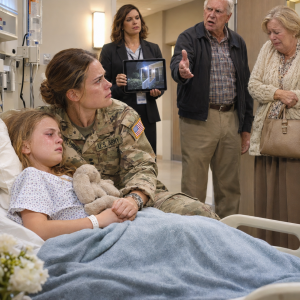
My own hands and arms were painfully cold, and one of my colleagues wrapped me in a warming blanket.
“They’re going to be okay, Kezia,” she reassured me.
I’d spoken those exact words to countless frightened parents throughout my career. But sitting there in my damp scrubs, watching another nurse examine my baby, I finally understood why reassurance sometimes wasn’t enough.
Tiernan refused to leave my side.
“Are you going back to work today, Mommy?”
“No, sweetheart. I’m staying with you.”
“Tomorrow?”
“We’ll figure that out later.”
A police officer arrived that afternoon. He asked about my arrangement with Wynter, my instructions regarding the pond, and whether I’d ever permitted her to record the children.
I showed him our previous messages.
“She knew the rules. I made sure of it.”
He explained that investigators were arranging to preserve the recordings from Wynter’s phone.
Then he asked me something unexpected.
“What time were you originally scheduled to finish work today?”
“Seven.”
“And would Wynter have known that?”
“Of course. She knew my schedule.”
He made another note.
“Is there something you’re not telling me?” I asked.
He paused before answering.
“We’re trying to establish whether this was planned in advance.”
Until that moment, I’d been telling myself that Wynter had made a terrible, impulsive decision.
The possibility that she’d deliberately waited for me to leave for work was considerably harder to accept.
The Message That Explained Everything
Denise arrived shortly before six. She looked exhausted, and her eyes were swollen from crying.
“She’s beside herself, Kezia. She keeps saying she’s sorry.”
I looked toward my daughter’s hospital crib.
“I told her not to take them near that pond.”
“I know. She’s sixteen. Sometimes kids do ridiculous things without thinking.”
I didn’t have the energy to argue. I told Denise that Wynter would never babysit for me again and that I intended to cooperate fully with the investigation.
She nodded, but instead of leaving, she reached into her handbag.
“My niece called me after she heard what happened. Apparently, Wynter had discussed the video with her.”
Denise opened a series of screenshots her niece had sent that afternoon. The conversation was dated thirteen days earlier.
Wynter had described a winter video involving the children she babysat. Her cousin had warned her that putting a stroller on a frozen pond was dangerous.
Wynter dismissed the warning.
Her cousin responded again.
What if their mom finds out?
I looked at Wynter’s reply.
She won’t. I have until seven.
For several seconds, I couldn’t bring myself to hand the phone back.
Denise began crying.
“I didn’t know about any of this, Kezia. I swear.”
I asked her to forward the screenshots to the investigating officer. Then I turned toward Neve, who was sleeping peacefully beneath a hospital blanket.
Thirteen days.
Wynter had thirteen days to reconsider what she was planning. Thirteen days to remember my instructions, listen to her cousin, or simply decide that a video wasn’t worth the risk.
Instead, she’d waited until she thought I wouldn’t be there to stop her.
And if my supervisor hadn’t sent me home six hours early, I might never have known what happened on that pond.
PART 2
What Else Had She Been Hiding?

Two days later, the investigating officer contacted me again. Both children were home, and my mother had driven over from Kalamazoo to help while I recovered.
The officer explained that Wynter had previously recorded my children without permission. Some clips had been posted publicly, while others remained saved on her phone.
There were videos of Tiernan playing in the living room, Neve eating breakfast, and ordinary moments that I’d assumed belonged exclusively to our family.
“How long has this been going on?” I asked.
“We’re still reviewing the dates, but some recordings go back several months.”
He explained that Wynter’s more recent videos appeared increasingly focused on challenges and exaggerated reactions. The pond recording wasn’t an isolated interest that had suddenly occurred to her that morning.
After ending the call, I sat at the kitchen table and stared at the childcare schedule hanging on my refrigerator.
My mother placed a cup of tea beside me.
“You couldn’t have known everything she was doing.”
“I knew she was obsessed with that phone, Mom. I should’ve listened to myself.”
“You gave her clear rules. She promised to follow them. That’s not an unreasonable thing to expect from somebody you’re paying to watch your children.”
I understood what my mother was saying, but understanding it didn’t immediately relieve the guilt.
That evening, Tiernan approached me while I was folding laundry.
“Mommy, is Wynter famous now?”
I stopped folding his pajamas.
“Why are you asking that, sweetheart?”
“She said everybody would see our video. She said you’d be proud of me because I was brave.”
I put the laundry aside.
“Did she tell you that before you went onto the pond?”
He nodded.
“I wanted you to see me skating.”
I pulled him into my arms.
“You don’t have to do anything special to make me proud. You don’t have to be brave for strangers, and you never have to do something that makes you uncomfortable just because somebody asks you to.”
He rested his head against my shoulder.
For days, I’d wondered why my son had ignored the rule I’d repeated every winter.
Now I understood.
He hadn’t been trying to disobey me. He’d trusted somebody I’d told him he could trust.
Two Mothers, Two Very Different Priorities
The following Saturday, Denise and her husband, Mark, came to my house. Mark apologized immediately and offered to cover whatever medical expenses weren’t paid by insurance.
Denise waited until he’d finished speaking.
“We’re hoping you’ll consider talking to the prosecutor. Wynter’s never been in trouble before, and she’s worked so hard in school.”
I set my coffee down.
“What exactly are you asking me to say?”
“That she’s a good kid who made a terrible mistake. This could follow her for years, Kezia.”
“I’m aware of that.”
She looked frustrated.
“She’s sixteen! Are you really willing to let one ridiculous video ruin the rest of her life?”
Mark turned toward her.
“Denise, that’s enough.”
But she continued.
“Both children are fine. Thank goodness. Surely we can acknowledge that and find a way to move forward without making everything worse.”
I looked at her for a moment, wondering how she could sit in my living room and ask me to minimize what had happened.
“Your daughter went home that afternoon, Denise. I spent mine in a hospital waiting for somebody to tell me my baby was okay.”
“I understand that you’re upset.”
“Upset? My six-year-old asks me every morning whether I’m coming home. He won’t go into his own backyard without holding my hand.”
Denise’s expression tightened.
“What do you want me to do? I’m her mother. I’m trying to protect her.”
“And what do you think I’m doing?”
Nobody spoke.
I reached for my phone and opened the screenshot she’d given me at the hospital.
“You showed me this yourself. Your daughter was warned nearly two weeks before it happened.”
“Teenagers say stupid things to each other.”
“Then why did she wait until I was at work?”
Denise looked away.
“Why did she promise me she’d never film my children? Why did she tell her cousin she had until seven?”
Mark rubbed his forehead. Denise appeared close to tears, but I wasn’t going to apologize for asking questions that deserved answers.
“I’m grateful my children are okay. But their being okay doesn’t erase what your daughter did.”
Mark eventually stood and collected his coat.
“We’ll cooperate with whatever the authorities decide.”
Denise left without saying goodbye.
I watched their car disappear down the street, knowing that our relationship might never recover.
For the first time, I was comfortable accepting that possibility.
The Attention She Had Always Wanted
A local television station eventually reported the incident after learning about the emergency response in our neighborhood.