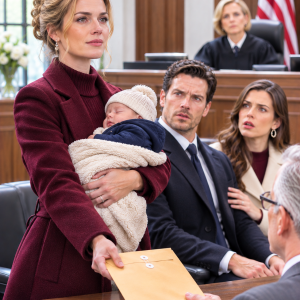
The doctors began with simple prompts. They checked his pupils, asked him to follow a voice, and used questions with answers we could verify. I stood to one side, close enough for Owen to know I was there, but I did not want my presence to influence what the doctors saw.
After a time, Dr. Sloan asked me to try the hand signal again.
I leaned down. “Owen, is your middle name James?”
He squeezed once.
“Is it Patrick?”
Two squeezes followed, faint but distinct.
Paula looked at the physician. Dr. Sloan did not smile or announce a miracle. She simply made a note and asked another question.
“Are you in a hospital?”
One squeeze.
“Are you at home?”
Two.
The room seemed to hold its breath. I kept my eyes on Owen’s hand, afraid that if I looked up I might lose the thread of it. His answers were slow and tiring. Sometimes there was no movement, and sometimes we could not be sure what it meant. The doctors took their time, repeating the prompts and checking their observations.
By the time they finished, they had enough to pause the Friday plan and request an evaluation by a neurologist who specialized in disorders of consciousness.
Andrew stood near the doorway with his jaw set. Tessa had come in and was looking at the equipment as though it were a list of expenses written in a language she did not want to learn.
“We can’t keep extending this indefinitely,” she said. “The bills are already enormous.”
I turned toward her. “Owen is not a bill.”
She lowered her eyes for a second, then looked back at me. “I’m saying the family needs to be realistic.”
“The family needs accurate medical information.”
Victor stepped in again, making a soft motion with his hands as if we were arguing about a routine business matter. “The academy has an obligation to help manage the costs connected to Owen’s injury. We have a proposed payment that could cover a significant portion of what’s accrued.”
I looked at him. “Why would the academy be paying his medical costs?”
“Because he was injured during a sanctioned training session,” he said. “The circumstances are still under review, but we want to make sure the family isn’t left without support.”
The way he said family made my skin prickle. I asked for a copy of the form with the false signature. He said he would need to check whether it could be released. I told him he could check while I waited.
Paula stood beside me. “The patient’s legal guardian is entitled to review relevant paperwork in the chart,” she said, her voice calm but firm.
Victor stopped smiling. He turned toward the charge nurse and asked whether this was really necessary. Paula did not move.
“We need accurate records,” she said. “That includes documenting Ms. Mercer’s objection.”
It was the first time anyone in the room had treated my presence as something more than a complication.
When the physician and the nurses had gone, I sat beside Owen again. I told him what had happened, even though I could not be sure how much he understood.
“They’re going to take another look, honey. You don’t have to explain everything at once. Just keep giving us what you can.”
His fingers rested against mine without moving. I stayed there until the nurse reminded me that he needed rest.
I found Andrew in the hall. He was staring at his phone, his thumb moving over the screen.
“Who filled out that form?” I asked.
He slipped the phone into his pocket. “I didn’t.”
“You knew it existed.”
He glanced toward Owen’s room. “It was supposed to be a request for a conversation. Everyone was trying to make a difficult situation manageable.”
“You could have called me.”
“You were at sea.”
“I was unreachable. I was not gone.”
He rubbed a hand over his face. “You always think there’s a right answer if you keep asking enough questions.”
I felt the words in my chest, but I did not answer them. There was too much at stake for an old argument about our marriage.
Instead, I went back to the room and waited for the specialist.
The Photograph From The Track

The neurologist arrived the next morning. Dr. Martin Kessler had silver hair, a careful manner, and a habit of asking a question twice if he thought the first answer might have been shaped by expectation. He spoke with me, with Andrew, and with the nurses before examining Owen.
The evaluation lasted most of the morning. Owen’s responses came slowly, and some could not be repeated, but others were purposeful. When the doctor finished, he gathered us in the small consultation room.
“At this point, I believe Owen may be moving into a minimally conscious state,” he said. “He is not showing reliable responses to everything, but some of the responses we observed suggest intentional awareness. We need more time and continued assessment.”
I gripped the back of the chair.
“So the plan to remove support is off?”
“The team has put that on hold. There is no basis for rushing forward while this evaluation is underway.”
Andrew stared at the table. Tessa asked how long the process might take. Dr. Kessler said it was impossible to predict. The next steps would depend on Owen’s medical condition and the pattern of his responses.
When the meeting ended, I wanted to sit beside my son and do nothing but hold his hand. Instead, I knew I had to understand what had happened at the academy. Owen had been injured during practice, and I had heard almost nothing beyond a brief statement that he had fallen.
I asked Andrew for the academy’s incident report. He said it was being prepared. Victor said the insurance office would provide documentation through the proper channels. I told both of them I wanted the report that day.
That afternoon, I called an attorney I had once met through a colleague. Her name was Meredith Shaw. She practiced in San Antonio, and when I explained the signature, the medical deadline, and the academy’s involvement, she asked me to email every document I had.
By the time she arrived at the hospital, she had already reviewed the form.
“This needs to be preserved exactly as it is,” she told me. “Don’t write on it, don’t let anyone take the original out of your sight without a record, and keep a list of everyone who has handled it.”
She made calls from the quiet end of the waiting area, first to the hospital’s records department and then to the academy. She sent written requests asking them to preserve security video, access logs, practice records, and any reports related to Owen’s accident. She also advised me to make a formal record with local law enforcement regarding the signature.
A few hours later, I finally received a copy of the form. The witness line carried Tessa’s name.
I had seen her in the hallway, speaking about money as if the rest of us were being unreasonable for caring about something else. Her signature on the form made my suspicions harder to set aside.
Meredith read it over my shoulder. “This is a reason to ask questions. It isn’t proof of everything you suspect.”
“I know.”
“Then we start with what we can establish.”
That evening, one of Owen’s teammates contacted me. His name was Eli, a quiet boy who had visited the hospital once before I arrived and had been too nervous to say much. He texted that he had something I needed to see.
I called him. He said he had taken a photo from the edge of the track on the day Owen was injured. He had been waiting near the equipment shed after practice when a company pickup came through a gate marked for maintenance vehicles. The truck had turned sharply along the service road, and a few moments later Owen had gone down near the far side of the track.
“I didn’t know it mattered,” Eli said. “I thought the coaches had already handled it.”
“You’re not in trouble,” I told him. “I’m glad you told me.”
The image was grainy, taken from a distance, but the truck’s side panel showed the academy’s contractor logo. The driver’s face was visible through the windshield. It was Tessa.
I sat for a long time with the phone in my hand. There was no way to know from the photo alone what had caused Owen to fall. It did show that someone had entered a restricted area shortly before the accident, and it contradicted the simple account I had been given.