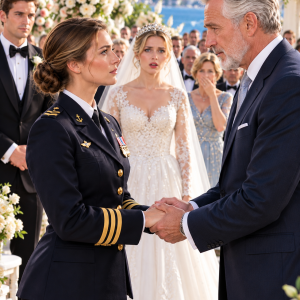
“Don’t apologize because you discovered who I am. Decide whether you would apologize if I were exactly the woman you thought I was.”
He had no answer.
The Person Who Saw Us
Then I turned toward Maribel.
She looked nervous now.
“Ms. Adler, I hope I didn’t interfere with front desk procedures.”
I almost laughed.
“You absolutely did.”
Her eyes widened.
I smiled.
“And I’m very glad you did.”
Willa reached toward the vase.
“Mom, can Miss Maribel help us put the flowers by Daddy’s picture tomorrow?”
Maribel looked at me.
I swallowed the emotion rising in my throat.
“If she has time.”
Maribel smiled.
“I think I can make time.”
The next morning, before any meetings began, Willa and I placed Andrew’s photograph beside the white roses near the window of Suite 1704.
Rain clouds hung above Seattle, but a small patch of light broke through over the water.
Willa stared at the photograph.
“Do you think Daddy would like this hotel?”
I put my arm around her.
“He helped choose it.”
“Would he like Maribel?”
I smiled.
“Very much.”
Later that morning, I met with Mitchell and the hotel leadership team.
We reviewed the previous six months of guest comments.
What we found bothered me more than what had happened the night before.
Several complaints described cold treatment toward guests who arrived casually dressed.
Others said certain employees became noticeably friendlier only after discovering a guest’s status or room category.
The problem was larger than two people.
It was a culture problem.
And culture could not be fixed by one dramatic punishment.
It had to be rebuilt.
What Changed After That Night
Over the next several weeks, we changed the guest-service program across all eight hotels.
Employees were no longer trained primarily around room categories and loyalty levels.
The first rule became simpler:
Treat the person standing in front of you as though they are the most important guest in the building, because in that moment, they are.
Trevor received a formal warning and was placed in retraining after his record showed that his behavior had usually been professional before that night.
He later wrote me a letter admitting that he had begun making assumptions about guests without realizing how obvious it had become.
Derek’s record was different.
There had been repeated complaints about dismissive behavior toward both guests and coworkers, particularly housekeeping staff.
After a formal review, the company decided to part ways with him.
I did not celebrate that decision.
Losing a job is serious.
But leadership also means accepting that one person’s repeated behavior can damage an entire team.
Maribel’s story took another direction.
I learned she had worked at the Bellweather Grand for eleven years.
She knew returning guests by name.
She remembered which older visitors needed extra pillows.
She helped new employees learn the building even when nobody asked her to.
Yet nobody had ever suggested she might have leadership potential because she did not work behind a polished desk.
Three months later, Maribel became our first Guest Care Training Coordinator.
Her job was not to teach employees how to smile.
It was to teach them how to notice.
On her first day in the new position, she called me.
“Ms. Adler, I still think you’re making too much of that little vase.”
I laughed.
“It was never about the vase.”
She was quiet for a moment.
Then she said,
“I know.”
The Lesson Willa Remembered
Nearly a year later, Willa and I returned to Seattle.
This time, she walked into the Bellweather Grand holding the roses herself.
She was taller.
The old stuffed fox was no longer tucked under her arm.
Maribel spotted us from across the lobby and hurried over.
Willa hugged her.
Then she looked toward the front desk.
A young couple stood there wearing jeans and carrying backpacks.
A receptionist greeted them warmly and offered directions before they even asked.
Willa watched for several seconds.
Then she looked up at me.
“Mom, they’re being nice to them.”
“They are.”
“Even though they don’t look fancy.”
I smiled.
“Especially because that shouldn’t matter.”
She thought about that as we entered the elevator.
Then she asked something I still remember.
“Mom, how do you know who important people are?”
I looked at my daughter.
For years, I had thought leadership meant learning to recognize talent, risk, opportunity, and character.
But a seven-year-old had found a simpler question.
I squeezed her hand.
“You don’t have to figure it out, sweetheart.”
She frowned.
“Why?”
“Because every person is important to someone.”
The elevator doors closed.
And for the first time in years, thinking about Andrew did not make that day feel quite so heavy.
I imagined him standing beside us, smiling the way he used to whenever Willa asked a question that was far wiser than she understood.
The hotel had changed because of one difficult evening.
But so had I.
I had arrived hoping to learn how my employees treated strangers.
Instead, I was reminded of something Andrew had understood from the beginning:
A beautiful building can impress people.
A luxury room can make them comfortable.
Excellent food can bring them back.
But the thing they remember longest is how someone made them feel when there was nothing obvious to gain from being kind.
Never measure another person’s worth by the clothes they wear, the luggage they carry, or the money you imagine they have, because the most meaningful parts of a human life are rarely visible from across a room.
True kindness reveals itself most clearly when there is no title to impress, no powerful name to recognize, and no reward waiting for the person who chooses to offer help.
The way we treat someone who appears unable to benefit us says far more about our character than the respect we show people whose influence is obvious.
A simple gesture of attention can stay in someone’s heart for years, because people often remember the person who noticed their exhaustion long after they forget the person who admired their success.
Leadership is not proven by occupying the largest office or carrying the most impressive title; it is proven by creating an environment where dignity is protected even when the leader is not present.
Never assume that someone’s quietness means weakness, because some people have simply learned that they do not need to announce their strength in order to possess it.
Before judging another person’s appearance, remember that you cannot see the journey that brought them to that doorway, the grief they may be carrying, or the responsibilities resting quietly on their shoulders.
Respect should never be upgraded after discovering someone’s position, wealth, influence, or connections, because genuine respect should have been there before any of those things became known.
Sometimes the employee with the least impressive title understands the heart of a business better than anyone else, because compassion, observation, and character cannot be measured by where someone appears on an organizational chart.
At the end of the day, people may forget the price of the room, the elegance of the lobby, or the details of the conversation, but they rarely forget the person who made them feel seen when the world seemed determined to look past them.