I wanted to answer casually, yet something about his voice made me realize how long he had been waiting to say those words.
After Caroline passed away, I had tried to protect him by hiding my sadness and filling every quiet hour with work, believing that being a dependable father meant never allowing my son to see me uncertain.
Instead, I had unintentionally taught him that we should carry our grief separately.
That evening, for the first time in years, we talked openly about his mother, about the months when I had been physically present but emotionally distant, and about the loneliness neither of us had known how to describe.
“I thought you didn’t need anybody,” Benjamin admitted.
“I needed you more than I knew how to say.”
He nodded.
“I wish you’d told me.”
I reached across the table and squeezed his shoulder.
“I wish I had too.”
We could not recover those years, but there was still time to build something better.
By early summer, Meredith and I had begun discussing a future together, carefully and without making promises to the children before we understood what those promises would mean.
One Sunday afternoon, Rosie made the conversation unavoidable.
“Are you going to marry Mommy?” she asked over lunch.
Meredith nearly dropped her fork.
Harper looked delighted, June began giggling, and Abigail watched us with the thoughtful seriousness that had become familiar to me.
“We’re getting to know each other,” Meredith answered.
“You’ve been doing that forever,” Rosie observed.
Benjamin covered his mouth to hide a smile.
Abigail leaned forward.
“If you do get married, does that mean we have to stop talking about Dad?”
The question settled over the table, and I understood immediately that whatever answer we gave would matter more than anything else we said that afternoon.
Meredith took her daughter’s hand.
“Sweetheart, nobody could ever take your father’s place.”
I nodded.
“And I wouldn’t want to. I would just like to be another person you can depend on.”
Abigail thought about that before giving a small, satisfied smile.
“I think that would be okay.”
Rosie frowned.
“But can he still be our pretend daddy?”
“I think we can retire that job title,” Benjamin suggested.
“Fine,” she replied. “But I’m keeping the cookies.”
Part Six: The Drawing on the Wall
The following spring, nearly a year after our first meeting, Meredith suggested returning to the hotel restaurant where everything had begun.
The girls were delighted, particularly Rosie, who immediately crawled beneath our old table to demonstrate precisely where she had been hiding.
“This is where we found Nathan,” she announced.
“Technically, I was sitting here first,” I reminded her.
“Yes, but you didn’t know you needed us.”
I had no argument for that.
After breakfast, Abigail handed me a wrapped picture frame containing a new drawing, this time showing Meredith, all four girls, Benjamin, and me standing together beneath a bright blue sky.
Beside it was a second drawing of Thomas with his daughters outside the cottage.
“We made both,” Abigail explained. “One is how our family was before, and one is how it is now.”
I looked at the pictures for a long time, struck by the simple wisdom of a child who understood something adults often struggle to accept: that welcoming new people into our lives does not require us to stop loving those who helped shape them.
Later, while Benjamin took the girls to choose pastries, I reached into my jacket and placed a small velvet box beside Meredith’s coffee.
She looked at it, then at me, her eyes widening.
“Nathan, what are you doing?”
“Something I’ve been thinking about for quite a while.”
I opened the box and took her hand.
“I don’t want to replace the life you had with Thomas, and I don’t expect you to forget a single wonderful thing about him, but I’d be grateful for the chance to build the next part of our lives together, with all the memories and all the children included.”
Her eyes filled with tears.
“Are you asking me to marry you?”
“I am, although I had hoped to sound considerably more composed.”
She laughed softly.
“You’re doing fine.”
Then she said yes.
Our wedding took place that autumn at the cottage beside the lake, with family and close friends gathered beneath trees beginning to turn gold.
Benjamin stood beside me, the girls carried flowers, and Meredith walked toward us wearing a simple ivory dress, looking happier and more peaceful than I had ever seen her.
Victor attended as a guest, having accepted a quieter role outside the company and finally learned to respect the boundaries Meredith had established.
There was no elaborate celebration, no attempt to make our family appear perfect, and certainly no shortage of small disagreements about flowers, music, or who was supposed to carry the rings.
Rosie insisted on giving a speech, which consisted mostly of explaining that she had personally discovered me and therefore deserved some credit for the wedding.
Everyone laughed, including me.
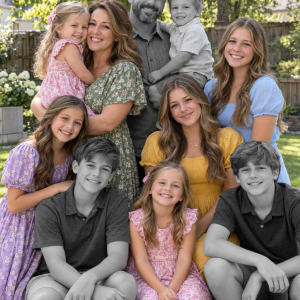
Years later, the two drawings still hang side by side in my study, surrounded by family photographs that tell a story far more complicated and wonderful than I could ever have planned.
Benjamin eventually married, the girls grew older, and our home became the sort of place where someone was always looking for a missing sweater, asking for advice, or arguing affectionately over what to watch after dinner.
Sometimes, when visitors ask how Meredith and I met, she simply says that we happened to sit near each other in a restaurant.
Abigail always corrects her.
“Actually, we hid under his table.”
And Rosie, who has never been particularly interested in allowing anyone else the final word, adds that I looked lonely and obviously needed a family.
Perhaps she is right.
For years, I had believed that keeping my life orderly and unchanged was the safest way to honor everything I had lost, while Meredith had believed much the same about her children and the memories of their father.
Neither of us understood that a family could preserve its history while still making room for a different future.
All it took to begin teaching us was four little girls, one whispered request, and a stranger willing to stay at the table long enough to listen.
And whenever I look at that first crooked drawing, with its oversized figure and uneven letters spelling Thank You, Pretend Dad, I remember that the girls thought they were asking me for a favor.
What they could never have known was how much they were giving me in return.