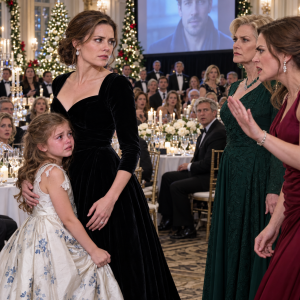
Minutes later, the room filled with the thin but determined cry of a very small baby girl. The neonatal team lifted her carefully, and one nurse smiled.
“She’s breathing on her own.”
Claire closed her eyes as relief moved through her. “Her name is Grace.”
Margaret leaned close to the baby. “Welcome, Grace. You certainly know how to make an entrance.”
Owen heard his daughter’s first cry from the hallway. Later, Claire allowed him into her room, stripped of every title and defense.
“I almost missed her,” he said.
“Yes.”
“Please let me repair our family.”
Claire looked toward the doors leading to the neonatal unit. “You can learn to be her father. You can arrive when she needs you, and you can become someone she is proud to love.”
His eyes filled. “What about us?”
“You can become her father without becoming my husband again.”
For once, Owen did not try to change the meaning of her words.
A Chair at the Family Table
Grace weighed a little over four pounds. Beside her incubator, Owen let her tiny fingers curl around his and remained there without checking his phone.
Margaret entered quietly. Brother and sister stood together beneath the soft lights, connected by a father whose silence had shaped them in different ways.
Owen spoke first. “Maggie.”
Margaret’s eyes brightened. He had never called her that.
“When you told me the family would reject me, did you ever ask them?” she said.
He lowered his head. “No.”
“You said your mother couldn’t bear it, your aunt would turn me away, and your cousins would assume I wanted money. Did you ask even one of them?”
“No.”
“Then you decided for everyone.”
“I thought I was protecting the family.”
“From what? From knowing I existed?”
Owen had no polished answer left.
“You offered me money before you offered me a chair at the table,” Margaret continued. “You could have called once without an attorney beside you. You could have asked what I wanted.”
“I know.”
“Do you?”
“Yes. I treated you as if you were the problem when the problem was what Dad and I chose to hide.”
Margaret nodded slowly. “That is the first honest thing you have ever given me.”
At mediation, Arthur confirmed Leonard understood the amendment, and Calvin produced the encrypted copy and Owen’s email. When counsel questioned Leonard’s capacity, the mediator asked whether the company had raised the same concern over refinancing agreements signed that month. It had not. The business could not trust Leonard’s judgment when it benefited the company and dismiss it when it benefited Margaret.
Leonard’s estate was reopened, Margaret’s status recognized, and independent counsel calculated what she should have received. The company separately reviewed the legal payment and restricted Owen’s authority.
Then Leonard’s relatives began calling Margaret. His younger sister, Ruth Bennett, was first.
“I’m your aunt,” Ruth said after a long silence.
“I suppose you are.”
“I didn’t know about you.”
“I believe that now.”
Ruth began to cry. “Whatever my brother failed to do, you were never responsible for his fear. If you are willing, I would like to meet you.”
Weeks later, six Bennett relatives gathered at Harbor & Elm with photographs, awkward questions, and genuine regret. No one asked what Margaret intended to claim. She did not have to prove she belonged before being offered a chair.
Owen’s case against Claire weakened. Her physicians confirmed her good judgment, her work showed independence, and Mallory’s documents proved he had planned the narrative months before Claire left.
His attorney withdrew the harshest claims. Claire did not want to punish him or deprive Grace of a father. Owen visited the neonatal unit, learned the feeding routine, and one afternoon apologized for the custody filing.
“You tried to frighten me,” Claire said.
“Yes.”
“Why?”
He took a long time to answer. “Because I could no longer control what you knew.”
For the first time, Claire believed an apology from him—not because it repaired the marriage, but because he had finally named fear without disguising it as concern.
The Meaning of Home

Grace left the hospital forty-one days later, wrapped in a pale green blanket Margaret had knitted. Owen carried the diaper bag, but he and Claire did not travel to the same address. Separation no longer felt like ruin; it was the boundary that allowed a healthier family to form.
Their marriage ended nine months later. Owen’s parenting time expanded as Grace grew stronger, and he and Claire learned to discuss her needs without reopening every wound.
Margaret received Leonard’s assigned share, kept her bookstore, and used part of the inheritance to create the Leonard Ellis Book Fund for rural children.
When Owen asked why she had used Leonard’s name, Margaret answered simply, “I am finished pretending he was not my father, and I am also finished pretending that being my father made every choice he made acceptable.”
The company survived under new governance rules that no longer bent around Owen. Mallory resigned and later sent Claire an apology with no excuses. Claire read it once and stored it away; some chapters could close without reconciliation.
Claire’s consulting work grew until she opened Bennett Rowe Advisory under her maiden name. One afternoon, after hours analyzing a development, she realized she had not thought about Owen once. Healing had entered quietly, when her old life stopped being the center of her new one.
The following Christmas Eve, Margaret hosted dinner above the bookstore. Ruth came with cousins, Calvin brought wine, and Arthur arrived with a suspiciously perfect pie. Claire stood by the fireplace holding thirteen-month-old Grace.
A small stocking marked GRACE hung from the mantel. One year earlier, Claire had believed losing her marriage meant losing her family. She knew better now.
Owen had been invited for an hour so Grace could see her father and extended family. When he reached Margaret, he paused.
“Merry Christmas, Maggie.”
“Merry Christmas, Owen.”
They did not embrace, but no attorney stood between them.
Grace wobbled toward her father and fell laughing into his chest. Claire watched without wishing for their lost marriage, and that absence of longing felt like freedom.
Later, as Grace tore wrapping paper into delighted handfuls, Owen stood beside Claire.
“You look happy,” he said.
“I am.”
“I used to think that meant you needed me.”
“So did I.”
He glanced toward Margaret, who was laughing with Ruth beside the tree. “I thought that controlling the story would keep Dad’s choices from changing everything.”
“You did change everything,” Claire said. “Just not in the way you planned.”
Before leaving, Owen handed her a small box. Inside was the ornament she had left unopened the previous Christmas. The original engraving read Our First Christmas as Three. On the back, he had added Grace’s name and the year of her early arrival.
“Her first Christmas really was last year,” he said. “Even if none of us imagined it that way.”
Claire ran her thumb over the letters. “Thank you.” For once, the gratitude was uncomplicated.
After he left, Margaret brought out Leonard’s walnut case. The pen and keys had not broken the family; they had revealed what was already broken.
“I think Leonard would have liked tonight,” Margaret said.
Claire considered the crowded room, the mismatched ornaments, and the relatives still learning how to speak honestly to one another.
“I think he would have been grateful.”
“For what?”
“That everyone became braver than he was.”
Near midnight, Claire carried a sleeping Grace onto Main Street. A year earlier, she had entered that town frightened and uncertain whether leaving was courage or desperation. She had believed she was running away.
She had been moving toward truth, work she loved, a daughter who would know that love never required surrendering dignity, and a sister who had spent half a lifetime believing no family wanted her.
Grace stirred, and Claire kissed her soft hair. “Ready to go home, sweetheart?”
Claire smiled because home no longer meant a townhouse, a husband, a famous family name, or a future someone else had designed. Home was any place where truth could enter, where love could remain without ownership, and where no one had to become smaller in order to belong.
One year earlier, Owen Bennett had left on Christmas Eve believing his pregnant wife would still be waiting when he returned. By morning, she was gone from the house.
But Claire had never disappeared.
She had finally arrived.