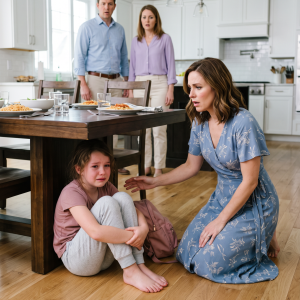
She watched me for several seconds before unlocking her screen.
The messages revealed a household routine I barely recognized.
Vanessa expected Sophie to wash clothes before starting homework, clean bathrooms on Saturdays, prepare food when guests were visiting, and complete whatever additional chores were assigned before spending time with friends.
One message instructed her to finish polishing the kitchen floor before the reading group arrived.
Another reminded her that Paige was visiting for the weekend and should not be bothered with household tasks.
Then I found the message that explained why Sophie had stopped playing soccer.
Vanessa had instructed her to tell me she no longer enjoyed the sport, adding that there was no point wasting money on activities when she struggled to finish her responsibilities at home.
I remembered asking Sophie whether she was certain about quitting.
I remembered her quiet answer.
“It’s fine, Dad.”
I had mistaken resignation for agreement.
The following morning, after Rebecca joined us by telephone, Sophie slowly began explaining what her afternoons had become.
She often arrived home from school, started the laundry, prepared vegetables for dinner, cleaned the kitchen, and finally opened her schoolbooks when she was already tired.
On weekends, she scrubbed floors and bathrooms, sometimes spending most of Saturday completing tasks that had never appeared on the chore chart displayed on our refrigerator.
“Sometimes I actually liked helping,” she told me. “I like cooking. I just couldn’t get everything finished.”
“Helping isn’t the problem,” I said. “The problem is that you were expected to do more than a child should, and you were afraid to tell me.”
She twisted the sleeve of her sweatshirt.
“Vanessa said everybody would be happier if I did my part. And when the house was clean, you always seemed happy when you got home.”
I closed my eyes for a moment.
Without realizing it, I had taught my daughter that my peace mattered more than hers.
When we estimated how much time she spent on household work, the total came close to fifteen hours in an ordinary week.
The official chore chart required less than four.
I placed the two versions beside each other.
“You weren’t failing to keep up, Sophie. You were being asked to carry too much.”
Her eyes filled with tears.
“I thought I was just bad at everything.”
I put my arm around her shoulders, wishing I could return to every evening when she had needed someone to ask one more question.
Part Four — The Truth Beyond Our Front Door
The school arranged a meeting with the principal and guidance counselor, while Rebecca participated by video from North Carolina.
They explained that Sophie’s academic performance had declined, particularly after the days I traveled, and that several teachers had noticed she struggled to remain attentive.
The counselor also shared something Sophie had said privately.
She worried that if she disappointed Vanessa, she might be sent away to live somewhere else.
Rebecca covered her mouth when she heard that.
I wanted to insist that nobody had ever planned to send Sophie away, but I realized that my intentions mattered very little when my daughter had spent months believing her home depended on her usefulness.
We arranged academic support, regular counseling, and direct communication between the school and both parents.
I also contacted a family attorney and cooperated with the child-welfare professional who reached out following Mrs. Bennett’s report.
Vanessa moved temporarily into her sister Caroline’s home.
I told Sophie about the arrangement that afternoon.
“Vanessa won’t be staying here for a while.”
She looked down at her shoes.
“Because I told you?”
“Because I made a decision about what needs to change. You told me the truth, and I’m grateful you did.”
Unfortunately, Vanessa had already begun telling acquaintances a different version of events.
In a private parent discussion group, she claimed that Sophie had been spoiled, that ordinary chores had been exaggerated, and that I was punishing her for trying to establish discipline.
Several people believed her.
When Sophie learned about the messages from a classmate, she came downstairs carrying her phone.
“Dad, do they think I’m lying?”
“Some people have heard a story that isn’t accurate.”
“Can you show them what happened?”
I wanted to share every message and the recording, but my attorney reminded me that Sophie’s privacy mattered more than winning an argument with strangers.
Instead, I posted a brief correction explaining that the work had been regular, excessive, and concealed from me, and that the adults involved were addressing the situation.
I asked everyone to stop discussing my daughter.
Other information soon emerged. One woman admitted that Vanessa had previously suggested hiring a teenager to serve guests, while another provided messages in which Vanessa had joked about having someone available to do the cleaning.
The evidence made the situation clearer, but it did not make Sophie feel instantly safe.
That would require something far more difficult than proving Vanessa wrong.
It would require proving, through ordinary days and repeated choices, that her father could finally be trusted to notice.
Part Five — What Vanessa Had Carried

Several days later, I met Vanessa at Caroline’s house.
Without her usual polished appearance and carefully organized surroundings, she looked exhausted.
She explained that leaving her job as an event coordinator after our wedding had been harder than she expected. I had encouraged the decision because I earned enough to support us, and we both believed having someone home would simplify our schedules.
Instead, Vanessa had become resentful of the endless housework and the feeling that her own ambitions no longer mattered.
“You came home and everything looked easy,” she told me. “You never saw how much I was doing.”
“You’re right,” I admitted. “I should have listened when you were unhappy, and I should have taken more responsibility at home.”
She seemed relieved until I continued.
“But Sophie couldn’t change her circumstances the way we could. You made her responsible for problems she didn’t create.”
Caroline quietly encouraged her sister to explain something about their childhood.
Their father had remarried when Vanessa was young, and her stepmother regularly entertained friends while expecting Vanessa to serve refreshments and clean afterward.
Her father had dismissed her complaints, insisting that helping around the house would build character.
Vanessa stared at the kitchen table.
“I used to listen to those women laughing while I cleaned. I promised myself I’d never feel that small again.”
I remembered the laughter coming from our living room on the afternoon I returned home.
“Then why did you put Sophie in the same position?”
She struggled to answer.
Eventually, she admitted that she had resented the attention Sophie received from both parents and had convinced herself that the girl needed to become more responsible.
“I kept thinking she had everything I didn’t have,” Vanessa whispered. “And somehow I made that an excuse.”
For the first time, I understood how an old hurt could become a pattern that someone repeated without fully acknowledging what they were doing.
I felt compassion for the little girl Vanessa had once been.
But compassion did not require me to place my daughter back in the same situation.
Vanessa told me she had arranged professional counseling.
I wished her well and explained that our separation would continue while I considered the future of our marriage.
When I returned home, Sophie was drawing at the kitchen table.
“Was Vanessa upset?” she asked.
“We had a difficult conversation, but you don’t need to worry about taking care of either of us.”
She considered that answer, then turned her sketchbook toward me.
“Do you think a dragon could have purple wings?”
I smiled.
“I think purple wings would be excellent.”
For the next twenty minutes, we discussed dragons instead of family problems, and I realized how much I had missed hearing my daughter talk about something simply because it made her happy.
Part Six — The Shoes Behind the Boxes
Over the following weeks, I made changes that should have happened long before.
I accepted a position closer to home, even though it meant earning less money, and arranged my schedule around school pickups rather than expecting everyone else to accommodate my work.
My mother helped when necessary, Rebecca received school updates directly, and we hired someone to handle heavier household cleaning twice a month.
Sophie still helped with dishes and occasionally prepared dinner with me, but her homework, friendships, soccer interests, and rest came first.
One Saturday, while clearing space in the garage for her bicycle, I discovered a shopping bag hidden behind several storage containers.