What My Son Said
Carter stepped toward Caleb.
“I don’t know what to say.”
Caleb looked at me before answering.
I nodded.
He faced Carter again.
“Grandpa Walter told us you didn’t know about us.”
Carter swallowed.
“I should have.”
“Probably.”
Despite everything, I nearly smiled.
That was Caleb.
Direct, but never cruel.
Carter looked toward me.
“Avery, please. I can’t change the last nine years, but let me try now.”
I had waited a long time to hear those words.
But they no longer had the power I once imagined they would.
“Today isn’t about you and me.”
I gestured toward the casket.
“We came for Walter.”
One by one, my children walked forward.
Caleb placed his flower first.
Then Owen.
Then Miles.
Sophie rested hers beside Walter’s photograph.
Grace placed the final flower down and whispered,
“Bye, Grandpa. Thank you for finding us.”
That was the moment my composure almost disappeared.
Walter had not repaired what happened.
Nobody could.
But he had given my children something important.
He had given them a connection to the part of their history they had been denied.
I Didn’t Come Back for Revenge
After the service, Carter followed us toward the SUV.
Vanessa was nowhere in sight.
“Please don’t leave yet.”
I turned.
He looked nothing like the confident man who had once given me a stack of papers and demanded my signature.
He simply looked tired.
“I believed the wrong person.”
“Yes.”
“I ruined everything.”
I shook my head.
“No, Carter. Vanessa created the lie. But you made a choice too.”
He looked down.
“I know.”
“You didn’t lose nine years because she was convincing. You lost them because you decided I wasn’t worth one more question.”
His eyes filled again.
“Can I see them?”
I looked toward my children.
They were waiting beside the SUV.
This decision no longer belonged only to me.
“You can ask them when they’re ready.”
“And if they’re never ready?”
I answered quietly.
“Then you’ll have to respect that too.”
He nodded.
Before I turned away, he asked one final question.
“Why did you come today?”
I looked back toward Walter’s grave.
“Because your father earned his goodbye.”
Then I opened the SUV door.
What Happened After the Funeral
Carter did not suddenly become a father.
Life is rarely that simple.
He began with letters.
Not expensive gifts.
Not lawyers.
Letters.
At first, the children didn’t answer.
Then Sophie sent him three questions about his childhood.
Miles asked whether he really hated broccoli, because Grandpa Walter had claimed he did.
Caleb remained cautious the longest.
That was his right.
Vanessa and Carter separated several months after the funeral.
An internal company review later confirmed that Walter’s concerns about several financial decisions had been justified.
I stayed away from those matters.
They belonged to Carter.
My life was elsewhere.
A year after the funeral, Carter visited Maryland for the first time.
We met at a public park.
He brought no cameras, no attorneys, no grand promises.
Only himself.
For two hours, he listened while five children told him about nine years he had missed.
When it was time to leave, Grace surprised everyone by hugging him.
Caleb did not.
Carter didn’t complain.
That was when I realized he might finally be learning what fatherhood required.
Not ownership.
Not biology.
Patience.
The Life We Built Without Permission
People sometimes ask whether I regret not fighting harder to make Carter listen nine years earlier.
For a long time, I did.
Then I understood something.
I had fought.
I called.
I wrote.
I explained.
There comes a point when protecting your dignity matters more than repeatedly begging someone to believe you.
My children grew up knowing they were wanted.
Not by everyone.
But completely by me.
Walter found them because eventually he chose questions over assumptions.
Carter lost them because, years earlier, he chose certainty over trust.
And Vanessa’s lie survived because it gave someone exactly the story he was prepared to believe.
The funeral did not give me revenge.
It gave us something better.
It ended the secret.
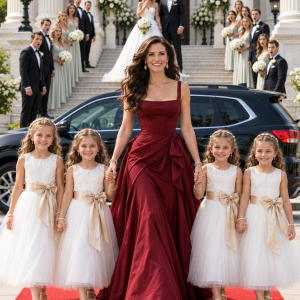
Nine years earlier, I had left Tennessee carrying five tiny lives no one knew existed.
When I returned, those five children walked beside me.
They didn’t arrive asking for the Kincaid name.
They didn’t need the family fortune.
They already had a home.
They already had a future.
They already knew who they were.
And when Carter finally looked at their faces and saw himself reflected back five times, he understood something I had learned years before.
Truth does not always arrive when you need it.
Sometimes it arrives after the damage has already been done.
But when it finally walks through the door, every lie in the room has to make space for it.
Sometimes the greatest loss in a relationship does not come from the lie itself, but from the moment someone who promised to love you decides that another person’s version of you deserves more trust than everything you built together.
When someone refuses to listen to your explanation, you can spend years trying to prove your worth to them, or you can use that same strength to build a life in which their approval is no longer necessary for you to feel whole.
Truth does not always arrive quickly enough to prevent heartbreak, but even a delayed truth can restore dignity, correct a false story, and give the next generation a clearer understanding of where they came from.
Children should never have to carry the weight of mistakes made by adults, which is why the most loving parent is often the one who gives them facts without forcing them to inherit bitterness.
Biology can reveal who a parent is, but only patience, consistency, respect, responsibility, and years of showing up can determine whether someone eventually earns the emotional place that comes with being called Mom or Dad.
The easiest story to believe is often the one that confirms what we already fear, which is why the moments when we feel most certain are sometimes exactly when we should ask one more question before making a decision we cannot undo.
Forgiveness does not require pretending the past never happened, reopening every closed door, or restoring someone to the position they once held; sometimes forgiveness simply means refusing to let their choices control the rest of your life.
A person who loses years through pride cannot purchase those years back with money, influence, or apologies, because the most valuable moments in a family are often the ordinary ones that happen only once and can never be recreated.
Walter could not erase what his family had done, but by searching for the truth and quietly building a relationship with his grandchildren, he proved that admitting a past failure can still create something meaningful for the future.
The strongest ending is not always watching the person who hurt you fall apart; sometimes it is realizing that while they were busy protecting a lie, you quietly built a life so full of love, purpose, and self-respect that you no longer needed their downfall to feel victorious.