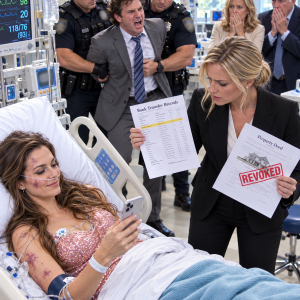
She placed a photograph on my hospital blanket.
It showed an exposed section of foundation wall beneath the office floor.
Inside a narrow cavity sat a small metal box.
My father’s initials were engraved on its lid.
Beneath them were two letters.
S.A.
Sealed Annex.
“The box was locked,” Celia explained.
“Did they find a key?”
She nodded.
“In a concealed compartment of Daniel’s briefcase.”
I stared at her.
Daniel had known about the box.
He’d possessed the key.
And he’d still tried to obtain control of the trust through altered documents.
The contents were formally documented before I was allowed to review copies.
Inside were contracts, private correspondence, and a digital recording.
The first envelope was addressed to me.
My father’s handwriting filled the page.
Mara,
I established this trust to protect your independence, not simply your money.
I’ve discovered that several people connected to my business have been using property transactions to conceal debts and move liabilities.
Jonathan Reed is involved. I believe Daniel may also be involved.
I do not yet know the full extent of their activities.
But I know Daniel has been asking questions about your inheritance that no prospective husband should need answered.
I stopped reading.
The letter had been written before our wedding.
Before the shared accounts.
Before Vivian moved into our house.
My father had suspected Daniel long before I did.
The supporting documents connected Jonathan to suspicious transactions and showed that Daniel had participated in business arrangements he never disclosed to me.
The recording contained a conversation between Dad and Celia shortly before his death.
Hearing his voice again nearly broke me.
“Daniel is interested in what Mara owns,” my father said. “Every time I question him, he tells her I’m trying to embarrass him.”
Celia asked:
“Should we warn her?”
“Yes. But we need evidence. Otherwise he’ll make himself the victim.”
There was a pause.
Then Dad said:
“My daughter is a good lawyer. But she gives the people she loves more chances than they deserve.”
I covered my mouth.
Adrian sat beside me without speaking.
The recording didn’t suggest Daniel had caused my father’s death. Dad had suffered a heart attack, and investigators found no evidence establishing anything different.
But the documents revealed the financial scheme’s history.
Jonathan had arranged questionable property transactions.
Daniel had become involved and accumulated substantial debts.
When he realized he couldn’t access my trust directly, he began using accounts connected to me and documents bearing my signature to support other financial arrangements.
Vivian’s company helped move the money.
The farmhouse served as collateral for a four-hundred-thousand-dollar loan.
And when I began asking questions, Daniel intensified his efforts to portray me as unreliable.
The kitchen incident had given him an opportunity to reinforce that narrative.
Except the camera had captured what really happened.
Over the following months, investigators assembled the financial records, witness statements, and recordings.
Daniel and Vivian faced criminal charges connected to the kitchen incident and the financial scheme.
Jonathan, who had left the country, became the subject of a separate investigation.
The trust remained protected.
Some of the missing money was recovered through identified assets and accounts, though the legal process took far longer than I’d hoped.
Daniel’s attorneys argued that Jonathan had misled him.
Vivian’s attorneys claimed she’d misunderstood the transactions.
Neither explanation accounted for the kitchen recording.
I attended one important hearing.
Daniel looked almost ordinary.
Expensive suit.
Carefully combed hair.
The same polished appearance that had once convinced me he was trustworthy.
During a break, he tried to approach.
“Mara, please. You know I loved you.”
My attorney moved closer, but I raised a hand.
“Then why did you put my name on documents I never signed?”
He looked toward his lawyer.
“I was under enormous pressure.”
“Why did you tell everyone I was unstable?”
“Because we were fighting constantly.”
“And why did you tell your mother to lie about what happened in the kitchen?”
His mouth opened.
Nothing came out.
I waited.
For three years, I’d filled his silences with excuses.
Not anymore.
Finally, he whispered:
“I never wanted things to go this far.”
I looked at him.
“Daniel, you had three years to stop.”
Then I walked away.
The legal proceedings eventually established responsibility for the proven financial wrongdoing and the attack. Daniel and Vivian faced criminal penalties, and restitution was ordered for the documented losses.
Not everything could be recovered.
And no court decision could give me back the years I’d spent doubting myself.
Recovery was slower than I expected.
There were appointments, difficult mornings, and ordinary tasks that required patience.
Lena stayed with me during the first weeks after I left the hospital.
Adrian visited every Saturday.
At first, we talked about paperwork.
Then about Dad.
Eventually, about the two years we’d lost.
One afternoon, Adrian admitted he’d sometimes resented how much authority Dad had placed in my hands.
“I thought he trusted you more than me,” he said.
“He trusted you enough to name you successor protector of the trust.”
Adrian smiled faintly.
“I know that now.”
“I’m sorry I believed Daniel.”
He looked at me.
“I’m sorry I stopped trying after he turned me away.”
We sat quietly.
Then I reached across the table.
He took my hand.
We didn’t pretend everything was fixed.
We simply agreed to stop letting someone else decide what we were allowed to say to each other.
Six months later, I moved into a smaller house.
It had bright windows, a little garden, and a kitchen that caught the afternoon sun.
I kept the trust under independent administration with safeguards requiring my direct approval for changes.
I returned to legal work gradually, helping people recognize financial manipulation and suspicious documents.
Sometimes clients asked how an experienced fraud attorney could have missed warning signs in her own marriage.
I never gave them a simple answer.
Daniel hadn’t introduced himself as a man who wanted control of my money.
He’d introduced himself as someone who wanted to take care of me.
And for a long time, I’d believed those were the same thing.
One Sunday, Adrian arrived carrying vegetables from the farmers’ market.
Lena brought bread.
We decided to make soup.
Standing beside the stove, I hesitated.
For a moment, I remembered the old kitchen.
Daniel’s voice.
Vivian’s anger.
The terrible realization that neither of them intended to tell the truth.
Lena noticed.
“Want me to take over?”
I looked at Adrian, who was peeling a carrot so badly that half of it had disappeared.
I laughed.
“No. But somebody needs to rescue that carrot.”
“I’m doing my best,” he protested.
“Your best is costing us dinner.”
Lena burst out laughing.
And just like that, the kitchen felt ordinary again.
Later, I opened the brown leather folder containing my father’s final trust documents.
At the back was his letter.
I read the last paragraph once more.
Never let anyone convince you that loving them requires surrendering the life you’ve built.
For years, I’d thought my father had left me money.
Now I understood what he’d really tried to protect.
My independence.
My judgment.
My right to ask questions.
I folded the letter and returned to the kitchen.
Lena was setting out three bowls.
Adrian had somehow gotten water across the entire counter.
“What happened here?” I asked.
He looked offended.
“I washed the dishes.”
“Did you wash the kitchen too?”
We laughed.
And for the first time in years, nobody told me I was too sensitive.
Nobody accused me of making trouble.
Nobody needed me to stay quiet so their lies could survive.
We simply sat down together and ate.
Halfway through dinner, I realized something.
I hadn’t thought about Daniel once all afternoon.
And that small, ordinary moment felt better than anything I’d imagined saying to him in court.