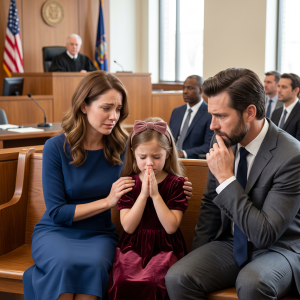
Some employees found new positions quickly, while others struggled with the uncertainty.
I felt responsible for their difficulties even though Rebecca repeatedly reminded me that exposing inaccurate records had not created the underlying misconduct.
Eventually, prosecutors filed charges related to financial misrepresentation, improper billing practices, falsified records, and the circumstances surrounding my abandonment.
The physician’s conduct was referred for professional review, and investigators separately examined the consulting payments connected to her household.
Not every allegation resulted in a charge, and some material I had gathered could not be used in the manner I originally expected.
But the independently obtained records, witness statements, and Natalie’s complete recording established a pattern that could no longer be dismissed as a disagreement between a daughter and her parents.
My father ultimately accepted responsibility for several financial offenses through a negotiated plea.
My mother continued insisting that her decisions had been necessary to protect the company, although she eventually entered a plea of her own.
The court ordered restitution using recoverable business assets, with priority given to affected clients and employees.
I attended only a handful of hearings.
The first time I saw my parents across the courtroom, my mother looked at me with the same disappointed expression she had worn whenever I challenged her as a child.
For an instant, I felt the familiar urge to explain myself.
Then I remembered that I had already spent years doing exactly that.
I turned toward Rebecca instead.
“I don’t think I need to say anything to her,” I whispered.
Rebecca nodded.
“You don’t.”
It was a small moment, but afterward I understood that I no longer had to persuade my mother to acknowledge what had happened before I could begin living differently.
The Sister Who Came Back

Natalie moved out of our parents’ house before the case concluded, found work at a community recreation center, and began meeting regularly with a counselor.
Our relationship recovered slowly, if recovery is even the right word for learning to know someone again after discovering how deeply they had disappointed you.
For several months, we met only in public places, usually for coffee or lunch, and there were afternoons when I could barely look at her without remembering the phone in her hand.
She never asked me to pretend that evening had not happened.
Instead, she answered my questions, accepted the boundaries I needed, and gradually learned to speak honestly about the ways she had allowed our parents to influence her decisions.
One afternoon, she brought me a small envelope containing a photograph from our childhood.
We were sitting on the back steps of our old house, sharing a bowl of strawberries, with Natalie leaning against my shoulder and both of us laughing at something outside the frame.
“I found this while I was packing,” she explained. “I almost didn’t bring it because I thought you might not want anything from that house.”
I held the photograph for a long time.
“I still want the good memories,” I told her. “I just don’t want them used to excuse the bad ones.”
She nodded, her eyes filling with tears.
“I understand.”
And for the first time, I believed she might.
We did not become the sisters we had been before, because those versions of us had depended on a family story that was no longer true.
Instead, we began building something quieter, where honesty mattered more than appearances and affection did not require silence.
A Different Kind of Home
A year after Arthur Bennett found me behind the shopping center, I accepted a position helping a nonprofit organization strengthen its financial oversight and client-protection procedures.
The organization had assumed responsibility for some of Willow Creek’s legitimate services, and its director wanted someone who understood how easily small discrepancies could be overlooked when employees were discouraged from asking questions.
I hesitated before accepting because I worried that working with similar records would keep me tied to the past.
But during my first week, I met an older woman whose transportation arrangements had been disrupted by the investigation, and she thanked me for helping establish a clearer system.
“I don’t need anything fancy,” she told me. “I just need to know somebody will show up when they say they will.”
Her words stayed with me because they described something I had wanted from my own family for years.
Reliability.
Not perfection, not endless promises, but the simple assurance that someone’s actions would match what they said.
That winter, Natalie came to my apartment for dinner on a snowy Sunday evening, bringing fresh bread and a bag of groceries because she had heard that I was working late.
We made vegetable soup, argued gently about whether it needed more pepper, and spent an hour discussing ordinary things.
At one point, she looked toward the window, where snow was gathering along the railing.
“Do you ever wish you’d never found those records?” she asked.
I considered giving her the answer I thought she wanted, but we had promised each other that our conversations would no longer be built around convenient truths.
“Sometimes,” I admitted. “I miss believing that our family was what I thought it was.”
She lowered her eyes.
“I miss that too.”
I reached for my cup and watched the snow drifting past the glass.
“But I don’t wish I had stayed quiet,” I continued. “I just wish telling the truth hadn’t cost so much.”
Natalie sat silently for a moment before reaching across the table.
This time, I took her hand.
There are still mornings when an unexpected noise makes me uneasy, and there are memories I would rather not carry, but the years since that winter have taught me that healing does not require pretending something never happened.
I have learned to accept help without feeling weak, to question people without assuming I am disloyal, and to recognize that love without accountability can become another way of asking someone to endure what should never have been expected of them.
Sometimes I think about Arthur Bennett, the stranger who stopped beside a woman he had never met and stayed until she was safe, and I wonder whether he realizes how much that ordinary decision changed my life.
My parents had spent years teaching me that protecting the family meant protecting its reputation.
Arthur taught me something different without ever intending to.
He showed me that caring for another person begins with recognizing what they need, even when helping them offers nothing in return.
Outside my apartment, the snow continued falling, covering the sidewalks and parked cars in a soft white layer, and although the sight reminded me of the cold pavement where my story might have ended very differently, I no longer felt that the memory belonged entirely to fear.
It belonged to the man who stopped to help, the attorney who listened, the investigators who examined the facts, the employees who finally found their voices, and the sister who chose, however imperfectly, to tell the truth.
Most of all, it belonged to the woman I had become.
For much of my life, I thought keeping a family together meant holding tightly to the people I loved, no matter what they asked me to overlook.
Now I understand that a family worth preserving must leave room for honesty, responsibility, and the freedom to say when something is wrong.
And while I cannot change what happened that winter, I can choose what grows from it, which is why I have spent the years since trying to build a life where nobody has to surrender their voice simply to feel that they belong.