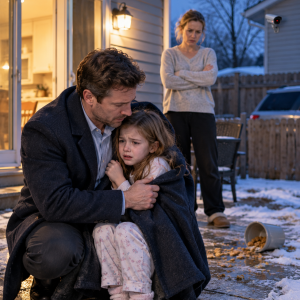
The Weekend He Chose Not to Come Home

For most of my adult life, I had believed that competence could protect a person from almost anything, because if you worked hard enough, planned carefully enough, hired the right people, read every contract before signing it, and refused to leave important decisions to chance, then surely you could build a life sturdy enough to withstand whatever arrived at the door.
I was thirty-seven when I learned how little control any of us truly have.
By then, I had spent nearly fifteen years building Hawthorne Medical Systems, a Minneapolis-based company that designed hospital logistics software, and although business magazines occasionally described me as fortunate, there had been very little luck involved in the beginning. I had started with a borrowed office above an accounting firm in St. Paul, two employees, an aging laptop, and an idea most investors politely dismissed before eventually becoming interested once hospitals began signing contracts.
By my mid-thirties, the company employed more than two thousand people across the country, and I still owned sixty-one percent of it.
My husband, Grant Holloway, had joined Hawthorne much later.
When we married, he was working in commercial real estate, and for the first few years I admired the qualities in him that I lacked: he could walk into a room full of strangers and know everyone’s name by dessert, he remembered birthdays, told wonderful stories, and possessed an easy confidence that made people assume he knew more than he sometimes did.
Eventually, I brought him into Hawthorne.
That decision would become one of the most expensive lessons of my life.
When my pregnancy became complicated late in the second trimester, my doctors ordered me to stop traveling and reduce my workload immediately, so I temporarily authorized Grant to handle many of my executive responsibilities while I remained at home.
We were expecting twin girls.
Their nursery was already finished, painted a soft blue-gray with two white cribs beneath a window overlooking the lake, and every evening before bed I would stand in the doorway for a few minutes, imagining the ordinary chaos that would soon fill that impossibly neat room.
I wanted ordinary chaos more than anything.
One Thursday afternoon in November, Grant appeared in our bedroom wearing a navy winter coat and carrying a leather weekend bag.
“You’re really going?” I asked.
He stopped near the doorway.
“Claire, we’ve talked about this.”
He said he needed to attend a leadership retreat in Park City, Utah, where several potential partners would be gathering for the weekend.
I had been experiencing uncomfortable tightening since breakfast, nothing dramatic enough to frighten me but persistent enough that I didn’t want to be alone.
“Could somebody else handle it?”
Grant exhaled, and something in his expression changed.
It was small, perhaps invisible to anyone who had not lived with him for seven years, but I recognized it immediately.
Impatience.
“I’m gone three nights,” he said. “You have the nurse’s number, your sister is twenty minutes away, and the hospital is practically around the corner. You’re surrounded by people whose entire job is taking care of you.”
He walked over and kissed my forehead.
“Try not to worry about every little thing.”
Then he left.
For a long while after the bedroom door closed, I stared at it and wondered when concern had become, in his mind, a character flaw.
The Photograph
About twenty minutes later, my tablet chimed.
I nearly ignored it.
The notification came from a social media account belonging to one of Hawthorne’s younger communications managers, a woman named Brooke Ellison, whom I had met perhaps four times.
She had posted a photograph from inside a private aircraft.
There was no photograph of Grant’s face, but there didn’t need to be.
His watch was visible.
So was the navy coat he had been wearing when he left our bedroom.
Brooke’s hand rested comfortably across his arm, and two glasses sat on the table between them.
Her caption referred to a weekend in the mountains.
I stared at that photograph much longer than I should have.
Strangely, my first emotion wasn’t anger.
It was embarrassment.
There is a particular humiliation in discovering that the person you trusted has been living inside a reality different from the one you thought you shared, because suddenly you begin revisiting old dinners, unexplained absences, changed passwords, late meetings and distracted conversations, asking yourself how many moments had contained truths you simply hadn’t known enough to recognize.
I enlarged the photograph.
Then I saw something else.
The aircraft belonged to Hawthorne.
The trip wasn’t merely personal betrayal.
He was using company resources.
I placed the tablet on the nightstand and closed my eyes.
That was when the tightening returned.
Only this time, it didn’t fade.
Within minutes, I knew something was wrong.
I called my private nurse, then my obstetrician, and by the time my sister Emily arrived, I could barely concentrate on what anyone was saying.
As she helped me into the car, I called Grant.
No answer.
I called again.
Nothing.
During the short drive to the hospital, I tried once more.
Voicemail.
“Grant, I’m going to the hospital,” I said, struggling to keep my voice steady. “Something’s happening. Please call me.”
I didn’t know then that those words would be the last time I ever asked my husband to come home.
Twelve Calls
The next several hours exist in my memory as fragments rather than a continuous sequence: bright hospital lights passing above me, Emily gripping my hand, nurses speaking in calm but urgent voices, a physician explaining that the babies needed to arrive much earlier than anyone had hoped, and my own mind repeatedly returning to one absurd thought.
Grant doesn’t know.
I kept thinking that if he understood the seriousness of the situation, he would come.
Surely he would come.
Our daughters arrived extraordinarily early and were immediately transferred to specialized neonatal care, where an entire team worked around the clock for them.
I was moved to intensive monitoring myself because of complications from the delivery.
Emily stayed beside me.
Grant did not.
Over the next two days, between my calls, Emily’s calls, and messages from my assistant, there were twelve attempts to reach him.
Some rang unanswered.
Some went directly to voicemail.
Eventually, on Saturday evening, my phone lit up with his name.
For one foolish second, relief moved through me.
Then I read the message.
“Claire, please stop panicking. I’m handling something important here. Call me when things calm down.”
I read it twice.
Emily saw my face.
“What did he say?”
I handed her the phone.
She read the message and slowly sat down.
“Oh, Claire.”
I turned my face toward the window.
Snow had begun falling over Minneapolis, small white flakes disappearing against the dark glass.
“Don’t call him again,” I said.
Emily looked at me.
“Are you sure?”
“Yes.”
That was the moment my marriage ended.
The paperwork came later, but the marriage itself ended quietly in a hospital room while snow fell outside.
The Longest Night

Our daughters had been born far too early, and despite everything the neonatal team did, their little bodies were simply not ready for the world they had entered.
On Sunday morning, Dr. Caroline Mercer came into my room and pulled a chair beside the bed.
Doctors sometimes have expressions that tell you what they’re about to say before they begin speaking.
Hers was one of them.
She explained the situation gently.
I listened without interrupting.
There are moments when language becomes strangely inadequate, when words like difficult, fragile and unlikely float through the room but cannot possibly describe what they mean to the person hearing them.
My daughters had been with us only a very short time.
Yet I had known them for months.
I knew which one moved whenever I drank orange juice and which one became active late at night. I knew the tiny disagreements they seemed to have inside me, the way one would stretch just as the other settled down. I had named them. I had folded their clothes. I had imagined first birthdays, scraped knees, school pictures and teenage arguments.
A whole lifetime had existed inside my imagination.
And now I was being asked to say goodbye to it.