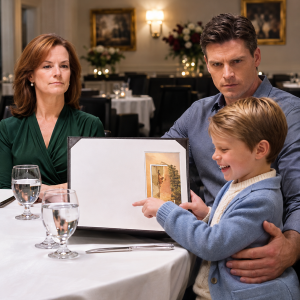
My mother stood beside Oliver, her expression filled with indignation.
“Apparently, somebody needs to teach this child some respect.”
Then, before I could move between them, she lifted his dinner plate with both hands and threw it directly at him.
The Sound of Breaking Porcelain
I can still remember the sound of that plate striking the floor, although what remains clearest in my memory is not the broken china or the food scattered across the hardwood, but the way Oliver sat perfectly still, looking down at his beautiful new sweater as warm gravy dripped from his chin.
The edge of the plate had struck his upper chest and brushed against his jaw, leaving a noticeable red mark that was already beginning to darken.
He looked toward me with wide, bewildered eyes, as though he were waiting for someone to explain what he had done wrong.
My mother pointed toward the front door.
“Take that disrespectful child and get out of my house. I won’t tolerate being spoken to like that under my own roof.”
Brandon immediately joined her.
“You heard Mom. Get out, and don’t bother showing your faces around here again.”
I turned toward my father, expecting that even after everything he had said, he would recognize that a line had been crossed.
He remained seated at the head of the table, looking at me with an expression of unmistakable disapproval.
Not once did he ask whether Oliver was hurt.
Something inside me changed during those few seconds, and although I cannot describe it as anger alone, I remember experiencing a remarkable clarity that had escaped me throughout the previous seven years.
I thought about the mortgage payments, the truck installments, the household repairs, the insurance premiums, and the countless occasions when I had rearranged my own plans to solve problems my family had created.
My records would later show that I had spent approximately $146,820 supporting them, beyond the substantial investments I had made in their housing.
Yet the moment my little boy had attempted to defend me, they had treated him as though he were the problem.
I collected several napkins, knelt beside Oliver, and gently cleaned his face.
“We’re going home, sweetheart. You don’t have to stay here another minute.”
He nodded, trying desperately to hold back his tears.
After helping him into his winter coat, I turned toward my family one final time.
“If that’s really how you feel about us, then you won’t object when I stop taking care of the things you’ve apparently forgotten belong to me.”
Brandon laughed.
“What’s that supposed to mean? Are you going to send us a bill for dinner?”
I didn’t answer.
Outside, I removed Oliver’s stained sweater, wrapped him in my own coat, and started the car.
The dashboard clock displayed 6:12 p.m.
As I adjusted the heater, Oliver finally began crying.
“Mom, did I do something bad? I didn’t mean to make Grandma angry.”
I reached across the center console and held his hand.
“You were trying to help me, sweetheart, and there was nothing wrong with what you said. Adults are responsible for how they behave, and nobody has the right to hurt you because they’re unhappy.”
He looked at me for several seconds before whispering that his chest hurt.
I promised him we would have a doctor examine him, and more importantly, I promised that he would never be required to return to that house.
For the first time in years, I made a promise to my son without considering how my parents might feel about it.
Thirty Minutes Later

We stopped at a small roadside diner on our way toward the children’s medical center, where I ordered Oliver something to eat after confirming that he was comfortable enough to do so.
The waitress noticed his trembling hands and brought him hot chocolate with extra whipped cream, along with a plate of chocolate-chip pancakes.
Her kindness nearly brought me to tears, because a woman who had never met my son was showing him more tenderness than the people who had known him since infancy.
While Oliver ate, I opened my personal laptop.
It was approximately 6:44 p.m., just over thirty minutes after we had left my parents’ driveway.
I began by reviewing the telephone account that I had maintained for my family for years, removing their access to the services I was paying for and arranging for them to establish their own accounts.
Next, I canceled the automatic monthly transfer of six hundred dollars into my mother’s checking account.
I contacted the automobile insurance provider to arrange for future billing to be sent directly to my parents, ensuring that they would receive appropriate notice and have the opportunity to maintain their coverage themselves.
Then I turned my attention to Brandon’s pickup truck.
The remaining loan balance was just under nineteen thousand dollars, and because the vehicle had originally been titled in my name under our financing arrangement, I contacted the lender to confirm the procedures for paying off the outstanding balance and obtaining the released title.
It was a substantial expense, but I was no longer willing to remain financially responsible for a vehicle Brandon treated as his personal property while refusing to honor our agreement.
Finally, I called Meredith.
She answered almost immediately.
“Natalie? Is everything all right?”
I explained what had happened, describing Oliver’s injuries, my mother’s actions, and the behavior of my father and brother.
Meredith listened without interrupting.
“First, have Oliver examined and make sure the doctor understands exactly how he was injured. Keep the sweater, document what happened, and save any messages your family sends you.”
“I will. But there’s something else I need you to do.”
I reminded her about the two properties and their month-to-month rental agreements.
“I want both tenancies terminated through the proper legal process. Give them whatever notice the law requires, but I’m not continuing these arrangements.”
She was quiet for a moment.
“You understand that your parents may never forgive you for this?”
Across the table, Oliver was carefully arranging his remaining pancakes into little squares.
“I spent seven years worrying about whether my parents would forgive me for disappointing them,” I replied. “Tonight, I realized that my son shouldn’t have to pay the price for that.”
Meredith agreed to prepare the necessary notices.
Before we left the diner, my phone began displaying messages from unfamiliar numbers, including one from Brandon accusing me of trying to ruin his life.
I saved the messages without responding.
There were no explanations left to offer.
When the Consequences Arrived
At the medical center, a compassionate physician named Dr. Eleanor Walsh examined Oliver’s shoulder, upper chest, and jaw, ordering imaging to make certain there were no fractures.
Fortunately, his injuries consisted primarily of significant bruising and muscular discomfort, although the physician explained that the circumstances required her to make a formal report to the appropriate authorities.
Oliver answered her questions honestly, and I remained beside him throughout the examination.
We returned home late that evening, and after helping him change into his pajamas, I sat beside his bed until he fell asleep.
The following morning, my inbox contained fourteen messages from my mother, ranging from angry demands to accusations that I was exaggerating an unfortunate accident.
She claimed that the plate had slipped from her hands because of discomfort in her wrist, although everyone at that dinner table had witnessed what actually happened.
By Monday morning, Meredith had arranged for formal notices to be delivered to my parents and Brandon, establishing the required timetable for ending their rental arrangements.
Several hours later, Brandon appeared at my workplace, demanding to see me.
He had apparently told the receptionist that there was a family emergency involving Oliver, which immediately prompted me to contact building security.
When I entered the reception area, he was pacing beside the elevators.
“Have you completely lost your mind?” he demanded. “I put eight thousand dollars down on that excavator, and now the seller has given it to somebody else because I couldn’t come up with the rest of the money.”
“You made a financial commitment without having the funds to complete it, Brandon. That was your decision.”
“You’re supposed to help me. I’m your brother!”
“And Oliver is your nephew. You watched our mother hurt him, and instead of helping him, you ordered him out of the house.”
His expression changed, although not in a way that suggested remorse.
“He shouldn’t have gotten involved in an adult conversation.”
That answer removed whatever remaining uncertainty I might have felt.
“From now on, any communication concerning the properties or the truck goes through my attorney. You will not come to my workplace, and you will not approach my son.”
Security escorted him from the building while he continued accusing me of abandoning the family.
Over the following weeks, relatives began posting vague accusations about ungrateful children on social media, and several members of my mother’s church contacted me, urging me to reconsider.
I did not publicly defend myself, nor did I share photographs of Oliver’s injuries to prove that I was justified.