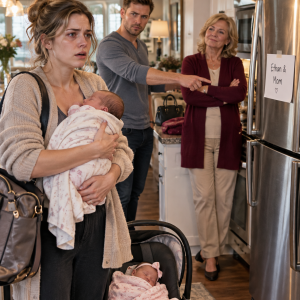
He swallowed.
“A little over two hundred thousand, not counting the deposit.”
Brenda gripped the back of a chair.
“You told me we were buying into a shopping center.”
“I couldn’t tell you what was happening. You would’ve panicked.”
“So you lied to me?”
Christopher’s face reddened.
“I was trying to fix it! Every time I got close, something went wrong. I thought if I could get the money from the house, I’d pay everybody back and start over.”
I shifted Harper higher against my shoulder.
“And where were we supposed to live while you started over?”
He looked away.
“You have money, Nora. You’ve always had money.”
“So you decided to take what Dad left me, give me two hundred dollars, and make your daughter somebody else’s problem?”
“I knew you’d be fine.”
Those five words hurt more than any insult Brenda had thrown at me.
Christopher wasn’t denying what he’d planned. He was telling me that because I was capable of surviving it, he believed he had permission to do it.
Brenda began crying, but even then, she found a way to blame me.
“If you’d helped him when he first started struggling, none of this would’ve happened.”
“He never told me he was struggling,” I replied. “He told me I was selfish for wanting to keep my father’s house.”
Christopher reached toward the envelope.
“Nora, please. We can work something out.”
I stepped back.
“You’ll need to work this out with the people whose money you took.”
Rachel explained that the buyer’s complaint and the disputed authorization documents would be handled through the appropriate legal process. She had already preserved the records and advised Christopher to obtain independent counsel.
No one was promising him an easy escape.
For the first time that day, Brenda sat down without being asked.
The Choice He Made
Over the next several weeks, I learned how much of our marriage Christopher had been hiding.
He’d opened credit accounts I didn’t know about, borrowed money from acquaintances, and convinced himself that one successful investment would repair every mistake. By the time he began asking about Dad’s deed, he was already desperate.
The failed sale wasn’t a sudden lapse in judgment. It was the last step in a long series of decisions he’d concealed from me.
His attorney eventually contacted Rachel about repayment and the disputed documents. Christopher faced an investigation over the purported power of attorney and the money he’d accepted. The outcome took time, and I refused to let anyone convince me that marriage required me to absorb his debts or excuse his conduct.
Brenda called repeatedly.
Sometimes she cried. Sometimes she accused me of destroying her son. Once she left a voicemail saying Harper deserved to have both parents under one roof.
I listened to it while sitting beside Harper’s bassinet in my temporary rental.
Then I saved the message and returned to folding her tiny clothes.
I wasn’t trying to keep Christopher from being a father. I was refusing to make his financial crisis the foundation of our daughter’s life.
I filed for divorce and worked with my attorney on appropriate custody arrangements. Christopher’s conduct mattered, but I understood that a court would consider Harper’s welfare rather than simply punish him for what he’d done to me.
He asked to see her several times. At first, I couldn’t bear the thought of sitting across from him, but we arranged contact through our attorneys while the legal issues were addressed.
One afternoon, he sent a message.
I never wanted either of you to get hurt.
I read it twice.
Then I replied.
You planned to put us out of the house three days after I gave birth. You don’t get to call that an accident.
He didn’t answer.
I thought often about the man I’d married. Christopher had once driven across town at midnight to bring me soup when I was sick. He’d cried when we heard Harper’s heartbeat for the first time. He’d painted the nursery himself because he wanted to surprise me.
Those memories were real.
So was the white envelope.
Accepting both truths was harder than simply deciding he’d never loved us.
Brenda’s Basement Room
Several months later, Brenda called from an unfamiliar number.
Her voice sounded different.
“Nora, I know you don’t want to hear from me.”
“What do you need, Brenda?”
She hesitated.
“Christopher can’t help me anymore. I’ve been paying some of his expenses, and I’ve fallen behind on my own bills.”
I listened without interrupting.
“I had to sell my townhouse,” she continued. “I’m renting a room near Scranton until I can get settled.”
I looked toward the kitchen table, where Harper was sitting in her infant seat, watching me with wide, curious eyes.
“What kind of room?” I asked.
Brenda gave a tired laugh.
“A basement apartment. Nothing fancy.”
For a moment, neither of us spoke.
I remembered her standing in my kitchen, telling me a basement room should be good enough for a woman with a newborn.
She seemed to remember it, too.
“I shouldn’t have said those things to you,” she admitted quietly.
“No, you shouldn’t have.”
“I thought Christopher was being treated unfairly. I thought you were holding the house over his head.”
“And when he told you to put Harper and me out?”
Her voice broke.
“I should’ve stopped him.”
I believed she regretted what had happened. I also knew regret didn’t erase the choices she’d made.
“I hope you find somewhere comfortable,” I told her. “But I’m not going to discuss money with you.”
She didn’t argue.
After the call, I sat beside Harper and watched her reach for the soft yellow blanket I’d brought from the old nursery.
For once, I didn’t feel any satisfaction in Brenda’s hardship. I simply felt grateful that it was no longer mine to solve.
A Different Kind of Home
Nearly a year after Harper’s birth, we moved to San Diego.
I had spent months considering whether to remain in Pennsylvania, but my design business had grown, and an opportunity to work with a small coastal architecture firm offered the flexibility I wanted. With careful planning and the proceeds from Dad’s house, I purchased a comfortable home with a bright living room and a little garden.
It wasn’t as grand as the house in Harrisburg.
There were no sweeping staircases or elaborate formal rooms. The kitchen was smaller, and the backyard needed work.
But the first morning we spent there, I carried Harper outside and watched her crawl toward a patch of sunlight on the patio.
I thought about Dad.
He would have liked the garden. He would have complained about the cost of California property taxes, then spent the afternoon telling me where to plant tomatoes.
I kept his old brass key in a wooden box beside my bed.
It no longer opened any door I owned, but I couldn’t bring myself to part with it.
The divorce and custody proceedings were still emotionally difficult. Christopher’s legal troubles had consequences for his finances and employment, and he was required to address the disputed deposit through the legal process. I kept the arrangements concerning Harper focused on her safety and stability.
Rachel visited one afternoon while attending a conference in California.
She brought Harper a wooden stacking toy and a folder containing updated legal documents. We sat at the kitchen table reviewing the remaining matters, and for the first time in months, the paperwork felt manageable rather than frightening.
“How are you doing?” Rachel asked when we finished.
I glanced toward Harper, who was pulling herself upright against the sofa.
“Better than I expected. Some days are still hard.”
“That’s allowed.”
I smiled.
“I know.”
Harper let go of the sofa and took two uncertain steps toward me.
I immediately moved to the rug, holding out my arms.
“Come on, sweetheart. I’ve got you.”
She stumbled into my lap, laughing at her own accomplishment. I kissed her forehead while Rachel applauded from the table.
After Rachel left, I put the legal folder away and carried Harper into the kitchen. She was hungry, impatient, and determined to pull the spoon out of my hand.
As I settled her into her high chair, I noticed a white envelope among the day’s mail.
For an instant, I was back in that old kitchen, exhausted and frightened, looking at two hundred dollars my husband thought would be enough to send us away.
I opened the envelope.
Inside was a simple card from a neighbor welcoming us to the street, along with an invitation to a small weekend gathering.
I smiled and placed it on the refrigerator.
Then I took Dad’s brass key from the wooden box and held it for a moment. I could almost hear him telling me that a house was only worth what the people inside it made of it.
I returned the key to its box and went back to Harper.
She was banging her spoon against the tray, delighted by the noise.
“All right, little lady,” I said, laughing. “Let’s get you some dinner.”
Outside, the garden was beginning to bloom. Inside, my daughter was safe, and nobody was waiting to tell us we didn’t belong.
I closed the front door, turned the lock, and sat down beside her.