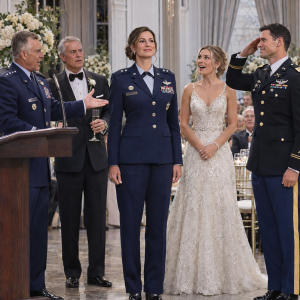
“Lieutenant Commander,” I said.
Nolan lowered his hand after a beat and glanced at the empty chair beside me.
“May I sit down, ma’am?”
“Please do.”
He pulled out the chair and sat. The sound of its legs against the floor seemed much louder than it should have.
Paige reached us first. Her smile was still there, but it had lost its ease.
“Nolan,” she said. “I didn’t know you were coming straight here.”
“I said I’d come when I could.” His tone was calm. He turned toward me. “I didn’t expect to see you here, Colonel.”
My mother arrived a second later, looking from him to me.
“What is this?” she asked. “Why did you salute Nora?”
Nolan did not answer immediately. He looked at her, then at my father, who had followed her across the room. My brother came last, his face flushed and his shoulders squared as if he were still trying to decide whether to be angry.
“Because she’s a lieutenant colonel,” Nolan said. “And because I respect her service.”
My father stared at me. “A lieutenant colonel?”
I could have answered. I could have told him the date of my promotion, the name of my unit, and how long I had been doing the work he had dismissed. But I didn’t need to narrate my service to make it true.
Owen gave a short laugh that sounded uncertain even to him.
“Come on. She works behind a computer.”
Nolan’s expression settled.
“You don’t know what her work involves,” he said. “I do. I can’t discuss the details, but I know enough to say that her judgment and leadership mattered to people serving in the field. I owe her respect.”
His words were measured, not theatrical. He did not make a speech or try to embarrass my family. That restraint made them harder to brush aside.
My father looked at Nolan, then at me. He seemed to be searching for some explanation that would allow him to keep his old picture of our family intact.
I sat back down. My hands had begun to shake, and I folded them in my lap so no one would notice.
Nolan leaned toward me, keeping his voice low. “How are you doing?”
“Tired,” I said. “But all right.”
His eyes moved briefly to June.
“She’s beautiful.”
“Thank you.”
My mother looked as if she wanted to say something, but nothing came. My father’s face had gone still. Owen stared at the tablecloth.
I had imagined, more than once, that the day they learned what I did would feel like vindication. Instead, I felt the familiar ache of realizing how much of my life I had spent hoping they would see me.
I picked up my phone and checked the photograph Elias had sent. June was asleep against his chest in the back seat, one tiny hand curled near her cheek. I wanted to be with them more than I wanted to hear what my family might say next.
I stood and lifted the bassinet handle.
“I’m going to head home,” I said.
Nolan stood too. “I’ll walk you out.”
“You should stay with Paige.”
He looked toward his wife, who was watching us from a few steps away.
“I’ll be all right,” he said. “You’ve had a long evening.”
The crowd opened as we moved toward the entrance. I heard no one call after us. My parents remained beside the table, surrounded by their guests and the careful arrangement of the evening.
Outside, the air was cool. Elias saw us coming and stepped out of the car. He opened the rear door while Nolan waited a respectful distance away.
“How did it go?” Elias asked.
I looked down at June, who had not stirred.
“I think I’m finished for tonight.”
Elias took the bassinet while I settled into the car. He kissed my forehead before closing the door. Through the window, I saw Nolan standing beneath the club’s lights, his hands at his sides.
Then the car pulled away.
The Boundaries I Had Avoided

For the first few days, I kept waiting for someone to call and ask how June was. No one did.
Instead, my mother left a voicemail saying the gathering had become “more complicated than it needed to be” and suggesting that we all sit down for dinner. She ended by reminding me that family was important.
I listened once, then deleted the message.
Owen posted a photograph of himself in uniform with a caption about people who hid behind titles. I saw it because a friend sent me a screenshot, worried that I might be upset. I blocked him without replying.
My father sent a short email saying he wished I had told him about my promotion. I read it twice. It did not mention June, the things he had said over the years, or the way he had turned away at the entrance. I wrote a reply, deleted it, and decided I did not owe him a quick answer just because he had finally become curious.
The requests kept coming, dressed in different clothes. My mother mentioned an old science fair photograph and how proud she had been of me when I was a child. Paige sent a message asking whether I would consider letting our parents visit the baby. No one asked what I needed. No one asked whether I was sleeping or recovering well.
Elias never told me what I should do. He made space for my thoughts to change and for my feelings to arrive in their own time. Some evenings, he worked quietly at the desk while I fed June in the nursery. When she finally slept, he would bring me tea and sit beside me without asking me to make a decision.
Our life was calm in a way that felt almost unfamiliar. Elias ran a logistics and technology company, and his work had taken him around the world. He had built it over many years, mostly without public attention. He never confused recognition with achievement, and that was part of what I loved about him.
A month after the reception, an envelope arrived with Paige’s handwriting on the front. Inside was a letter, written by hand.
She did not blame my mother or my father. She did not say she had been caught in the middle. She wrote that she had liked being treated as the successful one and had allowed our family’s jokes to continue because challenging them might have cost her that position. She admitted she had known I was carrying more than I let on, and she had chosen not to ask.
At the bottom, she had written, “I’m sorry I wasn’t there for you. I know an apology doesn’t fix the years I stayed quiet, and I don’t expect you to make me feel better about it.”
I read the letter twice beside June’s crib. Then I called Paige.
She answered almost at once.
“Nora?”
“I read your letter.”
There was a pause. “Thank you for calling.”