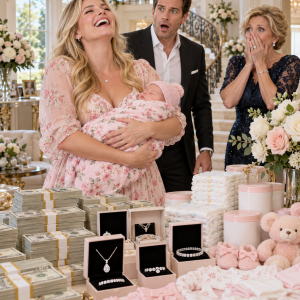
When we returned to the dining room, Ruby wore the bracelet and carried the little crown in her palm. My father cleared his throat.
“Samuel, we need to discuss the company.”
“No. We’re done talking about money tonight.”
Brooke gave an impatient sigh. “Easy for you to say. Your daughter just became one of the richest children in the country.”
“She’s still a six-year-old who wanted to wear the dress her mother made.”
Evelyn turned to Brooke. “Do you understand what you were laughing at?”
Brooke looked at the dress, then lowered her eyes. Mother covered her mouth. Dad said nothing.
Ruby tugged gently at my sleeve. “Daddy, can we go home now?”
“Absolutely.”
At the door Evelyn called my name. “I can’t give you back the years I missed, and I can’t bring Abigail back. I hope you will let me be part of Ruby’s life.”
I walked over and took her hand. “You already are.”
Ruby ran into her arms, and Evelyn held her close, crying without trying to hide it.
What We Chose to Keep

Three months later, Evelyn’s attorneys showed me that Abigail’s work had supported rural hospitals, engineering scholarships, and emergency grants for parents. She had never spent her wealth on mansions or designer clothes.
One scholarship made me stop turning pages: the Samuel Hayes Innovation Fund, which supported young inventors like me long before I knew it.
Abigail had also left instructions for Ruby to choose a charitable project when she was old enough, free from family pressure. The engineering scholarship had to continue whoever oversaw the company.
“She arranged all of this without telling me,” I said.
Evelyn nodded. “She never wanted you to feel indebted to her.”
I smiled through the ache. “That sounds exactly like her.”
That afternoon, I found Ruby drawing at the kitchen table: a man, a little girl, and a dark-haired woman wearing a silver crown beneath a yellow sun.
“Who’s that?” I asked.
“Mommy.”
I sat beside her. “And what are you drawing?”
She held up the page. “A hospital for people who don’t have enough money.”
“Why a hospital?”
“Grandma said Mommy helped make hospitals safer. And people shouldn’t have to be rich to get good help.”
I kissed the top of her head. “That’s a wonderful idea.”
She offered me a purple crayon. “Then help me draw it.”
Six months later, Evelyn invited us for a quiet dinner. We ate Ruby’s favorite spaghetti and listened to her talk about first grade before she ran to the living room for a book. Evelyn asked whether I had heard from my parents. Dad had sent letters, Mother had admitted she knew more than she had said, and Brooke had sent Ruby an expensive dress. I returned it; Ruby needed understanding, not another dress.
“I’m sorry I didn’t protect you when you were young,” Evelyn said.
I took her hand. “You protected Ruby.”
“I should have protected both of you.”
From the living room came the sound of Ruby singing Abigail’s princess song, changing the words whenever she forgot the tune. I listened for a moment and realized I could spend the rest of my life grieving what my family had taken from me, or I could use the time I had to give my daughter something better.
“We still have time,” I told Evelyn.
The following spring, Ruby turned seven and asked for a backyard party with balloons, cupcakes, and a magician. Evelyn brought her a book about inventors, inscribed: To Ruby, who already knows that the best things in life are made with love.
After the guests arrived, Ruby came downstairs wearing the navy-blue dress. It had grown a little short, and the sleeves were snug, but she had refused to wear anything else. She twirled in front of me.
“Daddy, do I still look like a princess?”
I knelt beside her. “You always will.”
She pulled the silver crown from her pocket and placed it in my hand. “Mommy said I don’t need a crown.”
“She was right.”
Ruby set it gently on Evelyn’s head. “Then Grandma can wear it today.”
Evelyn laughed so hard that she had to hold the crown in place with both hands. Watching them, I understood that Ruby had already received something more important than the company shares. She knew she was loved without having to earn it.
That evening, after everyone had gone, Ruby brought me a folded piece of paper. “Daddy, I made something for you.”
It was a drawing of our house, the flowers in the yard, and three figures standing by the front door: Ruby, me, and Abigail. Beneath them Ruby had written, in careful, uneven letters, This is what being rich means.
My family had measured success by money and status, believing our modest life meant we had failed. Abigail knew better. She chose our little home, a kitchen full of laughter, and mending Ruby’s favorite stuffed rabbit instead of throwing it away. She built a future that would last without teaching our daughter to look down on anyone.
I folded Ruby’s picture and set it beside Abigail’s letter. Then I carried my daughter upstairs.
“Daddy?”
“Yes, princess?”
“Do you think Mommy would be proud of us?”
I thought of the silver crown on her bedside table, the company Abigail had helped build, the hospitals her work had supported, and the navy-blue dress she had sewn for a little girl she would never see turn seven.
“I think she’d be prouder of you than anything else in the world.”
Downstairs, I took the photograph of Abigail sewing and placed it in a frame beside Ruby’s drawing. For three years, when I looked at my wife’s face, I had felt only the sharp edge of missing her. That night, beneath the kitchen light, the sorrow was still there, but it was no longer alone. I felt gratefulness, and something close to peace, because at last I understood the lesson Abigail had been trying to leave us: love was the richest thing she had ever given us, and it was the one inheritance no one could take away.