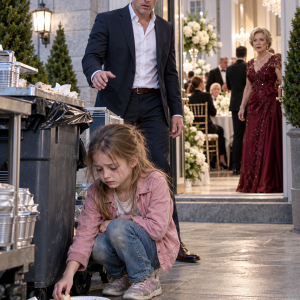
And they had decided those feelings were weaknesses they could exploit.
The Man My Sister Had Underestimated
Everett arrived at the building that afternoon with his attorney.
He wasn’t wearing a uniform.
He didn’t make threats or raise his voice.
He simply presented the recorded deed, the closing documents, and the security access records to the building manager.
Brielle tried one last time to insist that she had permission to stay.
“Cassidy gave me a lease. She can’t just change her mind.”
Everett looked at the document.
“Ms. Whitcomb, the date on this agreement is four days ago.”
“That’s correct.”
“I purchased this property three weeks ago. Your sister did not own it when this document was supposedly signed.”
Brielle opened her mouth, then closed it.
Everett continued.
“Even if your sister had signed this herself, she could not grant you a new lease over property she no longer owned.”
Her confidence disappeared.
She glanced at her children, who were sitting quietly on the sofa.
Everett noticed them too.
His expression softened.
“The children haven’t done anything wrong. Let’s make sure they’re comfortable while the adults resolve this.”
The building manager offered them water and snacks.
Everett’s attorney explained that the disputed document would be preserved for review.
Brielle was asked to collect her belongings and leave voluntarily.
This time, she agreed.
By early evening, the moving boxes were back in the delivery area.
My sister’s grand new life in the penthouse had lasted less than one day.
The Conversation I Never Wanted to Have
I returned to Boston two days later.
My attorney had already collected the relevant documents, and Everett had agreed to provide the necessary security footage.
There were questions about the unauthorized entry and the signature on the lease, but I decided to let the appropriate professionals handle them.
I wasn’t interested in turning my family into a public spectacle.
I wanted the truth documented and my boundaries respected.
Brielle asked to meet me at a quiet coffee shop in Cambridge.
When I arrived, she looked exhausted.
For once, she didn’t begin with an accusation.
“I didn’t think you’d actually sold it,” she admitted.
I sat across from her.
“I told you I had.”
“I thought you were saying that because you didn’t want us there.”
“You believed what was convenient for you.”
She looked down.
“I just wanted something better for the kids.”
I felt a familiar ache in my chest.
“Brielle, I understand wanting a better life for Hudson and Piper. But you cannot build that life by taking something that belongs to someone else.”
Her eyes filled with tears.
“You have so much, Cassidy.”
“And I’ve worked very hard for it.”
“You don’t understand what it’s like to struggle.”
I almost laughed, but there was nothing funny about the moment.
“I worked two jobs during college. I lived with roommates until I was thirty. I spent years paying off debts and building my business. You know all of that.”
She didn’t answer.
“I’ve helped you because I love you,” I continued. “But every time I help, you treat it like proof that I owe you more.”
Brielle wiped her cheeks.
“So what happens now?”
“You find a home you can afford. You take responsibility for the document. And you stop making decisions about my life without my permission.”
“Are you going to help me?”
I looked at her for a long moment.
“I’ll help make sure the children have what they need. But I won’t finance another plan built on dishonesty.”
It wasn’t the answer she wanted.
For the first time, I was comfortable with that.
The Final Truth My Mother Couldn’t Avoid
My mother called that evening.
Her voice was quieter than usual.
“Brielle told me you met.”
“We did.”
“She’s very upset.”
“So am I, Mom.”
There was a long silence.
Then she said, “I suppose we should have asked you first.”
I shook my head, even though she couldn’t see me.
“You did ask. I said no. You simply decided my answer didn’t matter.”
She began to explain how worried she had been about the children.
I interrupted gently.
“Mom, I love Hudson and Piper. But loving them doesn’t mean pretending their mother did nothing wrong.”
For once, she had no immediate response.
I told her that I needed some distance.
Not forever, necessarily.
But long enough to decide what a healthier relationship might look like.
“I never wanted to hurt you,” she whispered.
“Then I need you to stop treating my boundaries as something you can negotiate behind my back.”
We ended the call without shouting.
It was the most honest conversation we’d had in years.
The Home I Finally Chose for Myself
A month later, I was settling into a smaller waterfront condo near San Diego.
It wasn’t as extravagant as the Boston penthouse.
There were no four-bedroom suites, no private elevator, and no enormous terrace overlooking a famous harbor.
But the morning sunlight filled the living room.
I could walk to a neighborhood coffee shop.
And when I closed the front door at night, I felt completely at peace.
Everett sent me a short message after the security matter was resolved.
He thanked me for cooperating and confirmed that the old building access codes had been permanently removed.
My attorney told me the disputed lease had been documented, and Brielle had acknowledged that I never authorized it. The remaining legal questions were being handled separately.
Brielle eventually rented a modest two-bedroom apartment with help from a local housing program and income from a new administrative job.
I paid directly for the children’s school supplies and winter clothes, but I no longer transferred money to my sister whenever she asked.
Our relationship remained complicated.
Some days, I missed the closeness I had always hoped we would have.
Other days, I remembered the look on her face when she proudly announced that my home belonged to her.
I still loved my sister.
But I finally understood that love did not require unlimited access to my life.
One Sunday afternoon, Hudson called me.
“Aunt Cassidy, are you still coming to my birthday?”
I smiled.
“Of course I am, sweetheart.”
“Mom says your new house is smaller.”
“It is.”
“Does it still have a view?”
I looked through the window at the Pacific Ocean.
“A beautiful one.”
He thought for a moment.
“That’s good. You always liked looking at the water.”
I laughed softly.
“Yes, I always have.”
After we hung up, I sat by the window and watched the sunlight move across the ocean.
For years, I had believed success meant having enough to take care of everyone.
Now I understood something different.
Success also meant having the courage to protect the life I had built.
My sister had entered that penthouse believing she could claim whatever I owned.
She had prepared a lease, copied my signature, and convinced herself that having children would make her actions impossible to challenge.
But the property was no longer mine.
The new owner had every reason to protect his home.
And the security recording revealed a truth no carefully prepared document could erase.
I didn’t need revenge.
I didn’t need to humiliate her.
I only needed to stop accepting responsibility for choices I hadn’t made.
The penthouse had once been my greatest symbol of success.
Leaving it behind taught me something far more valuable.
A beautiful home isn’t defined by its price, its square footage, or the view from its windows.
It’s defined by the peace you feel when you walk through the door.
And for the first time in a very long time, that peace belonged entirely to me.
Ten Messages About Family, Respect, and Knowing Your Worth
Family love should never become an excuse for ignoring boundaries, because the people who genuinely care about you will respect your decisions even when those decisions do not benefit them.
Generosity is one of the most beautiful qualities a person can possess, but when kindness is repeatedly mistaken for an obligation, learning to say no becomes an essential act of self-respect.
You can spend years building a better future for yourself and still encounter people who believe they deserve the rewards of your sacrifices simply because they share your last name.
A person’s difficult circumstances may deserve understanding and compassion, but hardship does not automatically give anyone permission to disregard another person’s rights, trust, or personal space.
The strongest boundaries are not created through anger or dramatic confrontations, but through calm decisions that clearly communicate what you will and will not accept in your life.
Sometimes the most painful betrayal comes from people who know exactly how much you love them and deliberately use that love to pressure you into giving them what they want.
Helping someone through a difficult season can be an act of love, but continually protecting them from the consequences of their choices may prevent them from learning how to stand independently.
True family loyalty is built on honesty, gratitude, and mutual respect, not on the expectation that one successful relative must continually sacrifice their comfort to satisfy everyone else’s demands.
There is a special kind of freedom in realizing that you can care deeply about another person’s well-being without allowing their decisions to determine your finances, your happiness, or your future.
And perhaps the greatest lesson of all is that a peaceful life is worth protecting, because no luxury home, impressive bank account, or outward sign of success can replace the quiet comfort of knowing that your kindness is appreciated rather than exploited.