Four months after Nathan was gone, North Harbor reviewed a proposal involving a small water-treatment company in western Pennsylvania.
The financial return would be slower than several other projects under consideration.
Two advisers recommended reducing our involvement.
I studied photographs of the communities the system would serve.
Then I asked why Nathan had supported the project.
The company president looked at me.
“Because he thought clean water shouldn’t depend on whether a community is wealthy enough to attract investment.”
There it was.
Nathan.
I approved the next stage.
That evening, I called Benjamin.
“I want to start a foundation.”
He was silent for a moment.
“How serious are you?”
“Very.”
We spent the next several weeks designing it around environmental health, rehabilitation access, rural clinics, clean-water projects, and scholarships for nurses and therapists.
I named it the Nathan Bennett Whitmore Foundation.
Bennett came first.
Nathan would have appreciated that.
Six months after I left the Whitmore estate, an invitation arrived.
The Whitmore Family Foundation Annual Benefit.
For seven years I had attended that event on Nathan’s arm, smiling through speeches and quietly sharing desserts with him beneath the table because he claimed formal dinners violated the basic human right to adequate cake.
I almost declined.
Then I saw the handwritten line beneath my name.
We hope you will join us as we honor Nathan.
The irony was difficult to miss.
Still, I went.
Not to reveal anything.
Not to embarrass anyone.
I went because the foundation bearing Nathan’s name was about to begin its work, and sooner or later his family would learn what he had built.
I preferred that they hear it from me.
The Ballroom
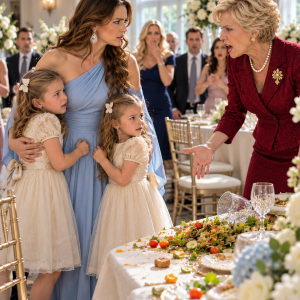
The gala was held at a historic hotel in Manhattan.
I wore a deep sapphire gown and the pearl-and-diamond earrings Nathan had given me on our last anniversary.
When I entered the ballroom, conversations changed almost imperceptibly.
People recognized me.
Some approached with warm condolences.
Others looked curious.
Across the room, Vanessa stopped speaking in the middle of a sentence.
Margaret turned.
Her expression froze.
Beside her stood Charles Pembroke, the financial adviser who had managed the Whitmore family holdings for more than twenty years.
Unlike Margaret, Charles did not study my dress.
He studied the people greeting me.
Then he saw Benjamin entering behind several North Harbor executives.
Something changed in his face.
Margaret approached first.
“Claire.”
“Good evening, Margaret.”
Her gaze moved around me.
“I wasn’t certain you would come.”
“Neither was I.”
Vanessa joined us.
“Where have you been?”
“Working.”
She gave a faint smile.
“Back at the clinic?”
Before I could answer, Charles spoke.
“North Harbor?”
Margaret turned toward him.
“What is North Harbor?”
I looked at Charles.
He already knew enough to understand that something important had been kept from him.
“Nathan’s investment company,” I said.
Margaret frowned.
“Nathan didn’t have an investment company.”
“He did.”
Vanessa laughed nervously.
“Come on, Claire.”
I looked at her.
“I’m not joking.”
Charles finally stepped in.
“Margaret, Nathan maintained substantial independent holdings.”
Her eyes narrowed.
“How substantial?”
Nobody answered immediately.
That silence did more than any speech could have done.
Margaret looked at me.
“How much?”
I had never planned to give her a number.
Yet something about the question reminded me of that morning outside the house, when she had looked at two suitcases and decided she knew exactly what my future would be.
“When ownership transferred, North Harbor’s estimated value was approximately four hundred sixty million dollars.”
Vanessa stopped moving.
Margaret looked at Charles.
“Transferred where?”
Charles said nothing.
She looked back at me.
I answered.
“To me.”
Her composure finally slipped.
“But the agreement—”
“Protected Whitmore family assets.”
“Exactly.”
“North Harbor wasn’t a Whitmore family asset.”
Charles lowered his eyes.
“Nathan built most of it independently,” he said.
Margaret looked as though she had suddenly discovered that the map of her own family contained an entire country she had never known existed.
Vanessa stared at me.
“You knew this when Mom asked you to leave?”
“Yes.”
“Why didn’t you say anything?”
I considered my answer carefully.
“Because I wanted to know how you would treat me when you believed there was nothing to gain from treating me well.”
Vanessa’s face changed.
Margaret stiffened.
“That’s unfair.”
“I didn’t put my belongings outside.”
Nobody spoke.
I felt no victory.
That surprised me.
For months I had occasionally imagined this moment, usually at three in the morning when anger was easier than sadness, and in those imaginary versions I delivered some magnificent speech that left everyone speechless.
Standing there, I wanted none of it.
Because Nathan was still absent.
Four hundred sixty million dollars had not changed that.
I set my glass on a nearby table.
“There’s something else you should know. The Nathan Bennett Whitmore Foundation begins operations next month. Its first projects will support rural rehabilitation programs, clean-water infrastructure, and environmental health initiatives.”
Margaret stared at me.
“You’re using his money for that?”
I shook my head.
“I’m continuing his work.”
There was a difference.
Perhaps she finally understood it.
I turned to leave.
Then Margaret called my name.
Her voice had changed.
“Claire.”
I stopped.
She looked suddenly older beneath the ballroom lights.
“That morning at the house… I shouldn’t have done what I did.”
It was not a complete apology.
Maybe it came too late.
Maybe the revelation about the money had made remorse easier.
But it was something.
“No,” I said quietly. “You shouldn’t have.”
Then I walked away.
The Conversation That Money Could Not Fix

Two weeks later, Margaret asked to meet me at a café.
I agreed for one reason.
She said she wanted to talk about Nathan.
Not money.
Nathan.